
Government Schemes for MSMEs: Complete Guide to PMEGP, CGTMSE, and ISEC

Launching a new business demands more than just a brilliant idea. Founders require access to seed capital, operational working capital, and structured support to transform raw plans into sustainable commercial enterprises.
Recognizing that small businesses are the backbone of the economy, the Government of India has introduced several high-impact schemes to support micro, small, and medium enterprises (MSMEs) and aggressively promote rural and urban entrepreneurship. Among the most prominent initiatives are the Prime Minister’s Employment Generation Programme (PMEGP), the Credit Guarantee Trust Fund for Micro and Small Enterprises (CGTMSE), and the Interest Subsidy Eligibility Certificate (ISEC) scheme.
Whether you need seed funding to establish a new manufacturing unit or subsidized credit to expand a Khadi enterprise, integrating these schemes into your comprehensive financial planning strategy can drastically reduce your capital costs. This detailed guide breaks down these three core schemes, explaining their financial benefits, eligibility criteria, and application protocols.
1. Prime Minister’s Employment Generation Programme (PMEGP)
The Prime Minister’s Employment Generation Programme (PMEGP) serves as the government’s flagship credit-linked subsidy initiative. It is specifically designed to generate mass self-employment opportunities by funding the establishment of micro-enterprises across the non-farm sector.
At the national level, the Khadi and Village Industries Commission (KVIC) acts as the primary nodal agency. At the state and district levels, the scheme is aggressively implemented through a coordinated network of:
- State KVIC Directorates
- State Khadi and Village Industries Boards (KVIBs)
- District Industries Centres (DICs)
- Participating Commercial Banks
Financial Assistance for New Enterprises Under PMEGP
The PMEGP provides substantial capital subsidies to help founders launch brand-new micro-enterprises. The maximum eligible project cost strictly depends on the sector you operate in:
| Business Sector | Maximum Eligible Project Cost |
| Manufacturing Sector | Up to ₹50 lakh |
| Business / Service Sector | Up to ₹20 lakh |
Note: If you plan to borrow the remaining project cost via a commercial bank loan, accurately projecting your monthly liabilities using an EMI calculator is vital before submitting your project report to the bank.
PMEGP Subsidy Structure and Beneficiary Contribution
The amount of subsidy the government provides depends directly on the applicant’s social category and the geographic location (urban vs. rural) of the proposed enterprise.
| Beneficiary Category | Applicant’s Own Contribution | Subsidy in Urban Areas | Subsidy in Rural Areas |
| General Category | 10% of Project Cost | 15% | 25% |
| Special Category | 5% of Project Cost | 25% | 35% |
Who Qualifies as a “Special Category” Beneficiary?
The government provides higher subsidies (up to 35%) to encourage inclusive growth. The Special Category includes:
- Scheduled Castes (SC) and Scheduled Tribes (ST)
- Other Backward Classes (OBC)
- Minorities and Women Entrepreneurs
- Ex-servicemen and Transgender persons
- Differently-abled individuals
- Residents of the North Eastern Region (NER), Aspirational districts, and notified Hilly/Border areas.
Second Loan for Upgrading Existing PMEGP and MUDRA Units
The scheme also heavily supports the expansion of existing businesses. Highly successful PMEGP or MUDRA units can apply for a secondary loan to upgrade their manufacturing capacity or expand service offerings.
For existing units seeking upgradation, the maximum eligible project costs expand significantly:
| Business Sector | Maximum Eligible Project Cost (Upgradation) |
| Manufacturing Sector | Up to ₹1 crore |
| Business / Service Sector | Up to ₹25 lakh |
Upgradation Subsidy Structure:
- All standard categories: 15% subsidy (with a 10% beneficiary contribution)
- North Eastern and Hilly States: 20% subsidy (with a 10% beneficiary contribution)
Who Can Apply for PMEGP?
The basic eligibility parameters are highly accessible:
- Any individual over 18 years of age can apply.
- Educational Requirement: For manufacturing projects costing above ₹10 lakh (or service projects above ₹5 lakh), the applicant must have passed at least the 8th standard.
Exclusions: Units that have already received government subsidies under other schemes (like the erstwhile PMRY) cannot apply for a new PMEGP loan. However, existing PMEGP/MUDRA units remain eligible for the second-loan upgradation facility.
How to Apply for PMEGP
Entrepreneurs can submit their detailed project proposals online through the dedicated PMEGP e-portal. Applications can also be submitted physically through local implementing agencies (KVIC, KVIB, or DIC offices).
To ensure rural accessibility, physical application forms are available in 11 regional languages (including Hindi, Bengali, Tamil, Kannada, and Marathi) directly from the KVIC website.
For further clarifications, applicants can contact the Joint CEO (PMEGP), KVIC at Mumbai via phone (022-26711017) or official email.
2. Credit Guarantee Trust Fund for Micro and Small Enterprises (CGTMSE)
While the PMEGP provides capital subsidies, the Credit Guarantee Trust Fund for Micro and Small Enterprises (CGTMSE) addresses a different problem: collateral.
Traditionally, commercial banks demand heavy collateral (like property or land) before issuing business loans, locking out millions of capable entrepreneurs. The CGTMSE resolves this by providing a government-backed credit guarantee to the lending bank. If the MSME defaults on the loan, the CGTMSE trust compensates the bank for the loss.
This enables new and existing micro and small enterprises to secure crucial term loans and working capital facilities from banks without pledging personal assets or third-party collateral.
(Note: If you secure a collateral-free loan, you must still manage the repayment schedule diligently. Using a SIP calculator can help you plan parallel corporate investments to ensure you have liquid cash available to service the loan.)
3. Interest Subsidy Eligibility Certificate (ISEC) Scheme
The Khadi sector represents a critical, labor-intensive pillar of India’s rural economy. However, Khadi institutions frequently struggle with high working capital costs. The Interest Subsidy Eligibility Certificate (ISEC) scheme functions as a targeted financial lifeline for this specific sector.
What Financial Assistance Is Available Under ISEC?
The ISEC scheme provides massive interest rate relief. Under this initiative, eligible Khadi institutions can access working capital credit from commercial banks at a highly concessional, flat interest rate of just 4% per annum.
The difference between the bank’s actual commercial lending rate and this 4% concessional rate is subsidized and paid directly by the Central Government (routed through KVIC) to the lending bank.
(For perspective, if a bank usually charges 11% interest on working capital, the Khadi institution only pays 4%. The government pays the remaining 7% directly to the bank. You can use an FD calculator to compare how saving 7% annually on massive working capital loans drastically improves institutional cash reserves.)
Who Is Eligible for the ISEC Scheme?
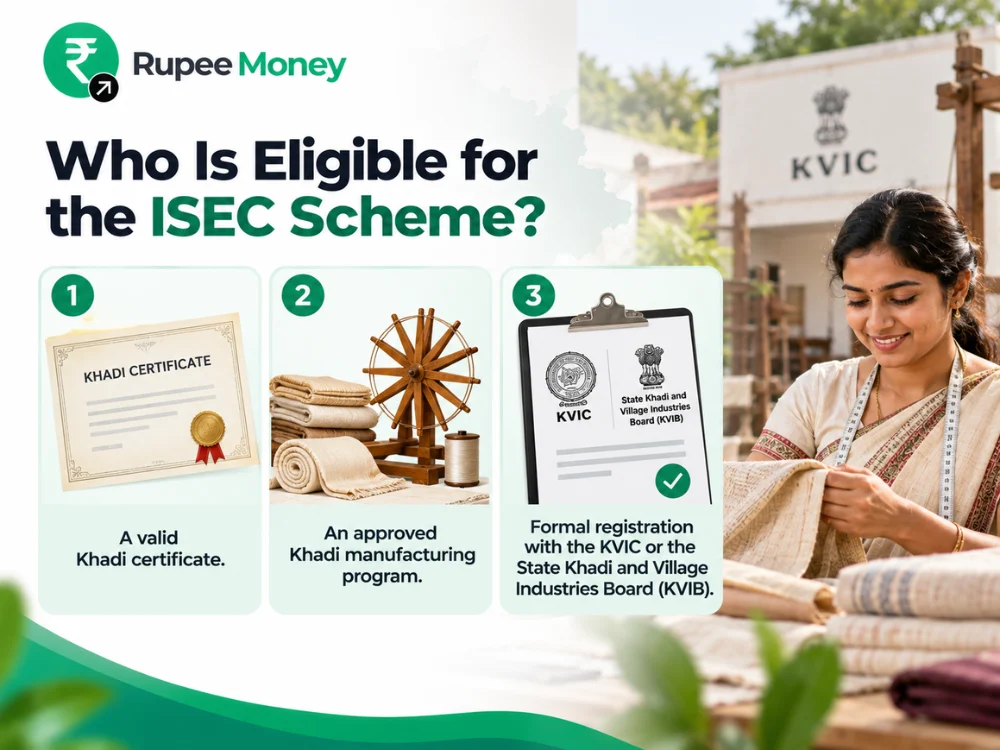
This scheme is restricted to institutions actively producing Khadi and Polyvastra products. To apply, the institution must possess:
- A valid Khadi certificate.
- An approved Khadi manufacturing program.
- Formal registration with the KVIC or the State Khadi and Village Industries Board (KVIB).
How to Apply for ISEC Financing
Eligible Khadi institutions must first obtain an official ISEC certificate from KVIC. They can then present this certificate to a commercial bank when applying for working capital financing. The bank handles the reimbursement claim for the interest subsidy directly with the nodal branch.
For ISEC assistance, institutions can contact the DCEO at KVIC (Phone: 022-26710021).
Conclusion
Government schemes provide indispensable financial leverage for entrepreneurs looking to build or expand their operations.
- For New Founders: The PMEGP offers aggressive capital subsidies (up to 35% in rural areas) for setting up manufacturing units up to ₹50 lakh.
- For Expanding Businesses: The CGTMSE unlocks the ability to secure commercial bank loans without the heavy burden of providing physical collateral.
- For Rural Textile Producers: The ISEC scheme drastically slashes the cost of working capital for registered Khadi institutions down to just 4% per annum.
Before applying, aspiring founders and established institutions must meticulously review the latest scheme guidelines, ensure all documentation is flawless, and build robust project reports to guarantee rapid banking approvals.
FAQs
What is the maximum project funding available under the PMEGP scheme?
Under the PMEGP scheme, entrepreneurs can secure up to ₹50 lakh to establish a new manufacturing unit and up to ₹20 lakh for a business or service enterprise. For upgrading highly successful existing units, the financing limit extends up to ₹1 crore for manufacturing.
Who qualifies for the higher "Special Category" subsidy under PMEGP?
The Special Category includes women, SC/ST, OBC, minorities, ex-servicemen, differently-abled individuals, and residents of North Eastern or hilly regions. Applicants in this category require only a 5% personal contribution and can receive up to a 35% capital subsidy for projects in rural areas.
How does the CGTMSE scheme help new entrepreneurs secure bank loans?
The CGTMSE scheme provides a government-backed credit guarantee to commercial lending banks, heavily mitigating their financial risk if a borrower defaults. This unique trust fund allows micro and small enterprises to easily access term loans and working capital without pledging personal property or third-party collateral.
Which organizations are eligible to benefit from the ISEC funding scheme?
The ISEC scheme is exclusively designed for officially registered institutions that are actively manufacturing Khadi and Polyvastra products. It provides these labor-intensive organizations with vital operational working capital at a highly subsidized, flat interest rate of just 4% per annum.
Where can individuals submit their applications for the PMEGP loan?
Aspiring business owners can submit their detailed project reports and applications digitally through the official PMEGP e-portal. Alternatively, physical applications – available in 11 regional languages – can be submitted offline at local KVIC, KVIB, or District Industries Centre (DIC) offices.
Why should a successful PMEGP or MUDRA unit apply for a second loan?
The government offers a targeted second-loan facility to help proven, successful micro-enterprises scale their operations, upgrade their manufacturing machinery, and expand their market reach. This upgradation facility offers up to ₹1 crore in funding along with an additional 15% to 20% capital subsidy.
Disclaimer: This article is strictly for educational and informational purposes. Government scheme parameters, subsidy ceilings, and eligibility criteria are subject to periodic amendments by the Ministry of Micro, Small and Medium Enterprises and KVIC. Always refer to the latest operational guidelines on the official MSME portals and consult with regional implementing agencies before initiating financial applications.
ABOUT THE AUTHOR

