
Entrepreneurship and Skill Development Programmes: ESDP and ATI

Launching a successful business requires far more than just initial capital or a unique product idea. Sustained commercial success demands strong management capabilities, operational skills, and a deep understanding of market dynamics. To bridge this knowledge gap and empower India’s massive entrepreneurial workforce, the Ministry of Micro, Small and Medium Enterprises (MSME) runs structured training and infrastructure support initiatives.
Two pivotal programs operating under this framework are the Entrepreneurship Skill Development Programme (ESDP) and Assistance to Training Institutions (ATI). While one directly trains aspiring and existing business owners, the other fortifies the physical infrastructure of the institutions delivering that training.
If you are exploring entrepreneurship, incorporating these training programs into your financial planning and business strategy can significantly reduce your operational risks. This guide breaks down both schemes, exploring their objectives, training components, and application processes.
1. Entrepreneurship Skill Development Programme (ESDP)
The Entrepreneurship Skill Development Programme (ESDP) operates as a continuous Central Sector scheme under the Development Commissioner, Ministry of MSME. The program’s core objective is to motivate youth, particularly from marginalized sections of society, to view self-employment and entrepreneurship as viable, long-term career paths.
The ESDP scheme actively targets broad participation, emphasizing inclusion for:
- Scheduled Castes (SC) and Scheduled Tribes (ST)
- Women entrepreneurs
- Persons with physical disabilities
- Ex-servicemen transitioning to civilian careers
- Individuals from Below Poverty Line (BPL) families
The broader goals of the ESDP initiative include promoting the establishment of new enterprises, upgrading the management capacity of existing MSMEs, and fostering a widespread entrepreneurial culture across the nation. The current operational guidelines for the scheme were formally approved on March 25, 2022.
Types of Training Programs Under ESDP
The ESDP scheme does not offer a “one-size-fits-all” solution. It segments its training into five distinct components tailored to different levels of business maturity.
| ESDP Component | Duration | Key Features |
| Entrepreneurship Awareness Programme (EAP) | One day | Targets 50-100 participants. Primarily conducted by MSME-Development and Facilitation Offices (DFOs) to introduce basic business concepts. |
| Entrepreneurship Skill Development Programme (E-SDP) | Minimum 6 weeks | Targets 25-30 participants. Focuses on actionable skill-building for new enterprises; conducted mostly by MSME-DFOs. |
| Management Development Programme (MDP) | Minimum 1 week | Targets 25-30 participants. Focuses on upgrading managerial skills for existing owners; conducted mostly by MSME-DFOs. |
| Advanced E-SDP | Minimum 1 week | Targets around 20 participants. Specialized training conducted by premier agencies like IITs, IIMs, NIESBUD, and ni-msme. |
| Advanced MDP | Minimum 1 week | Targets around 25 participants. High-level management training conducted by premier technical and agricultural institutes. |
Who Can Apply for the ESDP Program?
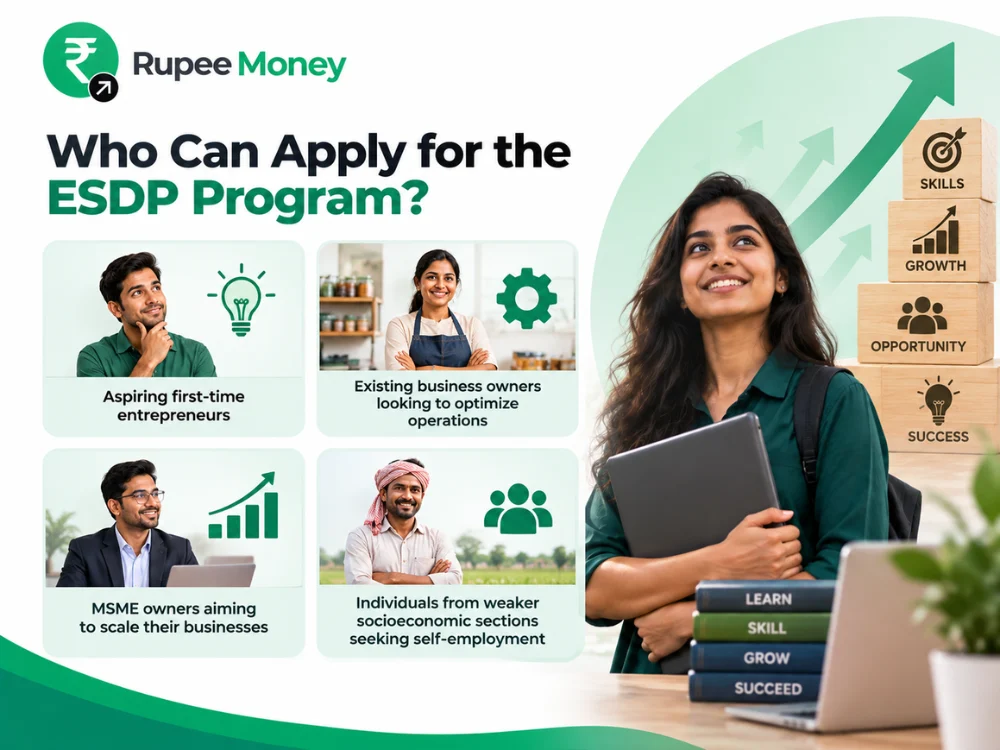
The ESDP framework is designed to be highly accessible. The program is open to:
- Aspiring first-time entrepreneurs
- Existing business owners looking to optimize operations
- MSME owners aiming to scale their businesses
- Individuals from weaker socioeconomic sections seeking self-employment
Basic Requirement: All participants must be 18 years of age or older.
Note: The specific eligibility requirements and any applicable fee structures for advanced programs are determined directly by the respective implementing agencies.
How to Apply for ESDP Training
Individuals interested in participating in these training programs should not apply to a centralized portal but rather contact the local implementing bodies directly for registration schedules:
- MSME-Development and Facilitation Offices (MSME-DFOs)
- MSME Technology Centres
- Authorized Implementing Agencies (like NIESBUD or ni-msme)
Contact details and branch addresses for these organizations are available on the official MSME web portal.
For high-level inquiries regarding the ESDP scheme, applicants can contact the Joint Director (ESDP) via the official email provided in the scheme guidelines.
2. Assistance to Training Institutions (ATI)
While the ESDP focuses on the entrepreneur, the Assistance to Training Institutions (ATI) program focuses on the educators. This initiative provides crucial financial support to selected national and state-level training institutions operating under the Ministry of MSME.
The primary objective is to help these institutions construct, upgrade, and expand their physical training infrastructure, ensuring they possess the modern facilities required to deliver high-quality entrepreneurship and skill development programs.
Institutions eligible for this support include:
- National Institute for Micro, Small and Medium Enterprises (ni-msme)
- Khadi and Village Industries Commission (KVIC)
- Coir Board
- MSME Tool Rooms
- National Small Industries Corporation (NSIC)
- Mahatma Gandhi Institute for Rural Industrialisation (MGIRI)
Crucially, the ATI program also extends support to existing State-level Entrepreneurship Development Institutes (EDIs) to help them expand their regional training capacities.
What Financial Assistance Is Available Under ATI?
The ATI program provides assistance in the form of direct capital grants utilized strictly for infrastructure-related requirements (such as constructing classrooms, upgrading labs, or purchasing training equipment).
- For Ministry of MSME Institutions: The assistance is granted based on the actual verified amount required to complete the infrastructure upgrade.
- For State-level EDIs: The maximum capital assistance is strictly capped at ₹3 crore per institution.
Note: If an institution plans to borrow supplementary funds to complete a massive infrastructure upgrade beyond the ATI grant limit, management should calculate their debt obligations using an EMI calculator to ensure the project remains financially viable.
How Do Institutions Apply for ATI?
State-level EDIs or eligible organizations seeking capital grants for infrastructure construction or expansion must submit a formal application to the central ministry.
Applications should be directed to:
Director/Deputy Secretary (EDI)
Ministry of Micro, Small and Medium Enterprises
Udyog Bhawan, Rafi Marg
New Delhi – 110 011
Institutions can also contact the Deputy Secretary (EDI) at the Ministry of MSME via the official phone number (011-23062736) for procedural clarifications.
ESDP vs. ATI: Understanding the Difference
Although both programs operate under the broader MSME entrepreneurship framework, they serve entirely different audiences and purposes.
| Feature | ESDP | ATI |
| Primary Focus | Entrepreneurship and skill development training | Infrastructure support for training institutions |
| Target Audience | Aspiring and existing entrepreneurs, MSME owners | MSME Ministry institutions and State-level EDIs |
| Type of Support | Direct training programs (1 day to 6 weeks) | Capital grants for building/upgrading facilities |
| Core Objective | Build MSME capabilities and encourage self-employment | Ensure training centers have modern infrastructure |
Conclusion
The MSME Ministry’s dual approach ensures that India’s entrepreneurial ecosystem receives comprehensive support.
The Entrepreneurship Skill Development Programme (ESDP) provides the actual knowledge transfer, offering everything from one-day awareness camps to advanced, multi-week management courses for established business owners. Meanwhile, the Assistance to Training Institutions (ATI) program acts as the foundational backbone, ensuring that the institutes delivering this crucial training possess the modern infrastructure and capital required to operate effectively.
For individuals looking to launch a startup or optimize an existing MSME, the ESDP provides a structured, government-backed learning pathway. Interested candidates and eligible institutions should review the complete official scheme guidelines and contact their regional MSME-DFOs to initiate the registration process.
FAQs
Who is eligible to participate in the ESDP training initiatives?
The ESDP scheme is widely accessible to aspiring youth, existing business owners, and individuals from marginalized communities (including SC/ST, women, and BPL families) who are 18 years or older. It is specifically designed to support anyone aiming to launch or scale a micro, small, or medium enterprise across India.
What kind of financial support does the ATI program provide?
The ATI initiative offers direct capital grants to national and state-level Entrepreneurship Development Institutes (EDIs) and MSME training centers. These government funds are strictly allocated for constructing new facilities or upgrading physical training infrastructure, with state-level EDIs eligible for up to ₹3 crore in assistance.
How do the ESDP and ATI schemes fundamentally differ?
While both operate under the MSME Ministry to boost business growth, the ESDP focuses on delivering direct management and skill training to individual entrepreneurs. Conversely, the ATI program provides infrastructure funding directly to the educational institutions and agencies that host these training sessions.
Where can individuals register for MSME entrepreneurship courses?
Interested candidates do not apply through a single centralized national portal; instead, they must directly contact their regional MSME-Development and Facilitation Offices (MSME-DFOs) or authorized implementing agencies. These localized branches manage the training schedules and handle all direct registrations for upcoming skill development camps.
Are there different levels of training available under the ESDP?
Yes, the program offers a highly tiered learning structure, ranging from one-day Entrepreneurship Awareness Programmes (EAP) for complete beginners to advanced, multi-week Management Development Programmes (MDP). This diverse curriculum ensures that both fresh startup founders and established business owners receive highly relevant, actionable
Disclaimer: This article is strictly for educational and informational purposes. Government scheme parameters, training durations, and capital grant limits are subject to periodic amendments by the Ministry of Micro, Small and Medium Enterprises. Always refer to the latest operational guidelines on the official MSME portal and consult with regional implementing agencies before initiating applications or committing resources.
ABOUT THE AUTHOR

