
PMS vs AIF: Key Differences Investors Should Know

High-net-worth investors (HNIs) frequently reach a point where traditional retail mutual funds no longer satisfy their complex wealth creation goals. When investors look for sophisticated, professionally managed options, they usually debate between two popular choices: Portfolio Management Services (PMS) and Alternative Investment Funds (AIFs). Welcome to RupeeMoney, your trusted financial guide for smart investing.
Both PMS and AIFs operate under strict regulations from the Securities and Exchange Board of India (SEBI). However, the similarities end there. They differ entirely in their legal structure, investment approach, taxation, liquidity, and investor entry requirements.
Understanding the difference between PMS and AIF is critical before you commit your capital. A PMS gives you direct ownership of stocks managed in your personal demat account. An AIF pools your money with other investors to execute highly specialized strategies.
The right choice in the AIF vs PMS debate depends entirely on your financial goals, risk appetite, desired control, and liquidity needs. Let us explore what these options mean, how they operate, and what factors you must evaluate before making a decision.
What Is PMS?
Portfolio Management Services (PMS) is a professional investment service. A SEBI-registered portfolio manager builds and manages a customized portfolio of securities on your behalf, strictly adhering to an agreed-upon investment strategy.
Unlike a mutual fund where you buy “units” of a massive pool, PMS investors hold the actual underlying stocks and bonds directly in their own demat accounts. You hire the manager to trade those securities for you.
How Does PMS Work?
The process follows a clean, transparent structure:
- You select a SEBI-registered portfolio manager whose philosophy matches your goals.
- You sign a detailed portfolio management agreement.
- You transfer your capital or existing shares to the manager.
- The manager executes trades according to the specific strategy (e.g., small-cap value or large-cap growth).
- You retain direct ownership of all securities.
- The manager provides regular, detailed reports on your holdings.
What Is the Minimum Investment for PMS?
SEBI mandates a strict minimum investment requirement of ₹50 lakh for PMS clients. However, many premium portfolio managers require a much higher minimum entry ticket, sometimes starting at ₹1 crore or ₹2 crore, depending on the exclusivity of their strategy.
What Is an AIF?
An Alternative Investment Fund (AIF) is a privately pooled investment vehicle. It collects massive amounts of capital from sophisticated domestic and foreign investors. It then deploys this capital according to a pre-defined, highly specialized investment policy.
AIFs operate under the SEBI (Alternative Investment Funds) Regulations. Because they cater to wealthy investors, SEBI grants them much broader flexibility. They can invest in complex assets and strategies that traditional mutual funds cannot touch.
Different Types of AIFs:
SEBI categorizes AIFs into three broad buckets based on their investment focus.
- Category I AIF: These funds invest in sectors the government considers economically desirable. This includes venture capital funds for early-stage startups, infrastructure funds, and social venture funds.
- Category II AIF: These funds cover private equity, private credit, and distressed asset funds. They do not use leverage for speculation. Many massive private equity buyouts happen within this category.
- Category III AIF: These funds employ highly complex, aggressive trading strategies. They trade in public markets and often use heavy leverage or derivatives. Traditional hedge funds operate under this category.
Difference Between PMS and AIF:
The core difference between PMS and AIF lies in how they structure your capital. With a PMS, the manager handles your portfolio individually. With an AIF, you buy into a massive, pooled fund alongside other investors.
| Feature | PMS | AIF |
| Structure | Individually managed portfolio | Privately pooled investment vehicle |
| Ownership | You own the specific securities | You own units of the fund |
| Minimum Investment | ₹50 lakh | ₹1 crore (generally) |
| Liquidity | Highly liquid (mostly public stocks) | Often illiquid with multi-year lock-ins |
| Transparency | You see exactly what you hold | You see periodic fund-level reports |
| Ideal For | Investors wanting direct stock ownership | Investors wanting access to private markets |
How Does Ownership Differ in AIF vs PMS?
Ownership defines the biggest operational difference between the two products.
Ownership Work in PMS
When you invest through a PMS, the manager buys the shares in your name. They sit in your personal demat account. If you invest in an aggressive equity PMS, you can log in and see exactly how many shares of Reliance or HDFC Bank you own. The manager simply holds a Power of Attorney to execute trades on your behalf.
Ownership Work in AIF
In an AIF, you do not own the underlying companies directly. You write a check to the fund. The fund manager pools your ₹1 crore with ₹500 crore from other investors to buy a massive stake in a private company. You own “units” or a percentage interest in the overall AIF, much like a traditional mutual fund.
Why Do Investors Choose PMS?
Investors gravitate toward PMS vs AIF when they want a highly transparent, equity-focused product.
- Direct Ownership: You physically hold the stocks, giving you total transparency.
- Agility: A PMS manager can move quickly in public markets to capitalize on sudden stock volatility.
- Customization: Some managers offer tailored portfolios, avoiding sectors you dislike.
- Tax Efficiency: You can harvest tax losses on individual stocks in your portfolio.
Where Can PMS Be Useful?
A PMS proves highly useful for an investor who already holds a large portfolio of fixed deposits and mutual funds, but now wants aggressive, concentrated exposure to high-growth public equities. However, concentrated portfolios carry massive downside risk during a market crash.
Why Do Investors Choose AIFs?
Investors choose AIFs to access asset classes that the general public simply cannot buy.
- Private Markets: AIFs let you invest in pre-IPO startups, unlisted companies, and massive infrastructure projects.
- Hedge Fund Strategies: Category III AIFs can short the market and use complex derivatives to generate absolute returns regardless of market direction.
- Diversification: They offer true portfolio diversification because private market returns often do not correlate with the daily movements of the Nifty 50.
What Makes AIFs Different?
The structure forces long-term discipline. You cannot panic and sell your AIF units during a bad news cycle because your money is locked into private, illiquid companies for several years.
PMS Returns V/S AIF Returns: Comparison
No one can state definitively which product produces higher returns. The performance depends entirely on the manager’s skill, the specific strategy, and the current economic cycle.
A Category III AIF might dramatically outperform a PMS during a bear market because the AIF can short stocks. Conversely, a small-cap PMS might generate massive returns during a raging bull market, easily beating a Category II Private Equity AIF.
Never select an investment solely because of a flashy historical return figure. Always evaluate the risk-adjusted returns, the maximum drawdowns, and the manager’s long-term consistency.
PMS Returns Calculator
A PMS returns calculator is a basic mathematical tool. It helps you estimate the future value of your capital based on an assumed annual growth rate.
For example, if you invest ₹50 lakh and assume a 12% compound annual growth rate over 10 years, the calculator will project a future corpus of roughly ₹1.55 crore.
Why Should You Be Careful With a PMS Returns Calculator?
You must treat this calculator purely as a planning tool, not a prediction. Real markets do not move in straight lines. Assuming a flat 15% return ignores the reality of brutal market corrections and negative years. Real portfolios experience extreme volatility. A PMS returns calculator cannot account for a sudden global recession or aggressive RBI interest rate hikes.
Difference Between PMS and AIF Fees:
Fees destroy compounding returns if left unchecked. You must understand the cost structures of both products.
What Fees Do PMS Investors Pay?
- Management Fees: Usually 1% to 2.5% of the total assets under management per year.
- Performance Fees: Often 15% to 20% of the profits generated above a certain “hurdle rate” (e.g., 10%).
- Brokerage & Demat Charges: Because the manager trades in your personal account, you pay the trading costs.
What Fees Do AIF Investors Pay?
- Management Fees: Typically 1% to 2% annually.
- Carried Interest (Performance Fee): Usually 20% of the profits, standard in venture capital and private equity.
- Set-up & Administration Costs: Legal and fund administration fees are passed down to investors.
Because AIF structures utilize complex private legal agreements, their overall fee burden can sometimes run higher than a standard PMS.
Liquidity Differ in AIF vs PMS:
Liquidity refers to how quickly you can convert your investment back into cash. This is a massive factor in the PMS vs AIF decision.
How Liquid Is PMS?
A PMS is highly liquid. Because the manager invests your money in publicly traded stocks, you can usually liquidate your portfolio within a few days. The PMS agreement might specify an exit load if you withdraw within the first year, but the underlying assets remain easy to sell.
Why Are AIFs Less Liquid?
AIFs are notoriously illiquid. If a Category I AIF invests your money into five early-stage tech startups, the manager cannot simply click a button and sell those companies tomorrow.
Many Category I and II AIFs come with strict “lock-in” periods lasting 5 to 10 years. You only receive your money back when the fund successfully sells the startup or takes it public via an IPO. You must plan your cash flows carefully before committing to an AIF.
Tax Difference Between PMS and AIF:
Taxation drastically alters your final take-home returns.
How Is PMS Taxed?
Because you own the stocks directly, the tax department treats PMS trades exactly like your normal stock market trades. Every time the manager sells a stock to rebalance your portfolio, you trigger a taxable event. You pay Short-Term Capital Gains (STCG) or Long-Term Capital Gains (LTCG) tax based on the exact holding period of each individual stock.
How Is AIF Taxed?
AIF taxation is highly complex and depends on the specific category.
Category I and II AIFs enjoy “pass-through” status. This means the fund itself pays no tax. The tax liability passes directly to you, the investor, as if you made the investment directly.
Category III AIFs do not enjoy pass-through status. The fund pays the tax at the fund level before distributing the net profits to you. Always consult a tax professional before investing in an AIF to avoid nasty surprises.
Where Does Risk Differ Between PMS and AIF?
Both options carry high risk, but the nature of that risk differs completely.
What Are the Risks of PMS?
A PMS carries heavy equity-market risk. Managers often run highly concentrated portfolios of just 15 to 20 stocks. If three of those companies announce terrible earnings, your entire portfolio will suffer a massive drawdown. You also face severe stock volatility during macroeconomic panic.
What Are the Risks of AIFs?
AIFs face private-market risks. A startup might go bankrupt, wiping out that portion of the fund completely. Category III funds often use leverage (borrowed money), which magnifies both profits and losses. Furthermore, valuing a private, unlisted company is highly subjective, leading to significant valuation risk.
How Should You Compare PMS vs AIF?
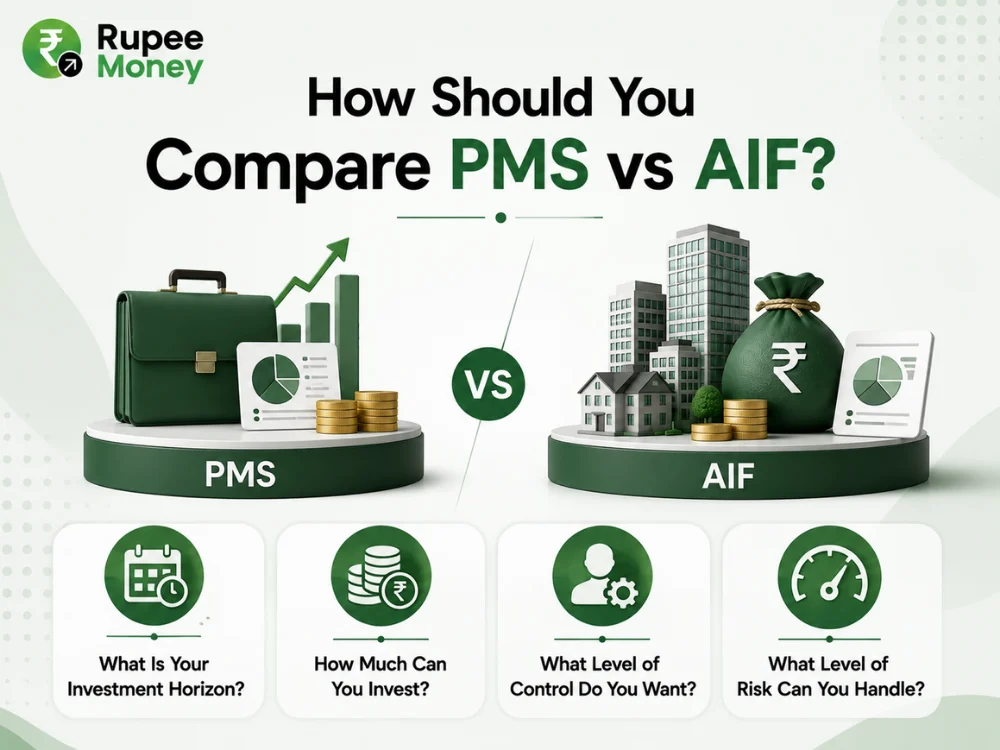
Never compare these products solely on projected returns. Build a framework using these questions:
- What Is Your Investment Horizon? If you might need the money in 3 years, avoid AIFs completely.
- How Much Can You Invest? A PMS requires ₹50 lakh. Most AIFs require a minimum ₹1 crore commitment.
- What Level of Control Do You Want? If you want to see exactly which companies you own daily, choose a PMS.
- What Level of Risk Can You Handle? If you want to avoid daily stock market volatility and prefer locking your money into long-term private ventures, choose an AIF.
When Should You Consider PMS?
You should consider a PMS when you have a substantial investment corpus and want highly aggressive exposure to public equities. It suits investors who enjoy transparency and want a professional manager to actively navigate the daily swings of the stock market. Ensure you have the financial stability to withstand severe short-term market crashes.
When Should You Consider an AIF?
You should consider an AIF when you already possess a robust, diversified portfolio of public stocks, mutual funds, and real estate. An AIF serves as the final layer of aggressive diversification. It suits investors who can comfortably lock away ₹1 crore for 7 to 10 years to capture the massive growth of private companies, venture capital, or complex hedge fund strategies.
AIF vs PMS: Which Is Better?
There is no universal winner in the AIF vs PMS debate. The better option depends entirely on your financial architecture.
- Choose PMS if you want direct stock ownership, high liquidity, transparent reporting, and aggressive public market growth.
- Choose AIF if you want to access exclusive private markets, startup venture capital, and complex hedging strategies that ignore daily stock market noise.
Key Things To Check Before Investing:
Do your due diligence before writing a massive check for either product:
- Manager Track Record: Do not just look at the bull market returns. Ask how the manager performed during the 2020 or 2022 market crashes.
- Investment Strategy: Understand exactly what the manager is trying to achieve. Do they buy safe large-caps or highly risky distressed assets?
- Fees: Calculate exactly how much the performance hurdle rates will eat into your total profits.
- Liquidity: Check the exact lock-in rules and exit loads.
- Regulatory Status: Always verify the manager’s SEBI registration status to prevent fraud.
Conclusion
The decision between PMS vs AIF must begin with your personal liquidity needs, not a chase for the highest advertised returns.
A PMS provides a highly customized, aggressively managed portfolio of public stocks. You retain direct ownership and enjoy the comfort of high liquidity. It is the perfect vehicle for investors who want to turbocharge their equity returns without doing the daily research themselves.
An AIF, on the other hand, unlocks the doors to the private markets. It allows you to invest in the next big startup, massive infrastructure projects, or sophisticated hedge fund strategies. However, you must be willing to lock your capital away for several years.
Understanding the difference between PMS and AIF helps you build a resilient, institutional-grade portfolio. Evaluate your exact financial goals, analyze the fee structures, and consult a qualified financial advisor before committing your capital to either of these powerful wealth-creation engines.
FAQs
What is the difference between PMS and AIF?
The primary difference is the legal structure. A PMS manages your personal portfolio of public stocks in your own demat account. An AIF pools your money with others into a massive fund to execute specialized, often private, investment strategies.
Which is better, PMS or AIF?
Neither is universally better. A PMS offers liquidity and transparency. An AIF offers access to exclusive private markets and alternative assets. The choice depends on your liquidity needs and risk appetite.
What is AIF vs PMS?
It refers to comparing the two premier professionally managed investment vehicles for High Net Worth Individuals (HNIs) in India.
What is PMS vs AIF taxation?
PMS taxation works exactly like your personal stock trading, triggering STCG or LTCG on every trade. AIF taxation depends heavily on the specific fund category, with Category I and II enjoying pass-through status where the investor pays the tax directly.
What is the minimum investment for PMS?
SEBI mandates a strict minimum investment of ₹50 lakh for any Portfolio Management Service.
What is the minimum investment for AIF?
SEBI mandates a general minimum investment commitment of ₹1 crore for an individual investing in an Alternative Investment Fund.
What is a PMS returns calculator?
It is a simple mathematical tool that projects the future value of your capital based on a hypothetical compound annual growth rate. It is an estimation tool, not a guarantee of future returns.
Are AIFs riskier than PMS?
Not necessarily, but the risks are different. PMS carries heavy public market volatility and concentration risk. AIFs carry severe liquidity risk, startup failure risk, and complex leverage risk depending on the specific fund category.
Disclaimer: This article is strictly for educational and informational purposes and does not constitute financial, tax, or investment advice. Both PMS and AIF investments carry substantial risks, including the complete loss of capital. Regulations, tax laws, and minimum investment thresholds frequently change. Always review the latest SEBI guidelines and consult a SEBI-registered financial advisor before investing.
ABOUT THE AUTHOR

