
How Do IPL Teams Make Money? The Complete IPL Team Revenue Model Explained
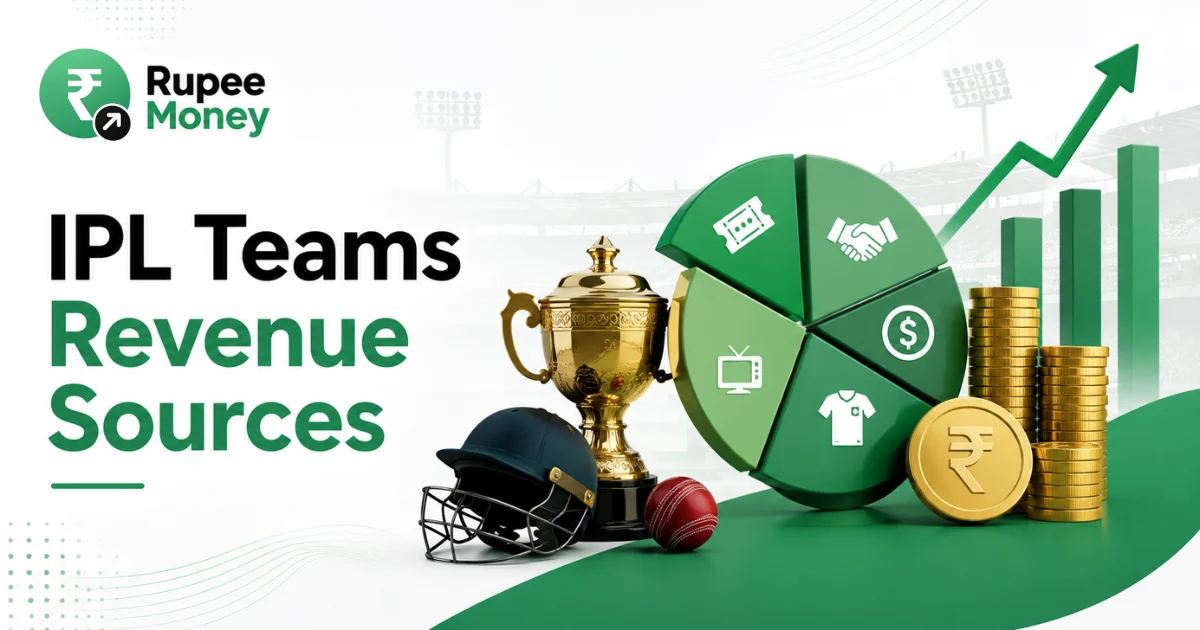
The Indian Premier League (IPL) looks like a massive cricket tournament on the surface, but behind every soaring six and sold-out stadium sits a robust, multi-billion-dollar business model. Many fans assume an IPL franchise relies entirely on winning matches or selling tickets. In reality, teams generate income through a complex web of central revenue sharing, direct sponsorships, merchandise, and digital content.
Understanding how sports franchises build wealth requires the same strategic approach you would apply to your own financial planning. Today, the IPL stands as one of the most commercially successful sports leagues globally, with its overall business value crossing an astounding $20.6 billion in 2026.
Let us break down the complete IPL team revenue model with RupeeMoney to see exactly where the money comes from, where it goes, and how franchises manage to turn a profit even if they finish at the bottom of the points table.
The Foundation of the IPL Team Revenue Model
The secret behind the financial stability of every IPL franchise lies in the league’s centralized business structure. The Board of Control for Cricket in India (BCCI) manages the biggest commercial deals and shares the wealth with the teams.
Media Rights: The Biggest Financial Pillar
When you watch an IPL match on television or stream it digitally, broadcasters pay the BCCI for the exclusive right to air those matches. Consequently, the BCCI distributes a massive portion of this money directly to the franchises. This central arrangement gives every team a predictable and enormous source of annual income.
For the 2023 to 2027 cycle, the IPL media rights fetched an unprecedented ₹48,390 crore. Disney Star secured the television rights for ₹23,575 crore, while Viacom18 paid ₹23,758 crore for the digital streaming rights. Under the current structure, the BCCI retains 50% of this central revenue pool. They then distribute 45% equally among all ten franchises, while the remaining 5% gets allocated based on team performance.
Because of this equitable distribution, a franchise does not need to fill every stadium seat to remain profitable. The league’s massive audience—which consistently exceeds one billion viewers across TV and digital platforms—creates immense commercial value that sustains all the participating teams.
Central Sponsorships
Alongside media rights, the BCCI sells overarching sponsorship rights for the tournament itself. The most prominent example is the title sponsorship. The Tata Group currently holds the IPL title sponsorship for the 2024 to 2028 period under a massive ₹2,500 crore deal, translating to roughly ₹500 crore per season.
The BCCI also packages associate central sponsorships with other major corporate brands. Just like the media rights, the BCCI funnels a percentage of this central commercial revenue down to the franchises. Therefore, central revenue sharing forms the absolute financial bedrock of the IPL team revenue model.
Direct Franchise Earnings
While the central pool guarantees basic survival, direct franchise earnings dictate which teams become truly wealthy and dominant off the field.
Team-Specific Sponsorships
Every IPL team directly negotiates its own unique commercial partnerships. If you look closely at an IPL jersey, you will notice multiple brand logos strategically placed on the front, back, sleeves, and even the trousers. Beyond the kit, teams secure principal partners, digital partners, and official merchandise sponsors.
The value of these independent deals depends entirely on the team’s popularity, star players, and social media reach. For example, legacy teams with massive, loyal fan bases command significantly higher sponsorship rates than newer franchises. Collectively, IPL franchises generate well over ₹1,000 crore annually from these direct sponsorships alone.
Ticket Sales and Matchday Hospitality
Every franchise hosts a set number of home matches during the season. With the tournament expanding to 84 matches in 2026, matchday revenue has grown proportionately. Teams earn directly from gate receipts, selling everything from standard stadium seats to premium corporate hospitality boxes.
Furthermore, franchises generate supplementary income through in-stadium advertising and food and beverage concessions. While ticket sales represent a crucial revenue stream, they still contribute far less to the bottom line than the central broadcasting pool.
Merchandise and Licensing
Passionate fans love representing their teams. Therefore, franchises heavily monetize their supporter bases through official merchandise. Teams sell official replica jerseys, caps, mugs, and training apparel through their own digital storefronts and third-party retail partners. A popular franchise effectively turns its supporters into a recurring consumer base, generating steady off-field income throughout the calendar year.
Digital Content Creation
The modern IPL team revenue model relies increasingly on digital media. Franchises now operate as full-fledged media companies. They produce behind-the-scenes documentaries, exclusive player interviews, short-form reels, and podcasts. This continuous content stream keeps fans engaged year-round and creates new, highly targeted advertising inventory for digital sponsors.
Prize Money vs. Business Expenses
Making money only represents half of the equation; running an elite sports team costs a fortune.
Is Prize Money the Main Goal?
Interestingly, prize money acts merely as a performance bonus within the broader business framework. The total IPL prize pool typically hovers around ₹50 crore, with the champion taking home approximately ₹20 to ₹22 crore. When you compare this to the hundreds of crores teams receive from media rights, the difference becomes staggering. While lifting the trophy boosts brand valuation immensely, the guaranteed central revenue ensures financial stability regardless of the final standings.
What Are the Biggest Expenses for IPL Teams?
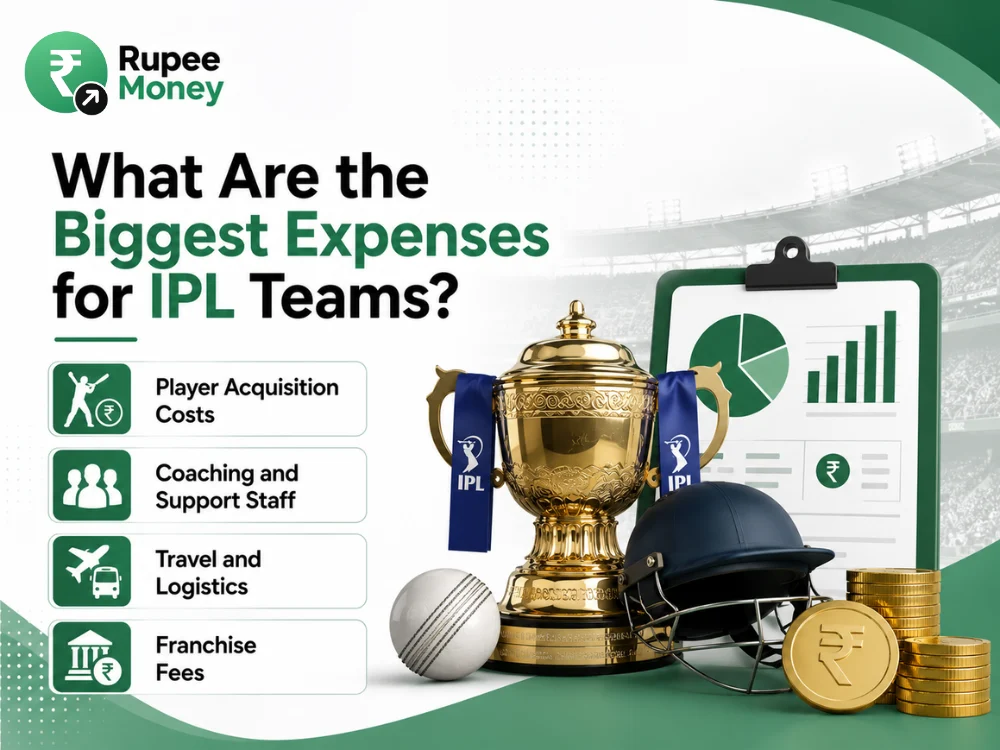
Generating massive revenue requires significant capital expenditure. Running an IPL franchise carries huge operational costs:
- Player Acquisition Costs: The single largest expense involves buying and retaining elite cricketers during the auctions. A franchise’s player salary purse currently stands at an immense ₹120 crore.
- Coaching and Support Staff: Teams employ world-class head coaches, data analysts, physiotherapists, and specialized physical trainers.
- Travel and Logistics: Transporting and accommodating a large squad across India for two months demands top-tier logistical spending.
- Franchise Fees: Owners must pay annual franchise fees or share a percentage of top-line revenue with the BCCI, depending on their original ownership contracts.
Managing these massive cash flows requires strict financial discipline, similar to how a small business might carefully plan its debt repayments using an EMI calculator to maintain steady liquidity.
Do Teams Make Money Even If They Lose?
Yes. This remains the most fascinating aspect of the IPL team revenue model.
Imagine a team finishes dead last on the points table. Despite the poor on-field performance, the franchise still receives its guaranteed equal share of the central media rights and central sponsorships. They still collect their pre-negotiated team sponsorship money, home match gate receipts, and merchandise sales.
They miss out on the 5% performance-linked central revenue and the winner’s prize money, but their business absolutely does not collapse. The BCCI deliberately designed this closed-league structure to protect franchise owners, ensuring that all teams remain commercially viable and competitive year after year.
Why IPL Franchises Are Billion-Dollar Assets
An IPL franchise operates as much more than an annual cash-generating machine; it is a rapidly appreciating capital asset. Because the league operates on a fixed-supply model with only ten teams, scarcity drives valuations incredibly high. Much like understanding compounding returns through a SIP calculator or tracking safe growth with an FD calculator, holding a scarce asset in a growing market yields massive long-term wealth.
If you want to dive deeper into long-term wealth building, learning what is SIP provides excellent fundamental knowledge that mirrors how sports valuations compound over time.
In 2026, the market proved exactly how valuable these teams have become. Financial reports indicate that Royal Challengers Bengaluru (RCB) attracted acquisition interest valuing the franchise at a staggering $1.78 billion. Similarly, the Rajasthan Royals attracted acquisition bids valuing them around $1.65 billion. Investors view these teams as premier global media properties, comparable to major NBA or English Premier League clubs. If you are curious about how these massive, privately held companies eventually access public capital, you can explore what is an IPO.
Conclusion
The IPL completely transcends the boundaries of a traditional cricket tournament. It operates as a highly sophisticated, multi-billion-dollar sports and entertainment ecosystem. The core of the IPL team revenue model relies on central media rights, which provide the crucial financial safety net that allows the entire league to thrive. Franchises then build immense independent wealth by layering on direct sponsorships, ticket sales, merchandise, and digital content strategies.
While every team fights fiercely for the championship trophy on the pitch, the underlying business model guarantees that all participants win financially off the pitch. For investors, owners, and broadcasters, the IPL proves that when you successfully monetize a billion passionate fans, the financial returns are nothing short of spectacular.
FAQs
How do IPL teams make money?
IPL franchises generate revenue through central revenue sharing (media rights and central sponsorships distributed by the BCCI), direct team sponsorships, home match ticket sales, hospitality packages, merchandise, digital content monetization, and tournament prize money.
What is the biggest source of income in the IPL team revenue model?
Central revenue sharing forms the absolute largest income source for IPL teams. The BCCI distributes 45% of the massive media rights and central sponsorship pool equally among all franchises, guaranteeing hundreds of crores in baseline revenue before a single ball is bowled.
Do IPL teams earn money from ticket sales?
Yes, teams retain the revenue generated from ticket sales and premium hospitality boxes during their home matches. However, compared to the multi-billion-dollar media rights deals, gate receipts make up a much smaller percentage of total franchise earnings.
Does the IPL winner take all the money?
No. While the tournament champion receives the largest share of the ₹50 crore prize pool (usually around ₹20 to ₹22 crore), this prize money remains minuscule compared to the guaranteed central revenue payout. Therefore, winning the tournament provides prestige and boosts brand valuation, but it does not determine immediate financial survival.
Can an IPL team make a profit without winning the tournament?
Absolutely. Because the BCCI distributes 45% of the central media and sponsorship pool equally, even the lowest-ranked team receives a massive financial payout. Combined with their own direct sponsorships and ticket sales, teams comfortably turn a profit despite poor on-field performances.
Disclaimer: This article is strictly for educational and informational purposes. The IPL revenue-sharing arrangements, sponsorship contract values, media rights figures, and franchise valuations mentioned are based on publicly available reports, including 2026 data from Reuters, market research studies, and historical structures. These figures are subject to change and do not represent the audited financial statements of the BCCI or any specific IPL franchise. We are not registered financial advisors, and readers should not treat this content as professional investment advice.
ABOUT THE AUTHOR

