
Government Securities vs Fixed Deposits: What is the Difference in 2026?
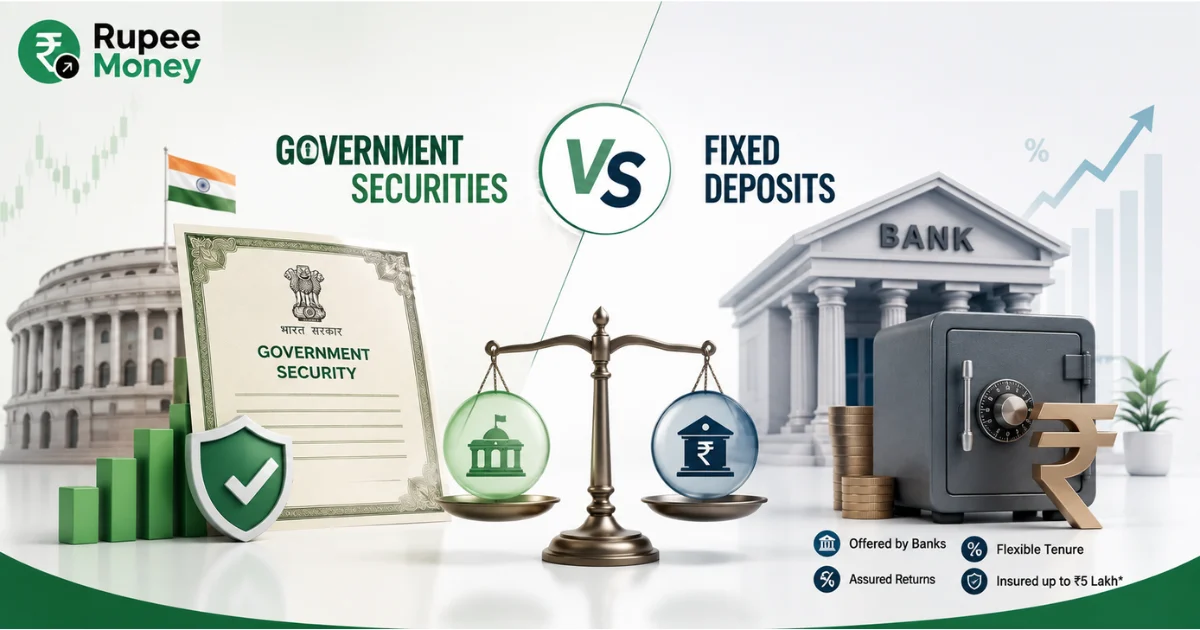
Do you want to invest your savings safely? You might consider Government Securities and Fixed Deposits. Both options help you preserve your hard-earned capital. They also generate regular interest income for your family. However, they function in completely different ways.
Welcome to Rupeemoney. We will help you understand these two popular investment choices. A Fixed Deposit involves giving your money to a bank. Government Securities involve lending your money directly to the government. The right choice depends on your specific financial goals. You must consider your investment timeframe and your liquidity needs. You also need to evaluate return expectations and tax brackets. Let us explore these important differences in detail for 2026.
What Are Government Securities (G-Secs)?
The central and state governments need funds for public projects. They issue debt instruments called Government Securities to raise money. Financial experts often call these instruments G-Secs. When you buy a G-Sec, you lend money to the government. The government promises to pay you regular interest. The government also returns your principal amount on the maturity date. The Reserve Bank of India manages this massive borrowing programme. The RBI allows retail investors to buy these securities directly. You can open an RBI Retail Direct account online easily.
H3: Common Types of Government Securities
You can choose from several types of government debt instruments.
- Treasury Bills: The government issues these for short periods. They mature in 91, 182, or 364 days.
- Government Bonds: These are long-term investment instruments. They pay regular interest to investors over many years.
- State Development Loans: State governments issue these bonds. They use the money to fund local infrastructure projects.
- Sovereign Gold Bonds: The government issues these unique bonds. They link your returns directly to market gold prices.
Treasury Bills work best for your short-term financial goals. Government bonds suit investors planning for their long-term future. You can read our detailed guide on government securities in India explained to learn more.
What Is a Bank Fixed Deposit (FD)?
A Fixed Deposit allows you to deposit a lump sum. You place this money with a bank for a fixed period. The bank guarantees a specific interest rate for your tenure. The bank returns your principal and interest at maturity. Banks offer various tenure options for these secure deposits. You can invest for seven days or ten full years. Many Indian banks offer higher interest rates for senior citizens. Indian households love FDs for their ultimate simplicity. You always know exactly how much money you will earn. FDs provide highly predictable interest income for conservative investors.
Government Securities vs Fixed Deposits: Core Differences
The biggest difference involves the actual borrower of your money. When you buy a G-Sec, the government takes your money. When you open an FD, the bank takes your money. The bank uses your deposit to issue loans to others. Let us look at other major differences clearly.
- Issuer: The government issues G-Secs. Banks issue FDs.
- Investment Type: A G-Sec is a tradable debt security. An FD is a standard retail bank deposit.
- Return Structure: G-Secs offer coupon payments or discount-based returns. FDs offer a fixed, unchangeable interest rate.
- Market Price: G-Sec prices change every day on the open market. FD values never fluctuate regardless of market conditions.
- Liquidity: You can sell G-Secs on the secondary market anytime. You can break an FD by paying a penalty fee.
- Credit Risk: G-Secs carry almost zero credit risk. FDs carry bank risk up to a specific legal limit.
Which Investment Is Safer for You?
Both options protect your investment capital exceptionally well. However, they manage financial risk very differently. Central government securities carry the lowest possible credit risk. The sovereign government promises to repay your money fully. The government will always honour its own financial debt.
However, government securities face constant market-price fluctuations. If overall interest rates rise, your bond price will fall. This only matters if you sell the bond before maturity. Fixed Deposits never face this specific market-price risk. Your FD value remains completely stable every single day.
However, bank deposits carry an entirely different type of risk. Banks can sometimes fail and close their business operations. The Deposit Insurance and Credit Guarantee Corporation provides a safety net. The DICGC protects your bank deposits up to ₹5 lakh. Therefore, you must understand the difference between these financial risks. You face market risk when you trade government bonds. You face bank credit risk when you open large FDs.
Government Securities vs FD: Which Gives Better Returns?
Neither option wins this return category permanently. Government bond yields and FD interest rates change constantly. Banks adjust their deposit rates based on market demand. They increase rates when they need more funds to lend. Government bond yields change based on national inflation expectations. They also react to new government borrowing plans.
You should always compare current rates before investing your money. Do not assume one option always pays a higher return. You must also calculate the heavy impact of income taxes. Taxes will reduce your final take-home return significantly. A higher headline interest rate might yield lower post-tax returns. If you worry about rising prices eating your wealth, read what is inflation and why does it matter.
How Do You Earn Interest in 2026?
These two investments calculate your financial profits very differently.
Returns from Treasury Bills
The government issues Treasury Bills at a steep discount. You buy the bill for less than its face value. On maturity, the government pays you the full face value. The difference between these two numbers becomes your actual profit. Treasury Bills do not pay regular monthly interest to you.
Returns from Government Bonds
Government bonds pay interest at a strict, fixed coupon rate. The government deposits this interest directly into your bank account. You usually receive these payments twice a year continuously. Also, you receive your original principal amount on the exact maturity date. You can also earn capital gains by selling bonds early. If bond prices rise in the market, you sell for a profit.
Returns from Fixed Deposits
FDs offer a strict, predetermined interest rate for everyone. You lock in this rate for your entire chosen tenure. The bank calculates your interest using a specific compounding method. Some FDs pay interest monthly or quarterly into your account. Other FDs reinvest your interest automatically to grow your corpus. The bank pays the total accumulated amount on the maturity date.
Liquidity: Can You Withdraw Your Money Early?
Liquidity refers to how easily you can access your cash. You can sell listed government securities before they mature. The secondary market facilitates these trades every weekday. However, your selling price depends entirely on current market demand. You might sell your bond at a significant financial loss.
Fixed Deposits offer a completely different exit route for investors. Banks allow you to break your FD before the maturity date. However, banks penalize you heavily for premature withdrawals. They reduce your applicable interest rate for the period. They also charge a flat monetary penalty fee.
Neither option gives you perfect, free liquidity anytime. Always check the exit conditions before you invest your money. If you need highly liquid funds, plan your finances carefully.
Tax Differences You Must Know
Taxes shrink your actual investment returns drastically. The government taxes your FD interest as regular income. You add your FD interest to your total yearly income. You pay tax according to your personal income tax slab. Banks also deduct TDS if your interest exceeds certain limits.
Government securities also attract taxes from the income tax department. The government taxes your regular bond interest as normal income. If you sell a bond early, you pay capital gains tax. You must always compare post-tax returns carefully. Do not look only at the advertised gross interest rate. Consult a tax professional for large investment amounts.
Can You Lose Money in Government Securities?
Yes, you can lose money in government securities. This happens if you sell a bond before its maturity date. Bond prices and interest rates move in opposite directions constantly. Suppose you buy a government bond paying 7% interest today. Next year, new bonds start paying 8% interest to investors. Nobody will want to buy your older 7% bond. You will have to lower your selling price to attract buyers. You will suffer a capital loss on your investment.
However, you avoid this loss completely if you hold the bond. If you wait until maturity, the government repays you fully. You will not lose your original principal amount. You can read more about how economic rates affect things. Check out our detailed guide on what is the repo rate explained in simple words.
Can You Lose Money in a Fixed Deposit?
An FD never fluctuates in market value like a bond. A ₹1 lakh FD remains worth ₹1 lakh every day. However, FD investors still face very real financial risks.
- Bank Default Risk: A bank could technically fail and close down its operations.
- Inflation Risk: Rising prices could easily outpace your fixed interest earnings.
- Penalty Risk: You lose interest if you break the FD early.
- Tax Impact: High taxes significantly reduce your real wealth creation.
The DICGC protects your money up to ₹5 lakh only. You could lose funds exceeding this limit during a bank failure. Therefore, you must select your banking partner very carefully.
Which Option Should Beginners Choose?
Fixed Deposits feel much easier for complete financial beginners. You just select your deposit amount and your desired tenure. You check the interest rate and choose a maturity payout. The bank handles all the complicated calculations for you.
Government securities require a deeper financial understanding from the investor. You must learn the exact difference between bills and bonds. You must understand how the secondary market prices these bonds daily. However, the RBI makes buying bonds very easy today. Retail investors use the RBI Retail Direct platform securely online.
Your choice should depend on your specific financial goal. Do not chase the highest interest rate blindly without research. If you want to explore other beginner options, read more. You can check our guide on what is SIP systematic investment plan.
Step-by-Step Guide to Making Your Choice
Follow these steps before you invest your hard-earned money.
Choose an FD for Ultimate Simplicity
Select an FD if you want a straightforward investment process. FDs give you entirely predictable interest income every year. You know your exact maturity amount on the very first day. You do not need a demat account to open an FD.
Choose G-Secs for Sovereign Safety
Select government securities if you want absolute sovereign backing. Bonds help you diversify your fixed-income portfolio effectively. They offer long-term fixed income for your retirement years. They protect large capital amounts perfectly from default risks.
Match Your Investment Horizon
Do you need your money back in exactly six months? Treasury Bills serve short-term financial goals perfectly. Do you want to invest for ten or twenty years? Government bonds fit long-term retirement goals extremely well. FDs let you pick any tenure from days to years. Always match your financial instrument with your exact timeline. If you plan to build long-term assets, start early. Read our guide on building wealth in your 20s.
Key Factors to Check Before You Invest
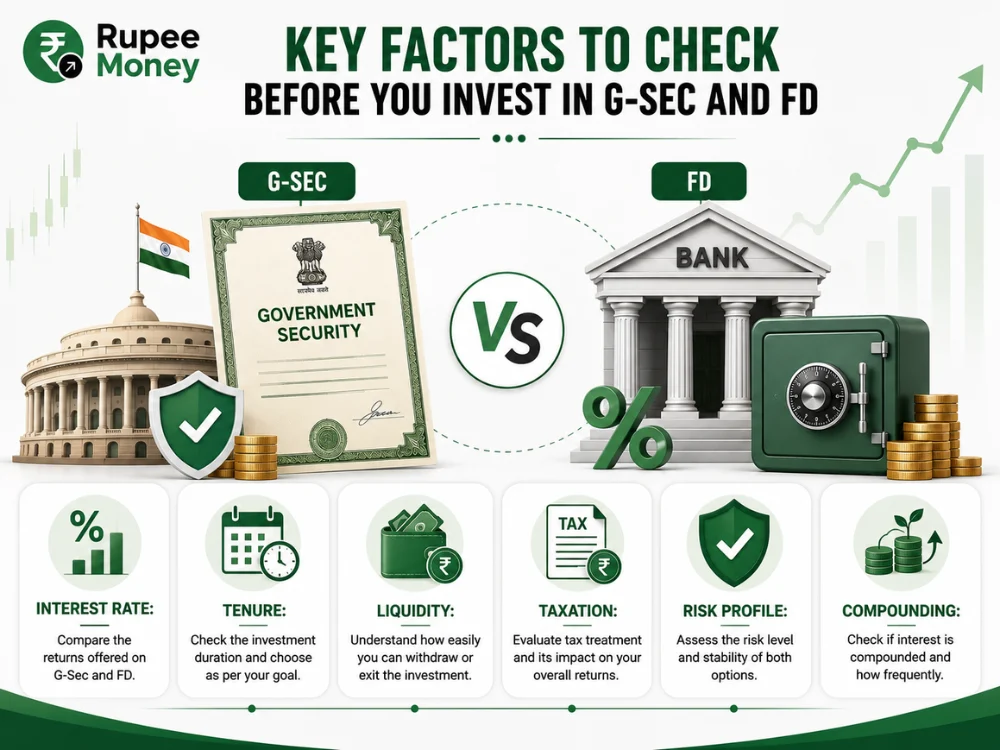
Evaluate these essential factors before you make a final decision.
- Interest Rate: Check the current bank rate or the latest bond yield.
- Tenure: Pick a maturity period matching your specific financial goal.
- Liquidity: Check the premature exit rules and bank penalties carefully.
- Taxation: Calculate your final post-tax income accurately using current rules.
- Risk Profile: Evaluate bank credit risk, inflation risk, and interest-rate risk.
- Compounding: Find out how often the bank compounds your FD interest.
A Simple Investment Scenario
Suppose you have exactly ₹5 lakh to invest today. You could place this entire amount into a bank FD. You could also buy a long-term government bond instead. Also, you should not decide based solely on the interest rate. Ask yourself if you need regular monthly income to survive. Ask yourself if you can lock the funds until maturity. Determine your exact tax bracket before choosing an instrument.
An investor who loves simplicity will always prefer the FD. An investor who wants sovereign safety will buy the government bond. You can compare other safe investments as well. Read our article comparing SIP vs FD which investment is better.
Conclusion
Government Securities and Fixed Deposits play crucial roles in investing. They both help you build a highly conservative financial strategy. They protect your capital while providing regular interest income. However, they function in very different ways fundamentally. You lend to the government when you buy G-Secs. You lend to a commercial bank when you open an FD.
G-Secs provide ultimate safety but carry specific market-price risk. FDs provide extreme simplicity but carry minor bank credit risk. The better choice depends entirely on your specific financial goals. Evaluate your liquidity needs, tax bracket, and investment tenure carefully. Compare the post-tax returns before you deploy your money anywhere. Make a smart, informed decision to protect your financial future.
FAQs
Are Government Securities better than Fixed Deposits?
Neither option is universally better for every single investor. Government securities provide sovereign debt exposure with absolutely zero default risk. FDs offer a simple, highly predictable bank-deposit structure for conservative savers. Your choice depends on your specific investment period and liquidity needs.
Are Government Securities completely risk-free?
Central government securities carry zero credit risk or default risk. However, traded government bonds experience constant market price fluctuations daily. You face a financial loss if you sell before the maturity date.
Is a bank Fixed Deposit completely risk-free?
An FD does not carry daily market-price risk like bonds. However, it carries a small amount of bank credit risk. The DICGC insures your bank deposit only up to ₹5 lakh.
Can I sell my Government Securities before they mature?
Yes, you can sell traded bonds on the secondary market. However, you must accept the current prevailing market price. You might sell at a financial loss if interest rates rise.
Can I withdraw my Fixed Deposit before maturity?
Most banks allow you to break your FD early for emergencies. The bank will apply a financial penalty for early withdrawal. The bank will also lower your final interest rate significantly.
Are FD returns and Government Securities returns taxed?
Yes, the government taxes both investment returns under current laws. You must declare FD interest as regular taxable income yearly. You must also declare bond interest as regular taxable income. Selling a bond early attracts specific capital gains taxes.
Disclaimer: This article provides educational and informational content only. Investment returns, interest rates, and market conditions change frequently. We do not provide personalized financial advice. Please consult a certified financial advisor before making investment decisions.
ABOUT THE AUTHOR

