
Intraday vs Delivery Trading: Key Differences, Risks & Benefits
The biggest difference between intraday and delivery trading is incredibly simple: intraday traders close their positions on the exact same day, while delivery investors hold shares beyond the trading session.
But this choice affects much more than just your holding period. Capital requirements, risk appetite, time commitment, trading strategies, and potential costs all differ vastly between the two approaches.
If you are new to the Indian stock market, understanding this fundamental difference can help you decide whether you want to trade short-term price movements or hold stocks for long-term financial goals. Welcome to RupeeMoney. Let us break down everything you need to know about intraday versus delivery trading.
What Is Intraday Trading?
Intraday trading (or day trading) means buying and selling a stock strictly within the same trading day. You do not intend to carry the position overnight.
For example, suppose you buy 100 shares of a company at ₹500 in the morning. If the price rises to ₹515 by the afternoon, you can sell the shares on the same day and pocket the difference (before applicable charges and taxes). Intraday trading focuses entirely on short-term price movements rather than the long-term fundamentals of the business.
How Intraday Trading Works
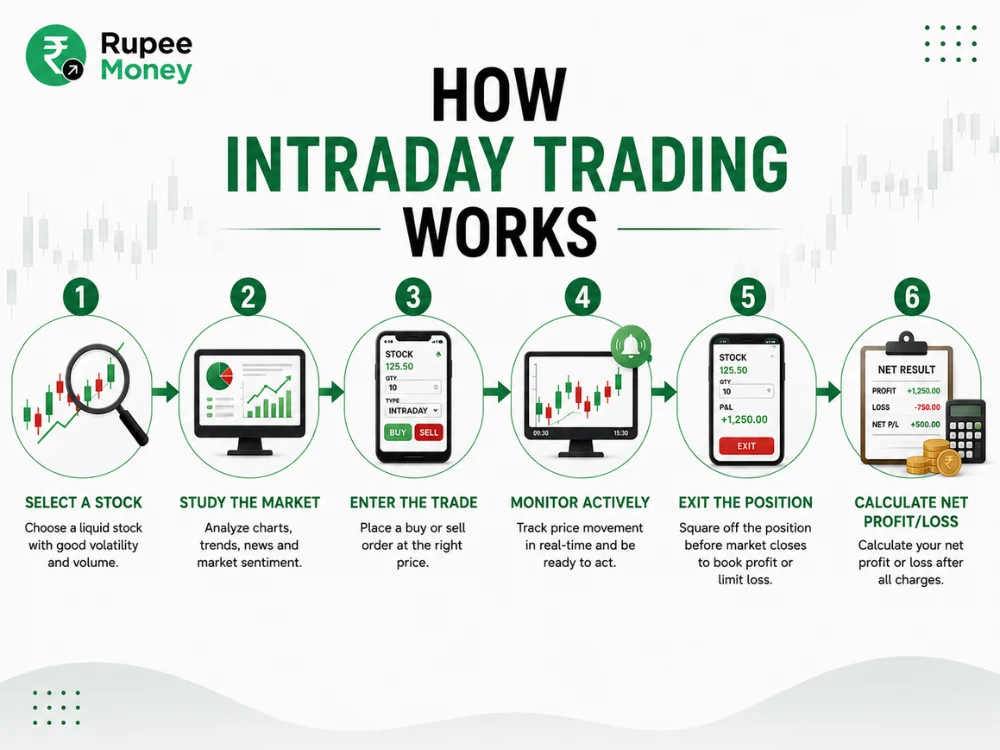
A typical intraday trade follows this rapid process:
- Select a stock: Identify highly liquid and volatile stocks.
- Study the market: Analyze price movements and immediate market conditions.
- Enter the trade: Execute a buy or sell order during market hours.
- Monitor actively: Watch the position closely as prices fluctuate.
- Exit the position: Close the trade before the daily trading session ends.
- Calculate net profit/loss: Account for brokerage, taxes, and other applicable costs.
What Is Delivery Trading?
Delivery trading means buying shares and holding them beyond the same trading day. When you purchase shares for delivery, you can hold them for days, months, or even several decades.
For instance, when you buy shares of a newly listed company after an IPO, they are credited directly to your demat account after standard settlement. You can decide when to sell them based on your personal investment objectives.
If you buy 20 shares at ₹1,000 each, you invest ₹20,000. The holding period depends entirely on your strategy and patience.
Intraday vs Delivery Trading: Key Differences
Here is a clear comparison between the two market approaches:
| Factor | Intraday Trading | Delivery Trading |
| Holding Period | Same trading day | More than one day |
| Main Objective | Short-term price movements | Longer-term wealth creation |
| Share Ownership | Position is squared off; shares don’t enter demat | Shares are credited to your demat account |
| Capital Requirement | Often lower (broker margin/leverage available) | Requires 100% of the purchase value upfront |
| Time Commitment | Extremely high (requires constant monitoring) | Relatively low |
| Overnight Risk | None (all positions closed by end of day) | Present (exposed to after-hours global news) |
| Dividends & Bonuses | Not eligible | Eligible (if held on the record date) |
| Primary Analysis | Technical analysis and momentum | Fundamental and technical analysis |
Capital Requirements: Leverage vs Cash
One of the most attractive differences for beginners is how much money you need to enter a position.
In delivery trading, you must pay the full purchase value of the shares. If you want to purchase 100 shares at ₹500, your upfront cost is strictly ₹50,000.
In intraday trading, stockbrokers often provide margin (leverage) for eligible trades. This allows you to take a larger position using a fraction of the upfront capital. However, margin acts as a double-edged sword—it amplifies both your profits and your losses. Lower upfront capital absolutely does not mean lower risk.
Advantages and Risks of Intraday Trading
Advantages of Intraday Trading
- No Overnight Risk: Because you close positions daily, you are not exposed to negative news or global market crashes that happen after Indian market hours.
- Short-Selling Opportunities: Intraday traders can sell shares they don’t own (short selling) to profit from falling stock prices during a single session.
- Lower Capital Hurdle: Broker-supported margins allow traders to execute larger trades with less cash.
Risks of Intraday Trading
- Extreme Volatility: A stock can move against your position in minutes, making strict stop-loss rules mandatory.
- Constant Attention Required: You cannot “buy and forget.” You must monitor charts, news, and price action continuously.
- High Failure Rate: Frequent trading increases brokerage costs rapidly. A highly cited SEBI study found that 7 out of 10 individual intraday traders in the equity cash segment incurred net losses in FY2022-23.
Advantages and Risks of Delivery Trading
Advantages of Delivery Trading
- Time on Your Side: You do not need to panic if the stock drops on day one. You have time to let your investment thesis play out.
- Focus on Fundamentals: You can evaluate a company’s true value. To understand how efficiently a business generates profit, you can study metrics like Return on Assets (ROA).
- Corporate Benefits: Holding delivery shares makes you eligible for dividends, stock splits, and bonus issues.
Risks of Delivery Trading
- Capital Lock-in: Your money stays invested until you sell, which reduces your immediate liquidity.
- Market Risk: Delivery trading does not eliminate losses. A fundamentally weak company can experience a prolonged, multi-year fall in its share price.
- Overnight Exposure: You remain exposed to negative macroeconomic news that occurs when markets are closed.
Which Is Better: Intraday or Delivery?
There is no universal answer. The right choice depends entirely on your financial goals, risk tolerance, market knowledge, and available time.
Intraday Trading May Suit You If:
- You thoroughly understand market volatility and technical analysis.
- You have the time to monitor markets actively from 9:15 AM to 3:30 PM.
- You have a ruthless, defined risk-management strategy.
- You do not depend on trading profits to pay your essential monthly bills.
Delivery Trading May Suit You If:
- You want to build long-term wealth without daily stress.
- You prefer studying company fundamentals and balance sheets.
- You have a full-time job and less time to monitor live markets.
- You can tolerate temporary price declines without panicking.
Intraday vs Delivery: A Simple Example
Suppose ABC Ltd trades at ₹1,000, and you want to purchase 10 shares (Total value = ₹10,000).
The Intraday Scenario:
You buy at ₹1,000 in the morning and sell at ₹1,030 at 2:00 PM.
Your gross profit is ₹300 (10 shares × ₹30). You book the profit immediately, minus applicable brokerage and taxes.
The Delivery Scenario:
You buy the 10 shares at ₹1,000. By next week, the price temporarily falls to ₹950. Your portfolio shows an unrealized loss of ₹500. Because this is a delivery trade, you are not forced to exit. You hold the shares for two years, and the company performs brilliantly, pushing the price to ₹1,500. Your unrealized gain becomes ₹5,000.
Is Delivery Trading the Same as Long-Term Investing?
Not necessarily. “Delivery” simply means you hold the shares beyond the current trading day. You could hold a delivery stock for two days, six months, or ten years.
If you are looking to build a massive retirement corpus through compounding over decades, you are engaging in long-term investing. Many investors achieve this safely by diversifying their capital into large-cap mutual funds rather than picking individual delivery stocks.
What Charges Apply to Intraday and Delivery?
Both transaction types involve mandatory costs that eat into your profits:
- Brokerage fees
- Securities Transaction Tax (STT)
- Exchange transaction charges
- GST (18% on brokerage and transaction charges)
- SEBI turnover fees
- Stamp duty
What Should Beginners Choose?
Beginners should heavily prioritize delivery trading (investing) to first understand how the stock market actually works.
Delivery investing provides the breathing room necessary to research a company and endure normal market fluctuations. Intraday trading requires iron-clad psychological discipline, instant decision-making, and advanced technical skills.
As highlighted by SEBI, 71% of individual intraday traders lose money. Learning risk management and capital preservation is far more important for beginners than chasing daily adrenaline and quick profits.
Conclusion
The fundamental difference between intraday and delivery trading comes down to your intent and holding period. With intraday trading, you attempt to capture rapid daily momentum. With delivery trading, you become a partial owner of a business, letting time and corporate growth work in your favor.
For beginners, the most important question is never “Which can make me money faster?” Instead, ask yourself: “Which approach matches my financial goals, risk tolerance, and daily schedule?”
If you want to build systematic, long-term wealth without the stress of daily stock picking, you can calculate the power of disciplined compounding using our SIP Calculator.
FAQs
What is the main difference between intraday and delivery trading?
Intraday trading involves buying and selling a stock within the exact same trading day to capture short-term price moves. Delivery trading involves buying shares, taking them into your demat account, and holding them for days, months, or years.
Is delivery better than intraday trading?
Neither is universally better; they serve different purposes. Delivery suits investors looking for long-term wealth creation with less daily monitoring. Intraday suits experienced, full-time traders who can actively manage high-speed risk.
Can I convert intraday shares into delivery?
Yes, most brokers allow you to convert an open intraday position into a delivery position before the market closes, provided you have the full 100% cash margin available in your trading account to pay for the shares.
Can I earn more from intraday trading?
While intraday leverage allows for higher potential returns on small capital, it mathematically carries much higher risk. Official SEBI data confirms that 7 out of 10 retail intraday traders lose money.
Do delivery shares qualify for dividends?
Yes. If you buy shares in the delivery segment and hold them in your demat account on the company's official "record date," you are fully eligible to receive corporate dividends.
Is intraday trading suitable for beginners?
No. Beginners should approach intraday trading with extreme caution. The rapid price movements, leverage risks, and emotional stress often lead to quick capital destruction for inexperienced market participants.
Yes. If you buy shares in the delivery segment and hold them in your demat account on the company’s official “record date,” you are fully eligible to receive corporate dividends.
Disclaimer: The information provided on RupeeMoney is strictly for educational and informational purposes only and does not constitute financial, investment, or trading advice. We are NOT SEBI-registered Research Analysts or Investment Advisers. We do not provide buy, sell, or hold recommendations or stock tips. Investment in the securities market is subject to market risks; please read all related documents carefully before investing. Past performance of any stock or mutual fund does not guarantee future results. Readers must conduct their own independent research or consult a SEBI-registered financial advisor before making any investment decisions. RupeeMoney and its authors accept no liability for any financial losses incurred by users based on the content of this blog.
ABOUT THE AUTHOR

