
What Are Upper Circuit and Lower Circuit in the Share Market? A Beginner’s Guide
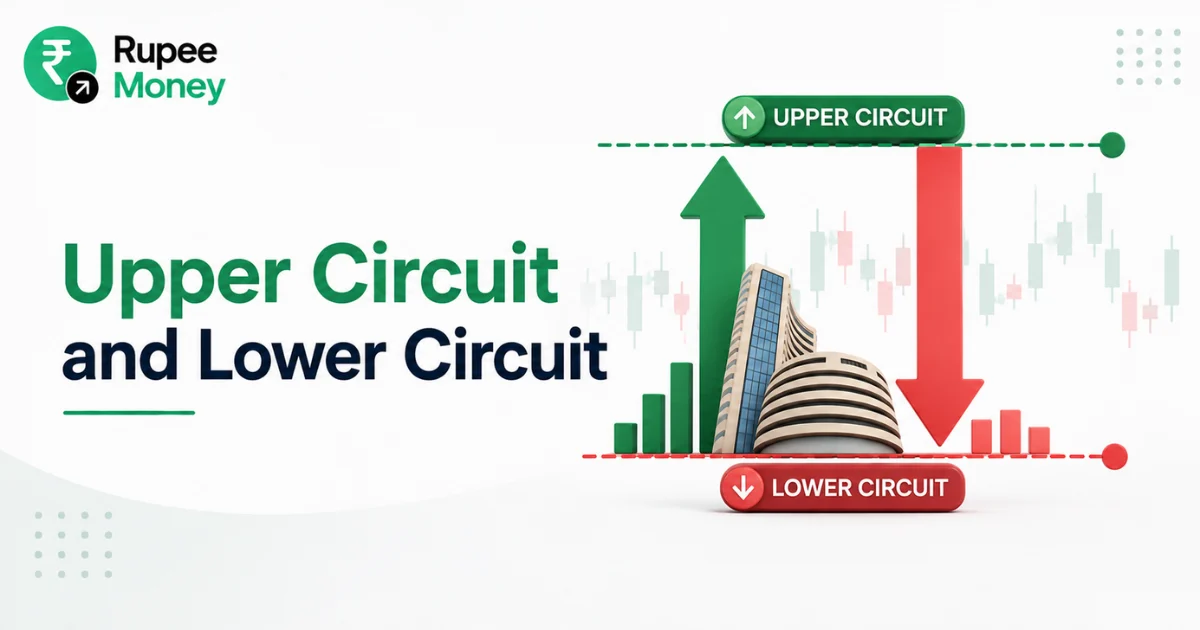
Ever noticed a stock jump 10% or crash 10% in a single day and then just… stop moving? You’ve probably also seen headlines saying a stock “hit the Upper Circuit” or “hit the Lower Circuit.” Plenty of new investors assume trading has frozen due to some technical glitch, but these limits actually exist to protect investors and rein in extreme volatility.
The Indian stock market can swing sharply on earnings announcements, corporate actions, economic news, or sudden shifts in investor sentiment. To keep panic buying and panic selling in check, stock exchanges apply circuit limits to many listed stocks.
At RupeeMoney, we think every investor should understand how Upper Circuit and Lower Circuit work before buying shares. Once you get these concepts, you’re far less likely to make emotional decisions — and you’ll understand exactly why some stocks suddenly stop trading. If you’re still getting comfortable with the basics of investing, our guide on how the stock market works in India is worth reading alongside this one.
This guide covers what Upper Circuit and Lower Circuit mean, why they exist, how they work in India, and how they affect you as an investor.
What Is Upper Circuit in the Share Market?
The Upper Circuit is the maximum price a stock can reach during a single trading session. Once it hits that limit, the exchange won’t allow the price to climb any higher for the rest of the day.
Say a stock closes at ₹100 and carries a 10% circuit limit — its Upper Circuit price becomes ₹110. If buyers keep placing purchase orders after the stock touches ₹110, the price simply can’t move past that mark for the remainder of the session. Plenty of buyers might sit in the order queue, but the stock won’t trade above its circuit limit no matter how much demand builds.
Why Does a Stock Hit the Upper Circuit?
Several triggers can push a stock toward its Upper Circuit:
- Better-than-expected quarterly results
- Positive government policy announcements
- Strong company earnings
- Major business expansion news
- Large institutional buying
- Merger or acquisition news
- Strong overall market sentiment
- Positive industry developments
When demand outpaces supply by a wide margin, buyers start competing for the available shares, and that pressure pushes the stock toward its upper limit.
What Is Lower Circuit in the Share Market?
The Lower Circuit is the lowest price a stock can fall to during a session. Once it hits this limit, the price can’t drop any further for the rest of that trading day.
If a stock closes at ₹100 with a 10% Lower Circuit, its lowest possible trading price for the next session becomes ₹90. Even if investors keep placing sell orders, the price simply won’t move below ₹90 that day. If no buyers show up at ₹90, the stock may stay locked at the Lower Circuit right until the market closes.
Why Does a Stock Hit the Lower Circuit?
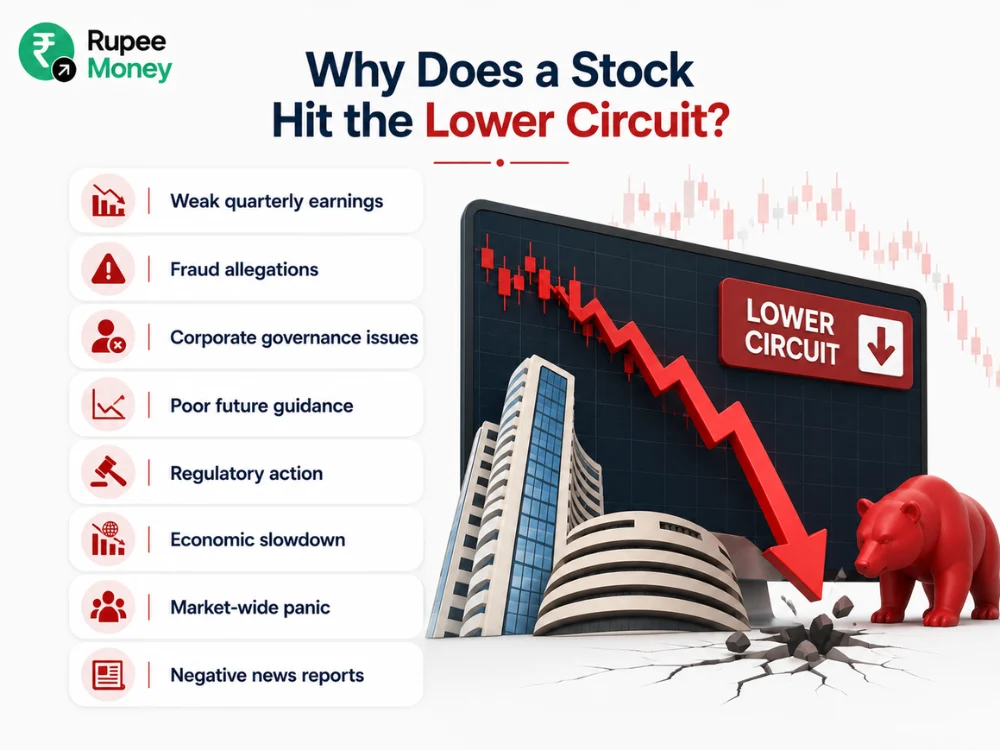
A few common situations trigger heavy selling:
- Weak quarterly earnings
- Fraud allegations
- Corporate governance issues
- Poor future guidance
- Regulatory action
- Economic slowdown
- Market-wide panic
- Negative news reports
When selling pressure massively outweighs buying demand, the stock eventually slides down to its Lower Circuit.
Why Does SEBI Use Circuit Filters?
The Securities and Exchange Board of India (SEBI) introduced circuit filters to protect investors and keep trading orderly. Without these limits, sudden rumours or panic could send stock prices to unrealistic levels within minutes.
Circuit filters exist mainly to reduce excessive volatility, prevent panic buying and selling, protect retail investors, allow more time for proper price discovery, and support fair market practices overall. They go a long way toward improving confidence in the Indian securities market.
How Upper and Lower Circuits Work in the Share Market
Every listed company gets a predefined daily price band, calculated by the exchange using the previous day’s closing price. Common circuit limits include 2%, 5%, 10%, and 20% in either direction. Some highly liquid stocks in major indices don’t carry fixed daily price bands at all, since SEBI places them under a separate dynamic price monitoring mechanism instead. Which limit actually applies depends on exchange regulations and the stock’s category.
How Circuit Limits Get Calculated
Say a company’s previous closing price is ₹500 and it carries a 10% circuit limit:
- Previous closing price: ₹500
- Upper Circuit: ₹550
- Lower Circuit: ₹450
During that trading day, the stock can’t trade above ₹550 or below ₹450. Once either limit is reached, the stock stays locked unless matching buyers and sellers show up within that permitted range.
Upper Circuit vs Lower Circuit
| Feature | Upper Circuit | Lower Circuit |
| Price Direction | Upward | Downward |
| Market Sentiment | Bullish | Bearish |
| Demand | Very high | Very low |
| Supply | Limited | Excessive |
| Buyer Activity | Strong | Weak |
| Seller Activity | Low | High |
Both limits exist for the same reason at their core — reining in sudden price swings and encouraging more disciplined trading.
Circuit Filters on the NSE and BSE
Both the National Stock Exchange (NSE) and the Bombay Stock Exchange (BSE) enforce circuit filter rules to control excessive price movement, implementing the framework SEBI sets out. Which limit applies depends on the stock’s category, its trading volume, and overall market liquidity.
Most small-cap and mid-cap stocks carry fixed daily price bands — 2%, 5%, 10%, or 20% — while highly liquid stocks and derivatives often follow different volatility control mechanisms instead of fixed filters. This system helps keep trading conditions fair across the Indian market.
What Happens When a Stock Hits the Upper Circuit?
A stock hitting its Upper Circuit tells you buying demand has become far stronger than selling pressure. When this happens, the stock reaches its maximum permitted price, new buy orders may keep entering the market, very few sellers remain available, and the stock can’t trade above the circuit price — sometimes staying locked until trading closes.
Many investors assume a stock locked at the Upper Circuit guarantees future gains, but that’s not the case. Prices can shift significantly in the following sessions depending on fresh information and changing sentiment.
What Happens When a Stock Hits the Lower Circuit?
A stock hitting its Lower Circuit usually points to heavy selling pressure, and this situation often worries investors holding the stock. Selling orders keep piling up, buyers become scarce, the stock reaches its lowest permitted price, and the exchange won’t allow it to fall further that session — making it genuinely hard for investors to exit their positions.
That said, a Lower Circuit doesn’t always mean the company has turned fundamentally weak. Sometimes it’s just broader market panic or temporary news driving the selling rather than a real business problem.
Why Investors Should Understand Circuit Limits
Knowing how circuit filters work helps you avoid emotional decisions. Instead of reacting to a sudden price move, you can pause and actually analyse what’s driving it. Understanding this concept helps you avoid panic buying and selling, evaluate company fundamentals properly, read market sentiment more clearly, sharpen your risk management, and make more informed calls overall. Long-term investors generally focus on business quality rather than a single day’s price action — a mindset that pays off well beyond circuit-hit stocks. Our guide on what SIP is and how it works covers exactly this kind of disciplined, long-term approach.
Can You Buy or Sell Stocks During a Circuit?
Yes — you can still place buy or sell orders, but whether they actually execute depends on matching orders being available.
During the Upper Circuit: buyers keep placing purchase orders while very few sellers remain, so your buy order may stay pending until sellers step in.
During the Lower Circuit: sellers keep placing sell orders while buyers stay scarce, so your sell order may remain pending until buyers show up.
Placing an order stays possible either way — execution just isn’t guaranteed.
Do Circuit Limits Apply to Every Stock?
No. The applicable limit depends on the stock’s category. Small-cap stocks often carry stricter circuit limits, mid-cap stocks tend to have fixed daily price bands, and large-cap stocks with high liquidity may follow dynamic price monitoring instead of a fixed daily limit. Stocks in the derivatives segment usually follow their own separate volatility management rules. Exchanges review these limits periodically based on market conditions.
Common Reasons Behind Frequent Circuit Hits
Some stocks hit Upper or Lower Circuits repeatedly, often because of sudden business announcements, quarterly results, corporate actions, regulatory developments, mergers and acquisitions, large institutional buying or selling, thin trading volume, or speculative activity. Always verify the actual reason behind repeated circuit hits before making any investment decision — our explainer on Return on Assets (ROA) can help you check whether a company’s fundamentals actually justify the price action.
Tips for Beginners Before Investing in Circuit Stocks
Stocks that frequently hit circuit limits can look tempting, but beginners should tread carefully:
- Study the company’s financial statements.
- Read official exchange announcements.
- Avoid investing based on rumours.
- Check trading volume before you buy.
- Understand the business model.
- Focus on long-term investing rather than chasing circuit hits.
- Diversify your portfolio — our guide to large-cap mutual funds is a good starting point if you’d rather spread that risk out.
- Invest according to your actual financial goals.
Patience usually delivers better outcomes than emotional, circuit-chasing trades.
Conclusion
Upper Circuit and Lower Circuit limits play a real role in keeping the Indian share market stable, protecting investors from excessive volatility and reducing panic-driven trading. Stocks can hit these limits because of strong buying or heavy selling, but you shouldn’t base investment decisions purely on daily price movements — understanding company fundamentals, financial performance, and long-term business prospects matters far more.
Learning how circuit filters work makes you a more confident, disciplined participant in the stock market. If you’d rather build wealth steadily instead of chasing circuit-hit stocks, you can estimate your potential growth using our SIP Calculator or Lumpsum Calculator, or explore a lower-risk, government-backed option through our PPF Calculator.
Frequently Asked Questions (FAQs)
What is the Upper Circuit in the share market? The Upper Circuit is the highest price a stock can reach during a trading session. Once it touches this limit, the exchange won’t allow any further price increase that day. Buyers may keep placing orders, but the stock can’t trade above the circuit price until the next session, unless exchange rules permit otherwise.
What is the Lower Circuit in the share market? The Lower Circuit is the lowest price a stock can reach during a session. Once it hits this limit, the price can’t fall further that day. If buyers stay unavailable, the stock may remain locked at the Lower Circuit right until the market closes.
Why do stocks hit the Upper Circuit or Lower Circuit? Stocks usually hit the Upper Circuit due to strong buying interest driven by positive earnings, corporate announcements, or favourable sentiment. They hit the Lower Circuit due to heavy selling triggered by weak results, negative news, poor outlook, or broader market corrections.
Can I buy or sell a stock after it hits the circuit? Yes, you can still place buy or sell orders after a stock reaches its circuit limit, but the trade only executes if matching buyers and sellers are available. Without matching orders, your order simply stays pending.
Does hitting the Upper Circuit mean a stock is a good investment? No. A stock reaching the Upper Circuit only shows strong buying demand during that particular session — it doesn’t guarantee future returns. Always evaluate the company’s financial health, business performance, valuation, and long-term growth prospects before investing, regardless of a single day’s price action.
Disclaimer: This article is meant to educate and inform readers and does not provide professional investment, financial, legal, or tax advice. Investing in the stock market carries inherent risks, and previous performance should not be viewed as a guarantee of future returns. Make informed decisions by conducting independent research and consulting a qualified financial advisor.
ABOUT THE AUTHOR

