
How Does Reliance Industries Make Money? Business Model and Revenue Sources
Reliance Industries ranks among India’s largest listed companies today. Millions of investors track its financial performance every single quarter. The company operates across several industries, rather than depending on just one. This diversified model has helped Reliance grow into one of India’s most valuable businesses.
Do you invest in the stock market, or plan to buy Reliance shares? Understanding how the company actually earns money matters here. Knowing its major revenue sources helps explain why its share price draws such heavy investor attention.
At RupeeMoney, we believe you should understand a company’s business before investing in it. This article explains how Reliance Industries makes money, breaks down its major segments, and covers why diversification keeps supporting its long-term growth.
Reliance Industries Business Model
Reliance Industries runs on a genuinely diversified business model. Rather than relying on a single income source, it earns revenue across multiple sectors at once.
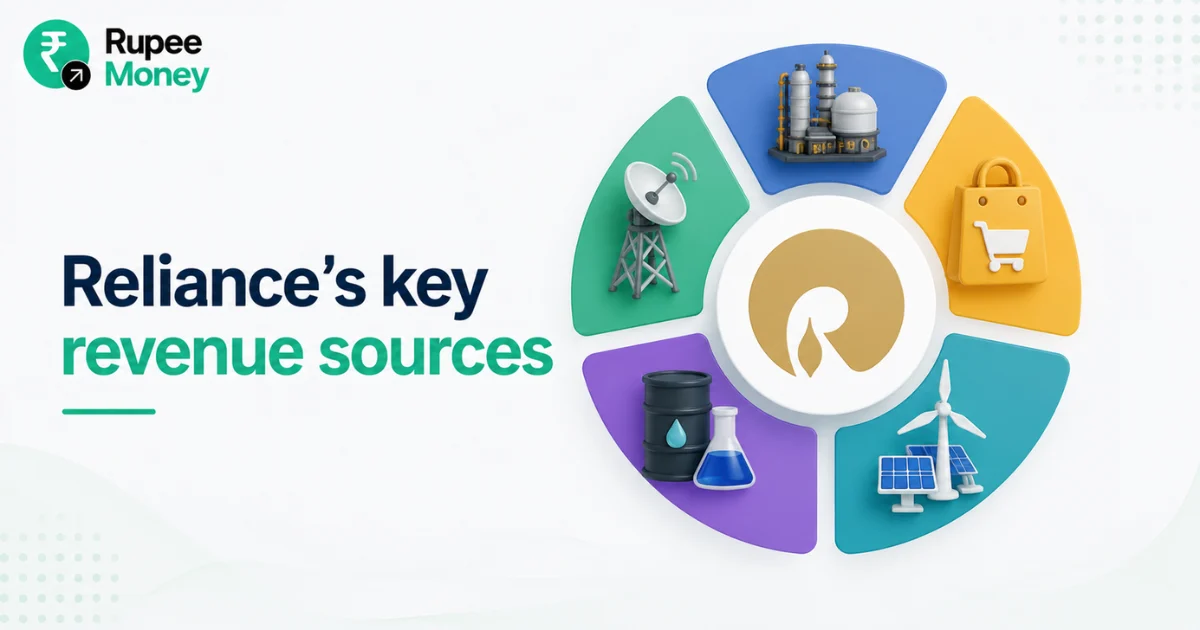
The company operates through several major businesses. These include Oil to Chemicals (O2C), refining, and petrochemicals. Reliance Retail, Jio Platforms, and digital services add further scale. Renewable energy and New Energy projects round out its newer growth bets.
This diversified structure genuinely reduces overall business risk. When one segment struggles, other businesses keep contributing steady revenue and profit. For FY2025-26, that balance showed up clearly in the numbers. Reliance posted record annual revenue of ₹11.7 lakh crore, up 10% year-on-year, with EBITDA growing 13.5%.
Oil to Chemicals Business of Reliance Industries
The Oil to Chemicals segment remains one of the company’s biggest revenue contributors still today. Reliance owns one of the world’s largest refining complexes, based in Jamnagar, Gujarat. The company refines crude oil into petrol, diesel, and aviation fuel. LPG, naphtha, and petrochemical feedstock round out its refined product range.
Reliance also manufactures chemicals, polymers, and polyester products at scale. Industrial materials from this segment serve businesses across India and international markets alike.
The O2C business has faced real headwinds too. Global oversupply and weak demand pressured petrochemical margins through FY2026. Despite that, O2C EBITDA still grew meaningfully during the year, helped by stronger transportation fuel margins. The segment showed genuine agility too, diversifying crude sourcing to maintain refinery output despite geopolitical disruptions near the Strait of Hormuz.
How Reliance Retail Makes Money
Reliance Retail has become one of India’s largest retail businesses by scale. The company earns revenue through thousands of physical stores and digital platforms combined.
Its operations span grocery stores, fashion outlets, and electronics stores. Jewellery stores, consumer products, and online shopping platforms round out the mix. Popular brands include Reliance Fresh, Reliance Smart, and Reliance Trends. Reliance Digital and AJIO add further reach across categories.
Revenue comes from product sales, private labels, and expanding retail partnerships nationwide. By late FY2026, Reliance Retail’s store count crossed 19,800 outlets, spanning nearly 78 million square feet. Quarterly revenue hit a record high during the year too, with grocery and fashion delivering particularly strong growth. India’s growing middle class and rising consumer spending keep fuelling this segment’s expansion.
How Jio Platforms Earn Revenue
Jio has genuinely transformed India’s telecom and digital services landscape. Today, Jio earns money from several sources, not mobile recharge alone.
Mobile Services
Millions of subscribers pay monthly prepaid and postpaid recharge plans. These recurring payments generate genuinely stable, predictable revenue for the business. Jio crossed 515 million subscribers during FY2026, with 5G users alone reaching 253 million. That means 5G traffic now accounts for over half the network’s total usage.
Broadband Services
JioFiber delivers high-speed internet to homes and businesses across India. Customers pay monthly subscription charges for this broadband access.
Enterprise Solutions
Jio offers cloud services, connectivity, and digital infrastructure to corporate clients. These enterprise customers contribute meaningful, growing revenue through dedicated business solutions.
Digital Platforms
Jio also earns through digital apps, entertainment platforms, and technology partnerships. The company’s digital ecosystem keeps expanding as internet usage grows across India. Average revenue per user climbed to roughly ₹211 by late FY2026, reflecting stronger pricing and engagement.
Renewable Energy Business of Reliance
Reliance has invested heavily in clean energy as part of its long-term strategy. The company focuses on solar energy, green hydrogen, and battery storage technology. Renewable power generation and broader energy storage solutions round out this push.
These businesses currently contribute less revenue than refining or retail do. Reliance still treats them as genuinely important for future growth, though. The company kept investing in new technologies through FY2026, alongside expanding its FMCG business too, strengthening its position across India’s evolving energy and consumer sectors.
Why Diversification Makes Reliance Industries Strong
One of Reliance Industries’ biggest strengths remains its genuine diversification. The company doesn’t depend on one industry or one product alone. Instead, it earns revenue from energy, telecom, and retail together. Digital services, consumer businesses, and new energy initiatives add further balance.
This structure helps the company perform more consistently across different economic conditions. The FY2026 numbers back this up clearly. Consumer-facing businesses, namely Jio and Retail together, contributed over 55% of total EBITDA for the year. That’s a genuinely significant shift from Reliance’s older, energy-dominated earnings profile. It also gives investors real confidence, since revenue now flows from multiple growing sectors, not a single business.
How Reliance Industries Converts Revenue into Profit
Generating high revenue matters, but profitability matters even more in the end. Reliance focuses heavily on operational efficiency across every business line.
The company benefits from its genuinely integrated model too. Crude oil refining supports petrochemical production directly, while digital platforms strengthen the retail ecosystem. This integration helps cut costs and improve margins across segments.
Reliance also earns profits through large-scale operations and strong supply chain management. Brand value, long-term investments, and technology adoption all contribute here. As retail, telecom, and digital businesses keep growing, the company keeps building multiple sources of recurring income.
What Factors Affect Reliance Industries’ Earnings?
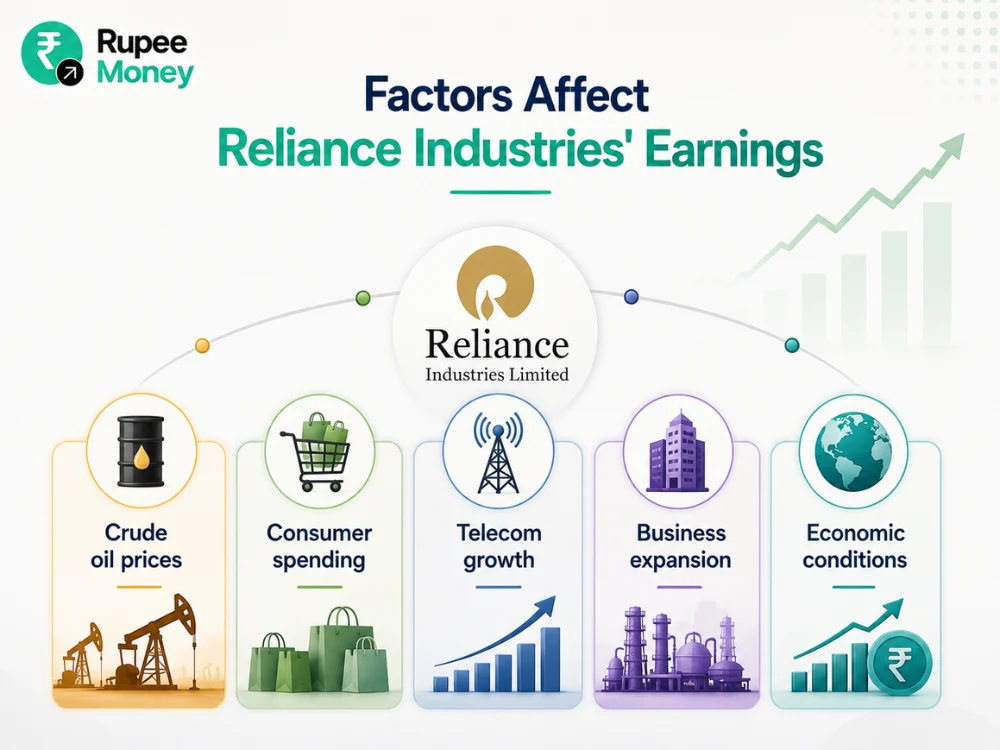
Several business and economic factors shape Reliance’s financial performance directly.
Crude oil prices affect the O2C business immediately and directly. Shifts in refining margins can swing profitability meaningfully within a single quarter.
Consumer spending benefits Reliance Retail whenever it rises. Customers then purchase more across its stores and digital platforms together.
Telecom growth supports Jio Platforms’ revenue directly. More mobile subscribers, broadband users, and enterprise customers all add up.
Business expansion creates fresh growth opportunities constantly. New retail stores, digital services, and renewable energy investments all count here.
Economic conditions shape nearly everything else indirectly. A strong economy generally lifts business activity, consumer demand, and corporate investment together, benefiting several Reliance segments at once.
Why Investors Closely Watch Reliance Industries Shares
Reliance carries genuinely significant weight in major Indian stock market indices. Given its size, Reliance shares often move benchmark indices like the Nifty 50 directly. As of June 2026, the company’s market capitalisation stood near ₹17.8 lakh crore.
Investors regularly track quarterly financial results and revenue growth closely. Net profit, expansion plans, and retail performance all draw attention too. Jio subscriber growth, renewable energy investments, and future strategy round out the watch list. Long-term investors generally treat Reliance as a genuinely diversified business, not a single-sector company.
Key Takeaways on Reliance Industries’ Business Model
- Reliance has evolved from an energy-focused company into a genuinely diversified business group.
- FY2025-26 revenue hit a record ₹11.7 lakh crore, up 10% year-on-year.
- Jio and Retail together now contribute over 55% of total EBITDA.
- Jio crossed 515 million subscribers, with 5G traffic exceeding half of total usage.
- O2C remains important, but no longer dominates earnings the way it once did.
- Diversification helps the company perform more consistently across economic cycles.
Understanding how Reliance earns money helps you evaluate its long-term growth story properly. That matters more than reacting to short-term share price swings alone.
Frequently Asked Questions (FAQs)
What is the biggest source of income for Reliance Industries?
Reliance earns revenue across several segments together. O2C has historically contributed a large share through refining and petrochemicals. Reliance Retail and Jio Platforms, though, have grown rapidly, together contributing over 55% of FY2026 EBITDA. This diversified model reduces dependence on any single income source.
How does Reliance Jio make money?
Jio earns through prepaid and postpaid mobile plans, broadband subscriptions, and enterprise solutions. Digital platforms and technology services add further revenue streams. Millions of customers pay recurring monthly charges, creating stable, predictable income as digital adoption keeps growing across India.
Why is Reliance Retail important for Reliance Industries?
Reliance Retail runs nearly 20,000 stores across India, serving millions of customers yearly. It earns revenue selling groceries, electronics, fashion, and private-label brands. Its large customer base and expanding network make it one of the company’s fastest-growing segments.
Does Reliance Industries still depend mainly on oil?
Not really anymore. While O2C remains genuinely important, Reliance has diversified significantly over the past decade. Retail, telecom, and digital services now drive over half of total EBITDA, making the company considerably more resilient to swings in global energy markets.
Why do investors closely follow Reliance Industries?
Reliance ranks among India’s largest listed companies by market capitalisation. Its performance influences major stock indices and reflects trends across multiple sectors at once. Investors track its quarterly earnings, digital growth, retail performance, and energy investments to gauge future prospects.
Conclusion
Reliance Industries has genuinely transformed from an energy-focused company into a diversified business group. Its FY2025-26 results, record revenue, strong EBITDA growth, and Jio and Retail driving over half of earnings, tell that story clearly. Understanding this business model helps you judge whether Reliance fits your own investment thesis, rather than just chasing its stock price. If you’re building a broader investing foundation, Building Wealth in Your 20s pairs well with company research like this. Curious how a metric like Return on Assets applies to a company this size? It’s worth reading alongside this guide. And if you’d rather invest in large companies like Reliance through a fund instead of individual stock picking, What Is SIP? explains that route well. Try the SIP Calculator to estimate regular equity fund investing, the Lumpsum Calculator for a one-time investment, or the FD Calculator to compare equity investing against a fixed-income alternative.
Disclaimer: This article is for educational and informational purposes only. It does not provide investment advice or recommend buying or selling Reliance Industries shares. Business performance, financial results, and market conditions can change over time. Always review the company’s latest annual reports, quarterly results, and official disclosures before making any investment decision. Consult a qualified financial advisor if you need personalised investment guidance.
ABOUT THE AUTHOR

