
How Does BEL Make Money? Bharat Electronics Business Model Explained
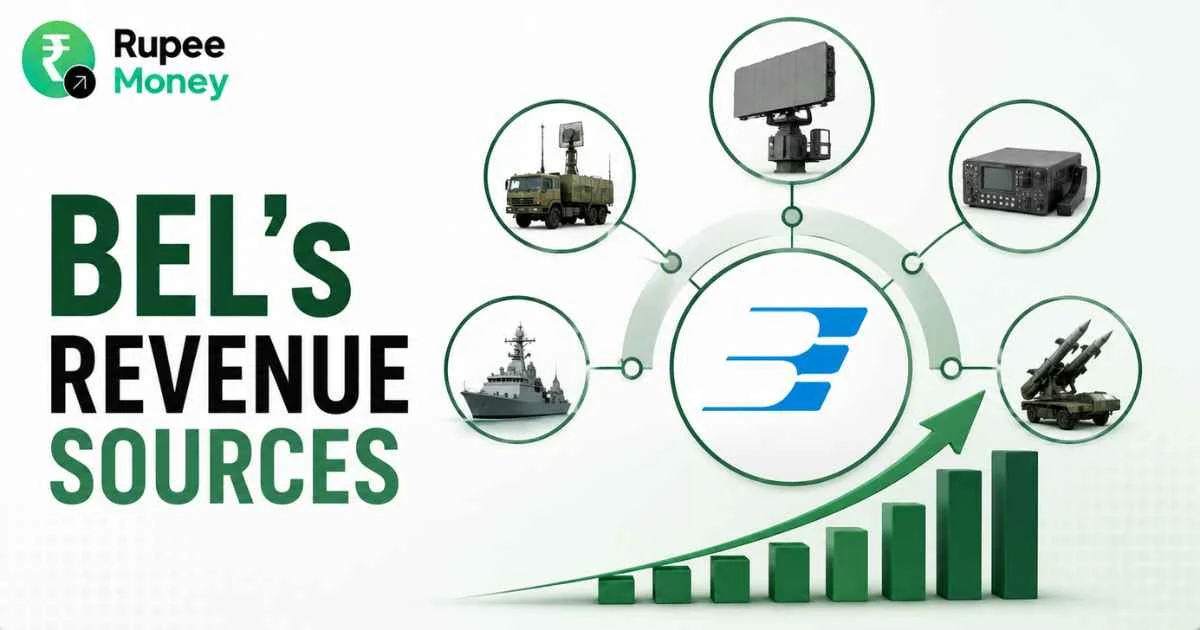
A radar detects an aircraft. A communication system connects soldiers. An electronic warfare system identifies hostile signals. Behind many of these critical systems stands Bharat Electronics Limited, or BEL.
But how does a defence electronics company actually make money? BEL earns revenue mainly by designing, manufacturing, and supplying advanced electronics and systems. It also earns from exports, upgrades, maintenance, spares, and services. The company serves India’s defence forces while steadily expanding into non-defence markets too.
At RupeeMoney, we believe understanding a company’s revenue model matters just as much as tracking its share price. BEL’s business has drawn real attention as India ramps up defence spending and domestic manufacturing. The company reported revenue from operations of ₹27,479.63 crore in FY2025-26, up 16.15% from ₹23,658.01 crore the year before. Its FY2025-26 profit after tax reached ₹6,048.48 crore. It entered FY2026-27 with an order book worth ₹72,258 crore as of July 1, 2026.
So where does this money actually come from? Let’s understand BEL’s business model in simple terms.
How Does BEL Make Money?
BEL makes money by selling defence electronics, systems, and related services. The company works across several technology-intensive areas, supplying the Army, Navy, Air Force, and other government organisations. It also sells selected products to civilian customers.
Revenue flows through several major channels: defence product sales, non-defence product sales, and system integration work. Exports add to this too, alongside maintenance, after-sales services, upgrades, modernisation, and spare parts.
BEL’s annual report describes product sales as its primary revenue source, with services and exports adding further income. Its value chain spans research, design, manufacturing, systems integration, project execution, and after-sales support. This gives BEL several distinct ways to monetise its technical capabilities.
BEL’s Defence Business Drives Core Revenue
Defence electronics forms the core of BEL’s business. The company develops and manufactures systems used across different military platforms. Its portfolio spans radars, communication systems, electronic warfare equipment, and avionics. BEL also supplies equipment for naval and land-based defence applications.
The company works with government defence organisations on large contracts that can run across multiple years. This gives BEL real visibility into future revenue once it wins major orders.
Radar and Fire Control Systems
Radars form an important part of modern defence systems. BEL develops radar and fire control technologies for different applications, helping detect, track, and identify targets. The company also supplies air defence radar solutions, with recent orders including mountain radars and air defence-related systems. Radar and fire control technology remains a major R&D focus area for BEL.
Communication Systems
Military operations need secure, reliable communication. BEL develops communication equipment supporting both tactical and strategic requirements, and the company regularly receives orders for communication networks. Communication equipment appears frequently among BEL’s recent domestic and export orders too.
Electronic Warfare and Avionics
Electronic warfare represents another major technology area for BEL. These systems help armed forces detect, monitor, and respond to electronic signals. BEL also develops avionics for aircraft and other platforms, with recent orders including electronic warfare systems and avionics equipment.
Weapon and Platform Electronics
BEL also supplies electronics used within military platforms, including tank electronics and gun upgrades. The company works on fire control and sighting systems too. This lets it participate across different parts of a defence platform, rather than depending on one product category.
How BEL Earns From Non-Defence Business
BEL doesn’t depend entirely on military orders. The company has gradually expanded into civilian and strategic non-defence markets, supplying communication equipment, airport surveillance radars, and software solutions. It has also worked on automatic train supervision systems and electronic voting machines, plus IT infrastructure for institutions like AIIMS.
This diversification gives BEL another genuine revenue source. It also lets the company reuse its existing engineering and manufacturing capabilities across different industries.
How BEL Makes Money From Exports
BEL also earns revenue by selling products and systems outside India. The company supplies defence electronics and related technologies to international customers, and its exports have grown alongside the domestic business.
For FY2025-26, BEL reported export sales of approximately US$141.9 million, up 33.65% from about US$106.17 million the year before. The company secured export orders worth US$346 million during FY2025-26. Its export order book stood at roughly US$495 million as of April 1, 2026. Exports therefore provide both current revenue and future business visibility. The company also targets communication equipment and satellite communication networks for overseas markets.
How BEL Makes Money From Services, Upgrades, and Spares
Selling equipment isn’t the only way BEL generates revenue. Complex defence systems need maintenance and support throughout their operating life, so BEL provides after-sales services and technical support. The company maintains service centres near customers and supplies spare parts for critical systems.
These activities generate revenue well after the original equipment sale, helping BEL maintain long-term customer relationships. Technology also changes rapidly, and military platforms often need upgraded electronics, software, and communication systems. Recent BEL orders have regularly included upgrades, spares, and services. This creates a genuinely recurring element within a business that otherwise leans on large project orders.
How BEL Uses R&D to Drive Revenue
R&D plays a central role in BEL’s business model. The company develops new technologies internally and through partnerships, currently employing more than 2,600 R&D engineers and scientists.
BEL states that indigenously designed and manufactured products generate around 80% of its annual revenue. Its R&D spending has stayed between 6.25% and 7.50% of sales turnover over the past five years. This matters because defence customers increasingly want locally developed technology. BEL can use its R&D capabilities to build products for new defence requirements. Successful products then become future commercial orders, creating a direct link between research spending and revenue.
BEL’s Business Model: From Order to Revenue
BEL’s business model follows a fairly straightforward cycle. It begins with a customer requirement, where a defence organisation or government entity identifies a technology need. BEL then participates in a tender or receives an order through the applicable procurement process.
The company designs, develops, or manufactures the required system, then integrates and delivers the equipment. BEL can later earn additional revenue through upgrades, spares, and services. The cycle looks like this: customer requirement → order → design → manufacturing → delivery → upgrades and services. This model explains why BEL’s order book matters so much to investors.
Why BEL’s Order Book Matters
An order book represents contracts the company has received but hasn’t yet recognised as revenue. BEL’s order book stood at ₹72,258 crore as of July 1, 2026. That’s more than twice its FY2025-26 revenue from operations.
A large order book never guarantees future profit, but it gives investors a real indication of potential business ahead. BEL keeps winning new orders too. It secured additional orders worth ₹572 crore in July 2026 alone, covering communication equipment, avionics, and encryptors. Tank subsystems, EVMs, batteries, upgrades, and spares rounded out this batch. Understanding how market capitalisation gets calculated can help you weigh this order book against the company’s current market value too.
BEL’s Financial Performance in 2026
BEL entered FY2026-27 with strong operating momentum. Q1 FY2026-27 revenue from operations reached ₹5,533.06 crore, up 25.27% from ₹4,416.83 crore in Q1 FY2025-26. The company reported PAT of ₹1,048.33 crore for the quarter, up 8.17% year-on-year.
These numbers show BEL continuing to grow while maintaining a substantial future order pipeline behind it.
What’s Driving BEL’s Growth?
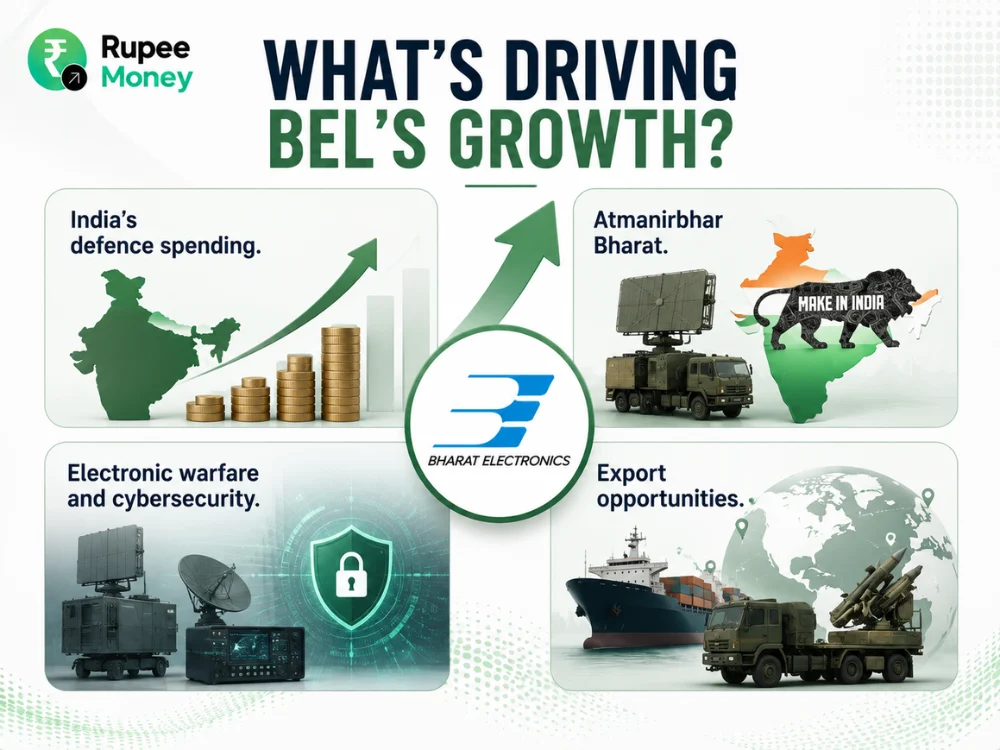
Several factors shape BEL’s future revenue outlook.
India’s defence spending. India keeps focusing on strengthening domestic defence capabilities, creating real opportunities for Indian defence electronics companies. BEL benefits from its established position within this ecosystem.
Atmanirbhar Bharat. India wants to reduce dependence on imported defence equipment, and this policy direction favours domestic manufacturers directly. BEL’s indigenous product development supports this goal, with roughly 80% of annual revenue already coming from indigenously designed products.
Electronic warfare and cybersecurity. Modern warfare increasingly depends on electronics and information, making secure communications and cybersecurity strategically important. BEL has identified these as future growth areas, alongside artificial intelligence and autonomous platforms.
Export opportunities. BEL’s growing export order pipeline could diversify its revenue base further, and international sales can scale existing technologies too. Exports still carry real regulatory, geopolitical, and execution risk, though.
What Are the Risks to BEL’s Business?
BEL operates in a specialised industry, and its business depends heavily on government and defence spending. Several risks can shape future performance.
Order execution risk. Large contracts require timely manufacturing and delivery on schedule.
Government dependency. A major portion of BEL’s business comes from government and defence customers specifically.
Supply chain risk. Component delays can affect production schedules directly.
Technology risk. Defence technology changes quickly, requiring continuous adaptation.
Export risk. International business faces genuine geopolitical and regulatory challenges.
Competition. Other Indian and global defence companies compete for the same contracts.
Working capital. Large projects can involve significant receivables and execution requirements. Before investing in any large PSU like BEL, check metrics like Return on Assets (ROA). It helps you judge how efficiently the company deploys capital.
Key Takeaways
BEL makes money from much more than just selling defence equipment. Its revenue model combines products, services, exports, upgrades, and spares together. The defence business remains its core engine. Non-defence operations add real diversification, while exports open opportunities beyond India’s domestic market. R&D supports the development of new products, and a large order book gives investors visibility into potential future revenue.
The latest numbers show continued growth. FY2025-26 revenue reached ₹27,479.63 crore, and Q1 FY2026-27 revenue rose 25.27% year-on-year. For investors, the bigger question goes beyond revenue alone. Profitability, cash flows, order execution, and valuation all deserve equal attention.
Conclusion
BEL’s business model rests on a fairly simple idea. The company develops technology that defence and strategic customers genuinely need. It then earns money by manufacturing, integrating, and delivering those systems. After delivery, BEL earns additional revenue through services, upgrades, and spares, while exports and non-defence products add further growth opportunities.
The next phase of BEL’s growth depends heavily on execution. Defence spending, indigenisation, exports, and emerging technologies can all create real opportunities. Investors should still weigh valuation, government dependence, and execution risk alongside these. If you’re researching large-cap PSU stocks, our guide to large-cap mutual funds offers a diversified alternative. Understanding how BEL makes money gives you a clearer picture before studying the stock further. Building this kind of research habit early pays off. Our guide on building wealth in your 20s covers exactly that. Our SIP Calculator can also show how disciplined, regular investing grows over time.
FAQs
How does BEL make money?
BEL earns money mainly by designing, manufacturing, and selling defence electronics and systems. This includes radars, communication systems, electronic warfare equipment, and avionics. It also earns from non-defence products, exports, upgrades, spares, and after-sales services.
What is the main source of BEL's revenue?
Defence products form the core of BEL's business, supplying electronics and systems to India's defence forces and government organisations. Product sales represent its primary revenue source, with services, exports, upgrades, and spares adding further income streams.
Does BEL make money from exports?
Yes. BEL exports defence electronics, communication equipment, and other specialised products. It reported approximately US$141.9 million in export sales during FY2025-26, up 33.65% year-on-year. Its export order book stood near US$495 million as of April 2026.
Does BEL have a non-defence business?
Yes. BEL has expanded into airport surveillance radars, communication equipment, software solutions, and railway systems. It has also supplied IT infrastructure and electronic voting machines. This helps the company use its technology capabilities beyond traditional defence contracts.
Why does BEL carry such a large order book?
BEL operates in an industry where customers often place large, multi-year contracts. Since the company recognises revenue only as it executes these contracts, new orders sit in the order book first. BEL's order book stood at ₹72,258 crore as of July 1, 2026. Execution still determines whether it converts into actual profit.
Does BEL earn recurring revenue?
BEL doesn't operate like a subscription software company, but it does generate repeat business through upgrades, maintenance, spares, and services. Defence equipment needs support throughout its operating life. BEL's service centres create additional revenue well after the original equipment sale.
Defence products form the core of BEL’s business, supplying electronics and systems to India’s defence forces and government organisations. Product sales represent its primary revenue source, with services, exports, upgrades, and spares adding further income streams.
BEL operates in an industry where customers often place large, multi-year contracts. Since the company recognises revenue only as it executes these contracts, new orders sit in the order book first. BEL’s order book stood at ₹72,258 crore as of July 1, 2026. Execution still determines whether it converts into actual profit.
BEL doesn’t operate like a subscription software company, but it does generate repeat business through upgrades, maintenance, spares, and services. Defence equipment needs support throughout its operating life. BEL’s service centres create additional revenue well after the original equipment sale.
Disclaimer: This article provides educational information about Bharat Electronics Limited and its business model. It does not constitute financial, investment, tax, or stock market advice. Company financials, order books, and market valuations can change over time. Verify the latest financial statements and regulatory filings before making any investment decisions. RupeeMoney does not recommend buying or selling any particular stock.
ABOUT THE AUTHOR

