
What Happens When a Company Gets Delisted? A Guide for Indian Investors
Imagine you own 100 shares of a company today. Tomorrow, you find out the company no longer trades on NSE or BSE. Your shares do not automatically turn worthless. Selling them, however, can become much harder.
This is what happens when a company gets delisted from a stock exchange. At Rupeemoney, we often see investors panic the moment this news breaks. This guide explains exactly what delisting means, why it happens, and what you should do next. Want more context on listed versus unlisted markets? Our guide on unlisted shares and their risks is a useful starting point.
What Does Delisting of Shares Actually Mean?
Delisting means the permanent removal of a company’s shares from a recognised stock exchange. Once this takes effect, you cannot trade those shares through the regular exchange platform.
The company itself can keep operating even after delisting. So delisting does not automatically signal that the business has shut down. SEBI’s Delisting of Equity Shares Regulations, 2021, govern this entire process in India.
Why Do Companies Get Delisted?
Companies leave the stock market for several different reasons. Promoters sometimes want tighter control over the business. They may feel public listing no longer offers enough benefit for the compliance cost involved.
Regulatory non-compliance can also force a company off the exchange. Financial or operational trouble sometimes plays a role too. Never assume every delisted company faces financial distress, though. The specific reason behind each delisting matters far more than the label itself.
Voluntary Delisting vs Compulsory Delisting
Start by identifying which type of delisting applies to your stock.
Voluntary Delisting
Voluntary delisting happens when a company or its acquirer chooses to exit the exchange. Promoters typically propose to buy shares back from public shareholders. Eligible shareholders then get a defined opportunity to exit. SEBI’s regulations set out the entire procedure, covering approvals, announcements, bidding, and payment.
Compulsory Delisting
Compulsory delisting happens when an exchange removes a company for regulatory or listing failures. Persistent non-compliance usually triggers this outcome. Investors generally face a tougher experience here than in voluntary delisting. NSE maintains a public list of compulsorily delisted companies through its dissemination mechanism.
What Happens to Your Shares After Delisting?
Your shares do not vanish from your demat account. The real question is whether you get a proper exit opportunity.
In a successful voluntary delisting, the promoter or acquirer offers a defined exit route. You can tender your shares through the prescribed process and receive the agreed payment. If you skip this step, you keep holding the shares. They simply stop trading normally on the stock exchange. This creates a real liquidity problem, since finding another buyer becomes much harder afterward.
How Does SEBI Decide the Delisting Price?
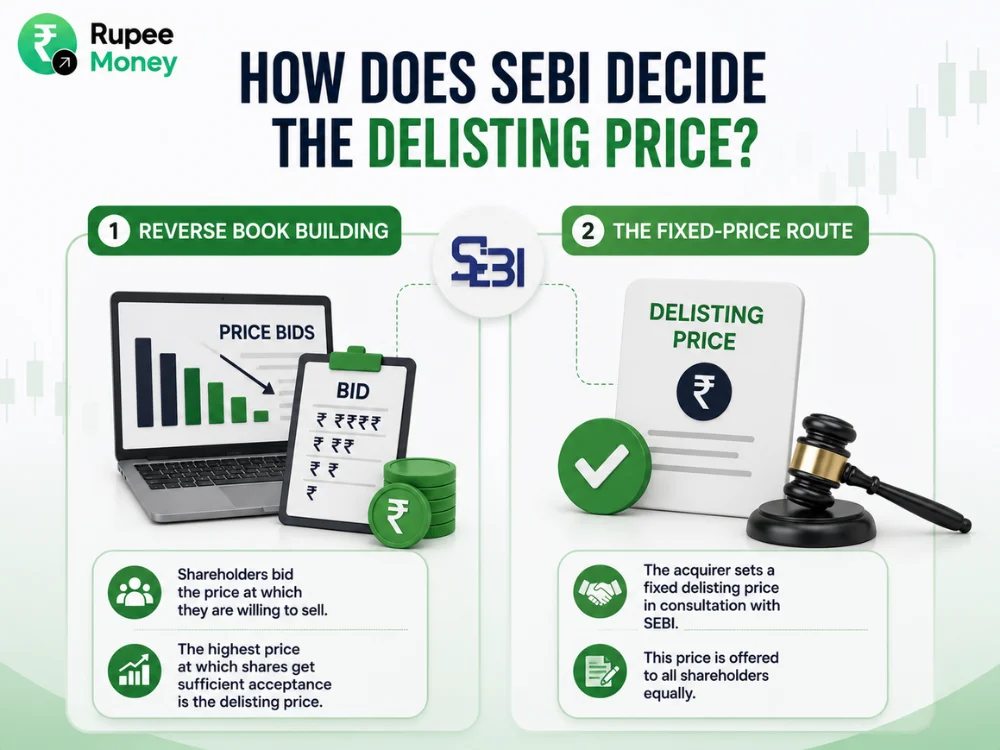
SEBI’s framework offers two main routes to determine the exit price.
Reverse Book Building
Under reverse book building, eligible shareholders submit bids at prices they find acceptable. This process runs during a fixed bidding window and helps discover a market-driven price. Do not confuse this with an IPO’s book-building process. Here, existing shareholders are seeking an exit, not new investors seeking entry.
The Fixed-Price Route
SEBI introduced a fixed-price mechanism through its 2024 amendments. Under this route, the acquirer sets a predetermined delisting price upfront. That price must carry at least a 15% premium over the calculated floor price. This route only applies to companies whose shares trade frequently. It gives promoters a faster alternative to the older bidding process.
Always read the specific public announcement for your stock. It will confirm which price mechanism applies to your situation.
Can You Sell Shares After Delisting?
Selling becomes considerably harder once a stock delists. You cannot use regular NSE or BSE trading for these shares anymore.
Compulsorily delisted companies can appear on an exchange dissemination board. NSE and BSE both run this mechanism. It lets buyers and sellers place matched orders outside the normal trading system. This route offers far less convenience than standard exchange trading, though. You may need to find interested buyers on your own, and pricing can become unpredictable. Understand this exit process fully before you continue holding a stock through delisting.
Delisting vs Bankruptcy: Know the Difference
Delisting and bankruptcy do not mean the same thing. A company can delist voluntarily while running a completely healthy, profitable business. Bankruptcy involves genuine financial distress and a separate legal process altogether.
Always identify the real reason behind a delisting before you react. Do not treat every delisted company as a failed business by default.
Is Delisting Good or Bad for Investors?
The outcome varies from one situation to another. A voluntary delisting offer can sometimes hand you a real premium over the market price. Investors who tender their shares on time can walk away with a solid return.
Investors who hold on, though, can face limited liquidity afterward. Compulsory delisting tends to create even greater uncertainty for shareholders. Judge every delisting offer on its own terms, valuation, and exit price. Do not assume that delisting always works in your favour, or always works against you.
What Should You Do If Your Stock Gets Delisted?
Avoid making a rushed decision the moment you hear the news. First, confirm whether your company faces voluntary or compulsory delisting. Read the official exchange announcement carefully, and check the proposed exit price and key dates. Review the eligibility rules before you tender your shares.
Keep copies of every tender form and transaction record you submit. Monitor your demat account through the entire process. If your stock stays unlisted, plan for the real difficulty of selling it later. Diversifying elsewhere can also soften the blow. Our guide on building wealth in your 20s covers long-term portfolio habits worth adopting early.
Latest SEBI Delisting Rules in 2026
SEBI’s Delisting of Equity Shares Regulations, 2021, remain the core framework, and the regulator last amended them on September 3, 2025. That amendment added special delisting provisions for public sector undertakings. It requires a fixed-price process with at least a 15% premium over the floor price.
The broader 2024 amendments still apply to regular companies too. They introduced the fixed-price delisting route as an alternative to reverse book building. Rules like these change fairly often, so avoid relying on old articles. Always check SEBI’s latest notification before you make a final decision.
How to Protect Your Portfolio From Delisting Risk
Consider liquidity carefully before you buy any stock, not just after a problem appears. A strong business today does not remove every future investment risk. Corporate actions like buybacks, mergers, or delisting can all change your position overnight. Our explainer on why companies buy back their own shares covers one related corporate action worth understanding.
Monitor company announcements and exchange filings regularly. Spread your money across companies and sectors instead of concentrating risk in one stock. Our guide on portfolio diversification walks through practical ways to do this. Diversification cannot prevent every loss. It can, however, reduce how badly one company’s surprise affects your overall portfolio.
Got a sudden exit payout to reinvest? The Lumpsum Calculator can help you plan where that money goes next. Investors who prefer steady, disciplined investing instead can explore the SIP Calculator to rebuild their portfolio gradually.
Key Takeaways
- Delisting removes a company’s shares from a stock exchange permanently.
- Your shares stay in your demat account, but trading becomes far harder.
- Voluntary delisting usually offers a structured, priced exit route.
- Compulsory delisting creates greater uncertainty and liquidity risk.
- SEBI allows reverse book building or a 15%-premium fixed-price route.
- Delisting and bankruptcy are two completely different situations.
- Diversification helps limit the damage from any single delisting event.
Conclusion
A company getting delisted does not automatically make your shares worthless. The outcome depends on the type and reason for delisting. Voluntary delisting generally provides a structured exit opportunity. Compulsory delisting can create greater liquidity and recovery challenges. Investors should check the official exchange announcement before taking action. They should understand the exit price, tendering process, eligibility, and deadlines. Most importantly, investors should never ignore a delisting announcement. A timely decision can make a significant difference to the eventual outcome.
Frequently Asked Questions
1. What happens to my shares when a company gets delisted?
Your shares stay in your demat account unless you tender them during an exit process. They stop trading on the regular stock exchange, though. You may get an exit opportunity during voluntary delisting, but holding on afterward means owning largely illiquid, unlisted shares.
2. Can I sell shares after a company gets delisted?
Not through normal NSE or BSE trading. Certain compulsorily delisted shares appear on an exchange dissemination board instead. This offers far less liquidity than regular trading, so you may need to find a buyer independently.
3. Do I lose all my money if a company gets delisted?
No, delisting does not automatically wipe out your investment. A voluntary delisting can offer a real exit price to shareholders. If you retain your shares instead, you continue owning the company privately, though selling later becomes difficult.
4. Is delisting good for shareholders? It depends entirely on the terms. A promoter may offer a genuine premium over the market price, which benefits shareholders who exit. Investors who hold on can face serious liquidity problems, so always judge the specific offer on its own merits.
5. How is the delisting price decided in India?
SEBI allows two main routes. Shareholders can use reverse book building to submit exit bids. Alternatively, they can accept a fixed-price offer carrying at least a 15% premium over the floor price. The company’s public announcement will specify which mechanism applies.
6. Can a delisted company get relisted later?
Yes, but only after meeting strict conditions. SEBI generally requires a minimum three-year cooling-off period before a delisted company can seek relisting. Treat any future relisting as uncertain, and base your decisions on today’s situation instead.
Disclaimer: This article provides general educational information for Indian investors and does not constitute investment, legal, or tax advice. Delisting rules, timelines, and price mechanisms can change through SEBI or exchange amendments. Please verify the latest requirements from SEBI, NSE, BSE, and the company’s official announcements before taking any action. Past exit prices or delisting outcomes never guarantee future results. Rupeemoney does not provide personalised investment advice or guarantee any financial outcome. All figures and regulatory references in this article reflect publicly available information as of August 2026.
ABOUT THE AUTHOR

