
Why Do Banking Stocks React to RBI Announcements? Understanding RBI Policy and Banking Shares
Every time the Reserve Bank of India (RBI) announces its monetary policy, banking stocks react instantly.
Sometimes Bank Nifty rallies right after the press conference. At other times, banking shares fall even when interest rates remain unchanged.
Many retail investors find these sudden price swings confusing. However, the underlying reason remains simple.
RBI policy decisions directly dictate how commercial banks borrow money, lend to customers, generate profits, and manage liquidity.
At RupeeMoney, we help you understand financial market movements so you can make informed decisions. Knowing how central bank policies shape bank earnings helps you interpret market volatility with confidence.
In this guide, you will learn why banking stocks react to RBI announcements, how policy tools affect profits, and what drivers move Bank Nifty.
What Are RBI Monetary Policy Announcements?
The Reserve Bank of India announces its monetary policy through the Monetary Policy Committee (MPC). The MPC meets periodically throughout the year to review national economic conditions.
The RBI balances several core economic goals during every meeting:
- Controlling price inflation across consumer markets
- Supporting sustainable national GDP growth
- Maintaining stability across the financial system
- Managing overall liquidity in commercial banking channels
Key policy disclosures during an MPC meeting include:
- Repo Rate: The key rate for central bank lending.
- Standing Deposit Facility (SDF): The rate for absorbing excess bank liquidity.
- Cash Reserve Ratio (CRR): The mandatory cash balance reserved with the RBI.
- Statutory Liquidity Ratio (SLR): Mandatory investments in liquid government securities.
- Economic Growth Forecasts: Inflation and GDP growth projections.
Each official statement reshapes investor expectations regarding future bank earnings and credit growth.
Core Reasons Why Banking Stocks React to RBI Policy
Commercial banks operate differently from standard manufacturing or technology companies. A bank’s core revenue depends on interest rate spreads and available financial liquidity.
When the RBI alters monetary settings, banks adjust their operational parameters:
- Home, auto, and business lending rates
- Savings and fixed deposit interest rates
- Interbank short-term borrowing costs
- Overall credit expansion and loan growth
Investors continuously estimate how these operational shifts affect corporate earnings. Consequently, bank share prices move as market expectations adjust.
Market prices react to future guidance as well as current rate changes. Even when rates stay flat, subtle shifts in policy tone trigger market reactions.
How the RBI Repo Rate Impacts Commercial Bank Shares
The Repo Rate represents the interest rate commercial banks pay when borrowing short-term funds from the RBI. It acts as the primary benchmark for credit pricing across India.
Impact of a Repo Rate Increase
When the RBI raises the Repo Rate, borrowing funds becomes more expensive for commercial banks.
Higher funding costs reduce profit margins if banks fail to pass rate hikes to borrowers quickly. As loan interest rates rise, consumer demand for home and vehicle loans cools down.
When evaluating credit risk, borrowers compare fixed and floating options. Learn more by reading our breakdown on choosing between a fixed vs floating interest rate.
However, agile banks with strong deposit bases can expand margins during rate hikes. Therefore, not all banking shares react identically.
Impact of a Repo Rate Cut
When the RBI cuts the Repo Rate, commercial banks access central bank capital at lower costs.
Lower funding expenses allow banks to offer cheaper loans to businesses and individuals. Affordable credit stimulates borrowing, expanding total loan portfolios across retail and commercial segments.
Investors view rate cuts as positive drivers for economic growth. Banking stocks often rally when markets anticipate sustained credit expansion.
You can learn how central bank benchmark rates operate in our guide on what is the repo rate.
How Net Interest Margin (NIM) Drives Bank Stock Valuations
Net Interest Margin (NIM) serves as a primary driver of banking profitability.
Net Interest Margin = Interest Earned on Loans -Interest Paid on Deposits
RBI policy changes directly alter lending yields and deposit costs. If a bank raises loan rates faster than deposit rates, its NIM expands, boosting quarterly net profits.
Conversely, if deposit costs rise faster than lending income, profit margins compress. Investors recalculate NIM projections immediately following every RBI announcement.
How CRR and SLR Rules Influence Banking Liquidity
Beyond interest rates, the RBI manages commercial bank liquidity through reserve ratios:
Cash Reserve Ratio (CRR)
CRR defines the percentage of customer deposits that commercial banks must hold as cash with the RBI. Banks earn zero interest on these required cash reserves.
- Higher CRR: Reduces deployable lending capital, slowing credit expansion and dampening profit expectations.
- Lower CRR: Releases cash back to commercial banks, increasing lending capacity and supporting earnings.
Statutory Liquidity Ratio (SLR)
SLR requires banks to hold a minimum percentage of deposits in approved liquid assets, primarily sovereign government securities.
Changes in SLR dictate how much capital banks allocate toward private sector lending versus government bonds.
How RBI Liquidity Operations Affect Banking Shares
Systemic liquidity describes the volume of cash available for daily commercial banking operations.
During tight liquidity periods, banks compete for deposits, raising funding costs. When liquidity is abundant, banks access capital easily, supporting loan growth.
The RBI manages system liquidity using targeted tools:
- Open Market Operations (OMO) bond purchases and sales
- Variable Rate Repo (VRR) and Reverse Repo auctions
- Standing Deposit Facility (SDF) windows
Clear liquidity support from the RBI boosts market confidence across the banking sector.
Which Banking Stocks Experience the Highest Volatility?
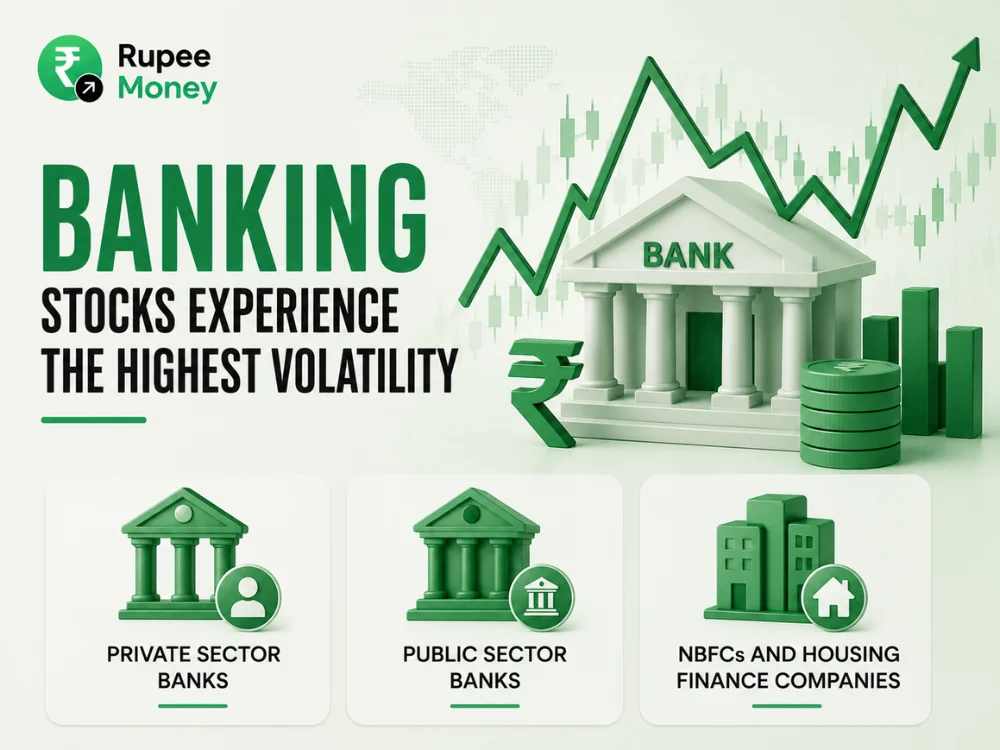
Policy announcements affect different financial institutions in distinct ways:
- Private Sector Banks: Highly sensitive to NIM projections, retail credit growth, and short-term valuation shifts.
- Public Sector Banks (PSUs): React to rate changes alongside government capital allocation plans and treasury portfolio valuations.
- NBFCs and Housing Finance Companies: Non-Banking Financial Companies depend heavily on commercial bank borrowings, making their stock prices sensitive to systemic interest rate trends.
Understanding company size and market weight helps investors analyze price movements. Learn how market indices group companies by reading how market capitalization is calculated.
To calculate how interest rate adjustments impact your personal property loans, use our Home Loan Calculator to project monthly installment scenarios.
Why Bank Nifty Moves Sharply on RBI Policy Days
Bank Nifty tracks the performance of India’s largest listed banking institutions. Because banking shares carry heavy weightings in broader indices like the Nifty 50, sector movements drive overall stock market trends.
On MPC policy announcement days, institutional investors adjust portfolios based on fresh economic data, inflation projections, and interest rate guidance. This concentrated trading volume creates intraday volatility across Bank Nifty.
You can learn more about share price fluctuations in our detailed guide explaining why are some stocks more volatile than others.
Other Critical Policy Signals Investors Track
Rate decisions capture headlines, but professional investors analyze additional RBI disclosures:
- Inflation Projections: High consumer price inflation increases the probability of future interest rate hikes. Understand consumer price dynamics through our analysis of what is inflation and why does it matter.
- GDP Growth Forecasts: Upward GDP revisions signal strong business activity and robust future loan demand.
- Policy Stance and Guidance: The RBI Governor’s commentary clarifies whether monetary policy will remain hawkish, dovish, or neutral.
To estimate your monthly payments under changing interest rate environments, try our user-friendly EMI Calculator.
Should You Trade Banking Stocks Before RBI Announcements?
Attempting to trade banking shares immediately ahead of RBI announcements carries significant risk.
Stock prices often price in expected rate adjustments days before the meeting. Even if the RBI delivers an expected rate cut, banking shares may drop if traders sell on the news.
Long-term investors should focus on core fundamental health rather than short-term policy speculation:
- Non-Performing Asset (NPA) trends
- Capital Adequacy Ratios (CAR)
- Return on Assets (ROA) metrics
- Low-cost CASA deposit ratios
- Digital banking capabilities
Fundamentally strong banks compound shareholder value across entire economic cycles.
To evaluate potential fixed deposit returns under prevailing interest rates, try our online FD Calculator.
Summary Key Takeaways
- Banking stocks react to RBI policy because central bank decisions dictate lending yields, deposit costs, and credit growth.
- Repo Rate hikes increase bank funding costs, while rate cuts stimulate borrowing demand.
- Net Interest Margin (NIM) serves as a primary metric for evaluating bank profitability after rate changes.
- CRR and SLR requirements dictate how much capital banks reserve versus deploy into profitable loans.
- Long-term investors should prioritize balance sheet quality and asset health over short-term policy reactions.
Frequently Asked Questions:
Why do banking stocks react immediately to RBI policy announcements?
Banking stocks react quickly because RBI monetary decisions directly alter commercial bank profit margins, borrowing costs, credit expansion rates, and liquidity settings. Investors recalculate future earnings expectations instantly.
How does a repo rate cut affect bank shares?
A repo rate cut lowers borrowing costs for commercial banks, encouraging credit growth across retail and corporate sectors. Expectations of expanded loan volumes often support banking stock prices.
Why does Bank Nifty experience high volatility during MPC meetings?
Bank Nifty tracks India’s top listed banking institutions. Concentrated institutional buying and selling driven by fresh interest rate decisions, inflation data, and GDP forecasts creates intraday index volatility.
Should investors buy banking stocks right before an RBI meeting?
No. Short-term rate decisions are difficult to trade profitably because market prices frequently reflect expectations beforehand. Long-term investors should evaluate balance sheet health, asset quality, and earnings growth instead.
Conclusion
Banking stocks react to RBI announcements because monetary policy shapes commercial banking profitability, credit demand, funding expenses, and market liquidity.
Repo rate adjustments, reserve ratio tweaks, liquidity operations, and inflation guidance directly influence investor sentiment across the financial sector.
However, short-term policy reactions should not replace fundamental research. Focus on asset quality, low-cost deposit growth, and management efficiency to identify strong banking institutions capable of delivering long-term value.
Before investing in individual banking stocks or financial funds, review core market concepts like what is an IPO to understand how financial entities issue public equity.
Disclaimer: This article is intended for educational and informational purposes only. RBI monetary policy announcements influence the banking sector and overall financial markets, but they should not be the sole basis for investment decisions. Investors should evaluate a bank’s financial performance, asset quality, profitability, valuation, and long-term growth prospects before investing. Conduct your own research or consult a qualified financial advisor before making any investment decision.
ABOUT THE AUTHOR

