
Why Are Some Stocks More Volatile Than Others? Understanding Stock Volatility in the Share Market

Some stocks jump or drop by 8% in one single trading session. Meanwhile, other stocks barely move at all.
This price difference is what investors call stock volatility.
Certain companies experience sudden and sharp price movements daily. Other companies remain steady, even during major market swings.
At RupeeMoney, we help you navigate market price swings with confidence. Understanding stock price volatility helps you make smart decisions without panicking during market dips.
In this guide, you will learn why stock prices fluctuate, how to measure risk, and how to manage volatile shares in your portfolio.
What Is Stock Volatility in the Share Market?
Stock volatility measures how fast and how much a stock price changes over a specific timeframe.
A high volatility stock sees wide price swings within short periods. A low volatility stock shows smaller, gradual price adjustments.
For instance, a share moving between ₹500 and ₹580 in one week has high volatility. A share moving between ₹500 and ₹505 shows low volatility.
Volatility measures the speed and size of price movements. It does not measure whether a business is good or bad.
Key Factors That Cause Stock Price Volatility
No two listed companies operate under identical market conditions. Several key factors cause share prices to rise or fall rapidly.
Quarterly Company Earnings and Financial Results
Quarterly earnings announcements drive sudden stock price movements.
When a company beats market expectations, investors buy aggressively. If quarterly profits fall short, heavy selling pressure follows immediately.
Investors track profit margins, revenue growth, and future debt guidance before trading earnings announcements.
Investor Sentiment and Market Emotions
Share prices often reflect investor emotions as much as financial reports.
Positive market sentiment creates strong buying momentum. Negative sentiment causes investors to sell shares quickly.
Management changes, government policies, legal issues, or international news can alter market sentiment overnight.
Industry Sector Dynamics
Certain business sectors experience higher natural price fluctuations than others.
Technology and AI companies react sharply to fast-paced innovation and competition. Commodity firms fluctuate alongside global crude oil, metal, and raw material prices.
Conversely, defensive sectors like FMCG and healthcare remain relatively stable. Consumer demand for essential goods stays constant during economic downturns.
Macroeconomic factors like rising interest rates also impact capital costs. You can learn how economic shifts influence markets by reading what inflation is and why it matter.
Company Size and Total Market Capitalisation
A company’s total equity scale significantly impacts its daily price swings.
Large-cap companies feature established business models and stable earnings. Consequently, their share prices usually fluctuate less.
Mid-cap and small-cap stocks experience much larger price movements. Their smaller earnings base makes them sensitive to sudden buying or selling volume.
You can learn how stock exchanges group companies by reading our guide on large cap mutual funds.
Trading Volume and Liquidity
Liquidity measures how easily investors buy or sell shares without affecting market price.
High liquidity stocks experience smooth price movements. Buyers and sellers remain active throughout the session.
Low liquidity stocks experience sharp price jumps or drops. Even small buy or sell orders move the share price significantly.
Foreign Institutional Investor (FII) Activity
Foreign Institutional Investors hold massive equity stakes in top Indian corporations.
Large FII buy orders push share prices upward rapidly. Heavy FII selling creates downward pressure across the market.
Because institutional trades involve billions of rupees, FII movements directly trigger short-term market volatility.
Central Bank Policies and Economic Events
National economic events influence almost every listed company on the exchange.
Key drivers include:
- RBI monetary policy updates
- National inflation metrics
- Repo rate revisions
- Gross Domestic Product (GDP) reports
Central bank policy changes alter borrowing costs across the economy. Learn more about central bank rate decisions in our guide on what is the repo rate.
Major Corporate Announcements
Company-specific news creates immediate short-term share price volatility.
Frequent triggers include:
- Dividend declarations
- Bonus share issues
- Share buyback programs
- Mergers and acquisitions
Traders adjust their price expectations instantly following corporate news disclosures.
High Volatility vs. Low Volatility Stocks
Comparing high and low volatility stocks helps you select investments matching your personal risk tolerance.
| Feature | High Volatility Stocks | Low Volatility Stocks |
| Price Movement | Large daily price swings | Small, gradual price movements |
| Risk Level | Higher investment risk | Lower investment risk |
| Return Potential | Higher potential gains | Stable, moderate growth |
| Target Investor | Experienced traders & risk-takers | Conservative & long-term investors |
| Common Examples | Small-cap stocks, emerging tech | Large-cap, blue-chip companies |
Neither option is inherently superior. Your choice depends on your investment horizon and comfort with short-term price swings.
How to Measure Stock Volatility
Investors use specific metrics to calculate how volatile a stock might be:
- Beta Indicator: Beta compares a stock’s price movement against the broader market index. A Beta above 1.0 indicates higher volatility than the market index.
- Historical Price Charts: Reviewing past price performance highlights historical price fluctuations.
- Standard Deviation: Financial analysts use standard deviation to measure how much returns deviate from historical averages.
Is Stock Volatility Good or Bad for Investors?
Stock volatility is neither inherently good nor bad. Its impact depends entirely on your strategy.
For long-term investors, temporary price dips offer attractive buying opportunities in strong companies. For short-term day traders, price swings create quick profit opportunities.
However, trading volatile stocks without proper research increases the risk of capital loss.
How to Manage Stock Volatility in Your Portfolio
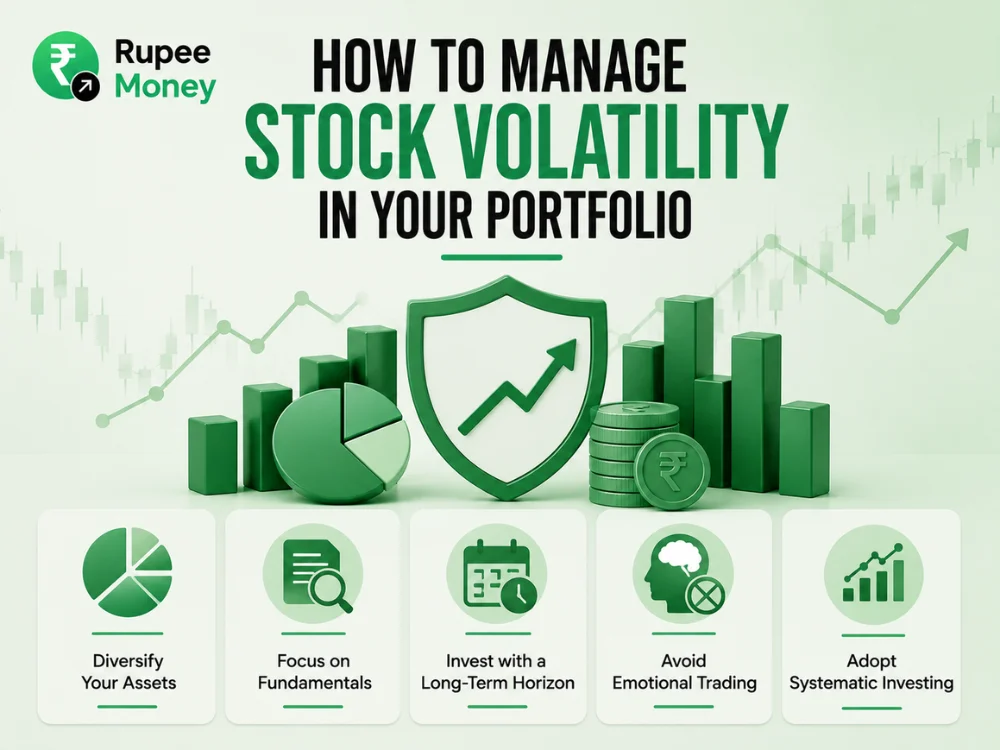
Market fluctuations are inevitable. You can manage risk using disciplined strategies:
- Diversify Your Assets: Spread capital across IT, banking, healthcare, FMCG, and manufacturing sectors.
- Focus on Fundamentals: Evaluate revenue growth, debt ratios, profit margins, and cash flows before investing.
- Invest with a Long-Term Horizon: Short-term swings matter less when you stay invested for several years.
- Avoid Emotional Trading: Fear and greed cause poor trading decisions. Stick to a research-backed strategy.
- Adopt Systematic Investing: Investing fixed amounts regularly averages your purchase cost across market cycles.
If you want to reduce volatility while building wealth, use our SIP Calculator to project your long-term systematic investment growth.
Young investors can explore early wealth creation strategies in our guide to building wealth in your 20s.
Common Myths About Volatile Stocks
Let us debunk common misconceptions surrounding stock volatility:
- Myth 1: Volatile stocks are always bad investments. Fast-growing companies often exhibit higher volatility while scaling up.
- Myth 2: Blue-chip stocks never decline. Large companies also experience price corrections during broader market sell-offs.
- Myth 3: High volatility guarantees higher returns. High price volatility increases risk of both gains and losses.
If you plan to deploy a single lumpsum payment into quality stocks during a market dip, use our Lumpsum Calculator to forecast potential growth.
Summary Key Takeaways
- Stock volatility measures the speed and size of share price changes over time.
- Company earnings, investor sentiment, market cap, and liquidity drive price volatility.
- Small-cap stocks generally exhibit higher volatility than established large-cap companies.
- Beta metrics help investors measure stock risk relative to the broader market index.
- Portfolio diversification and systematic investing protect long-term capital from short-term market swings.
Frequently Asked Questions (FAQs)
What causes some stocks to be more volatile than others?
Differences in quarterly earnings, industry sector trends, trading liquidity, market capitalisation, and institutional trading volume cause price volatility differences among stocks.
Are small-cap stocks more volatile than large-cap stocks?
Yes. Small-cap stocks feature smaller revenue bases and lower trading volumes. Small buy or sell orders trigger larger percentage price moves.
Is high stock volatility bad for long-term investors?
Not necessarily. Short-term price volatility gives long-term investors opportunities to buy quality business shares at discounted valuations.
How can I protect my money from stock market volatility?
You can manage market volatility through asset diversification, investing for long horizons, avoiding emotional trading, and using systematic investment plans.
If you plan to draw a fixed monthly income from your portfolio in the future, use our SWP Calculator to design a systematic withdrawal plan.
Conclusion
Stock volatility reflects normal market price adjustments. Company earnings, market sentiment, liquidity, and macroeconomic factors constantly influence share prices.
High volatility stocks offer rapid growth potential but carry higher capital risk. Low volatility stocks deliver price stability, making them suitable for conservative portfolios.
Focus on fundamental business strength, maintain a long-term perspective, and diversify your assets to navigate market volatility successfully.
Before buying individual stocks or mutual funds, review fundamental market concepts like what is an IPO to understand how companies issue public equity.
Disclaimer: This article is written for educational and informational purposes. Stock volatility is an inherent market characteristic and does not indicate guaranteed returns or losses. Conduct independent research before making financial decisions.
ABOUT THE AUTHOR

