
TCS Business Model: How Tata Consultancy Services Makes Money
Many people know Tata Consultancy Services (TCS) as India’s largest IT company. Millions recognise TCS as a top employer and stock market powerhouse. However, many retail investors still wonder how TCS earns thousands of crores every single year.
Unlike companies selling physical goods, TCS sells technology services and digital solutions. Global banks, healthcare firms, and airlines depend on TCS to manage their daily technology infrastructure.
At RupeeMoney, we help you understand how top Indian companies build massive wealth. TCS serves clients in over 50 countries today. Its smart business model ensures steady cash flows during changing market cycles.
In this guide, you will explore how TCS generates income, its key business segments, and its growth drivers.
What Is Tata Consultancy Services (TCS)?
Tata Consultancy Services is a flagship Indian IT company under the Tata Group. Founded in 1968, TCS delivers software development, business consulting, and digital solutions globally.
TCS provides technology services to key industries:
- Banking and Financial Services
- Healthcare and Life Sciences
- Retail and Consumer Goods
- Telecommunications and Media
- Energy and Utilities
- Travel and Transportation
Instead of selling individual software products, TCS offers long-term business technology management. Young investors studying stock fundamentals often evaluate blue-chip giants like TCS when building wealth in your 20s.
How Does Tata Consultancy Services Earn Revenue?
TCS operates a reliable service-based business model. The company earns money by delivering digital solutions under long-term client contracts.
Diversification protects TCS from industry-specific downturns. The company generates revenue across multiple key business streams:
- IT Services and Infrastructure Management
- Business and Technology Consulting
- Cloud Migration and Management
- Artificial Intelligence and Data Analytics
- Cybersecurity Services
- Engineering and Research Services
- Enterprise Software Implementation
Let us break down each primary revenue stream below
Core TCS Income Sources and Business Segments
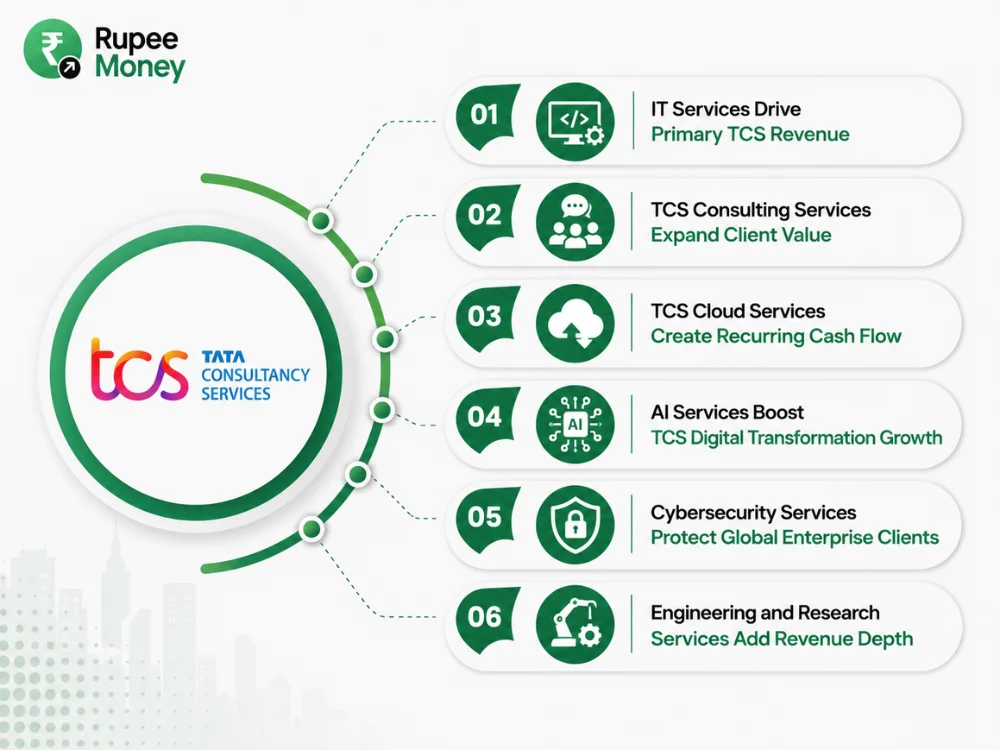
IT Services Drive Primary TCS Revenue
IT services generate the largest share of TCS income. Global corporations rely on massive IT systems to run daily operations. TCS engineers design, build, upgrade, and maintain these enterprise systems continuously.
Key IT service offerings include:
- Custom software development
- Legacy application maintenance
- System integration services
- Data centre operations
- Enterprise IT outsourcing
Clients usually sign multi-year contracts with TCS. These long-term agreements deliver predictable, recurring cash flow year after year.
TCS Consulting Services Expand Client Value
Global companies need expert strategy before upgrading expensive technology. TCS management consultants guide clients through complex digital change.
TCS consulting teams help clients with:
- Modernising outdated IT architectures
- Cutting operational technology costs
- Improving end-user customer experience
- Boosting workplace employee productivity
Consulting projects often start before software installation. Once clients trust TCS advisors, they usually hire TCS to execute the full project.
TCS Cloud Services Create Recurring Cash Flow
Modern businesses move operations onto cloud platforms instead of buying physical servers. TCS helps organizations migrate seamlessly to cloud environments.
TCS cloud solutions cover:
- Cloud infrastructure migration
- Multi-cloud management
- Cloud security protocols
- Hybrid cloud architecture
Cloud management requires ongoing daily oversight. Therefore, cloud contracts generate steady, multi-year recurring revenue for TCS.
AI Services Boost TCS Digital Transformation Growth
Artificial Intelligence transforms how modern companies operate. Organizations deploy AI to automate processes, analyze data, and assist customers.
TCS builds custom AI solutions using:
- Generative AI models
- Machine learning algorithms
- Intelligent process automation
- Predictive data analytics
AI-led digital transformation drives rapid revenue growth for TCS in 2026. Global demand for enterprise AI solutions continues to surge.
Cybersecurity Services Protect Global Enterprise Clients
Rising cyber threats make digital security a top corporate priority. A single data breach causes massive financial damage.
TCS cybersecurity teams provide:
- Real-time threat detection
- Network and data protection
- Identity management access
- Regulatory security compliance
Most clients sign multi-year security contracts. This provides stable revenue while building deep client trust.
Engineering and Research Services Add Revenue Depth
TCS assists global manufacturers with advanced product design and digital engineering.
Engineering solutions focus on:
- Smart product engineering
- Embedded software design
- Internet of Things (IoT) platforms
- Automotive and aerospace software
This segment diversifies TCS income beyond standard corporate IT software management.
Major Industries Serving as TCS Revenue Streams
TCS maintains a well-balanced client portfolio across multiple commercial sectors. Diversification protects overall income when one specific industry faces economic headwinds.
Primary customer segments include:
- BFSI: Banking, Financial Services, and Insurance
- Retail: Consumer packaged goods and retail chains
- Healthcare: Life sciences and hospital networks
- Manufacturing: Automotive, industrial, and aerospace firms
The BFSI segment remains the single largest income contributor for TCS. Global banks rely on TCS software for core banking, online payments, and fraud monitoring.
Investors tracking market leaders often study financial metrics like Return on Assets (ROA) to gauge how efficiently TCS turns capital into profit.
Why Is TCS So Profitable?
TCS consistently reports high profit margins compared to global peers. Several core operational strengths drive this profitability:
- Long-Term Client Contracts: Multi-year agreements create highly predictable revenue streams.
- High Client Retention: Existing clients regularly expand their service contracts with TCS.
- Global Delivery Model: Teams across different time zones deliver round-the-clock service efficiently.
- Tata Group Trust: The strong Tata brand reputation helps TCS win multi-million-dollar global contracts easily.
- Continuous Talent Upskilling: TCS trains hundreds of thousands of employees in new technologies like AI and cloud computing.
If you want to build long-term wealth like top corporate compounders, you can use our SIP Calculator to project your systematic equity investments over time.
Key Growth Drivers for TCS in 2026 and Beyond
Technology evolves rapidly, creating fresh business opportunities for TCS. Major long-tail trends supporting future growth include:
- Generative AI Integration: Enterprise clients need custom AI models to automate complex business workflows.
- Legacy IT Modernisation: Older companies must upgrade outdated legacy systems to stay competitive.
- Cloud Cost Optimisation: Companies hire TCS to manage and optimize their cloud spending.
- Next-Gen Cybersecurity: Expanding digital footprints require advanced threat protection systems.
Retail investors comparing market leaders often evaluate top-tier IT companies through large cap mutual funds to gain diversified exposure.
What Investors Can Learn from the TCS Business Model
The success of TCS offers valuable lessons for individual stock market investors:
- Diversification Reduces Risk: Earning revenue across multiple sectors protects cash flows during economic downturns.
- Predictable Cash Flow Matters: Recurring contract models create stable earnings growth over long horizons.
- Adaptability Drives Survival: Constant innovation helps technology companies stay relevant for decades.
- Corporate Governance Counts: Ethical leadership builds lasting shareholder value and market trust.
If you plan to deploy capital into quality market leaders via a single upfront investment, use our Lumpsum Calculator to estimate your long-term compounding potential.
Summary Key Takeaways
- TCS earns money primarily by providing IT services, consulting, cloud management, and AI solutions.
- Long-term corporate contracts provide stable, recurring revenue for the company.
- Banking, Financial Services, and Insurance (BFSI) remains the largest income-generating sector for TCS.
- The company serves enterprise clients across North America, Europe, Asia-Pacific, and Latin America.
- Strong corporate governance and continuous technology investments maintain high profitability.
Frequently Asked Questions (FAQs)
How does TCS make money in simple terms?
TCS makes money by building, managing, and securing technology systems for global businesses. Clients pay TCS through long-term service contracts for software development, cloud management, and AI integration.
What is the primary source of revenue for TCS?
IT services and application maintenance represent the largest revenue stream for TCS. Among industry verticals, the Banking, Financial Services, and Insurance (BFSI) sector contributes the highest income share.
Does TCS sell software products or physical goods?
TCS operates primarily as a service provider rather than a hardware seller. However, it also licenses proprietary enterprise software platforms like TCS BaNCS for banking operations.
Is TCS dependent only on Indian clients?
No. TCS earns most of its revenue from international markets, including North America and Europe. It serves clients across more than 50 countries globally.
How does AI impact the TCS business model?
AI creates new revenue streams for TCS. Global organizations hire TCS engineers to integrate Generative AI, automation, and machine learning into their business operations.
If you plan to structure an income strategy from your stock market profits, try our SWP Calculator to plan your withdrawals efficiently.
Conclusion
Tata Consultancy Services has built an exceptional global technology empire. Instead of relying on product sales, TCS generates steady income by solving complex technology challenges for top global corporations.
Its diversified business model, recurring revenue streams, global presence, and focus on artificial intelligence ensure sustainable long-term value. Understanding how TCS operates helps investors identify strong, cash-generating businesses in the stock market.
Before investing in individual stocks or equity funds, review key market concepts like what is an IPO to understand how companies raise public capital.
Disclaimer: This article is written for educational and informational purposes. The business operations, revenue streams, and financial figures discussed are based on publicly available disclosures as of 2026. Investors should perform independent research before making financial decisions.
ABOUT THE AUTHOR

