
Why Do Some IPOs Get Oversubscribed While Others Don’t?

Every IPO creates real excitement in the stock market. Some IPOs receive applications worth several times the shares on offer. Others struggle to attract enough investors before the closing date.
This gap often surprises new investors. If every company wants to raise public money, why do only a few IPOs see massive demand?
The answer lies in business quality, company valuation, and industry growth. Investor confidence and overall market conditions matter too. At RupeeMoney, we believe understanding this gap helps you apply smarter, not just more often.
An oversubscribed IPO usually reflects strong demand. It doesn’t automatically guarantee good long-term returns, though. This guide explains what oversubscription means, why some IPOs attract heavy demand, and why others fail to draw investor interest.
What Is an Oversubscribed IPO?
An oversubscribed IPO happens when investors apply for more shares than a company actually offers. Say a company offers 1 crore shares through its IPO. If investors apply for 10 crore shares, the issue becomes 10 times oversubscribed.
Since available shares can’t satisfy every application, the registrar allots shares using SEBI’s rules. Oversubscription reflects strong investor demand. It doesn’t guarantee the stock will deliver positive returns after listing, though.
What Does IPO Subscription Actually Mean?
IPO subscription compares the number of applications received against the shares on offer. This data usually breaks down across investor categories.
These include Qualified Institutional Buyers (QIBs) and Non-Institutional Investors (NIIs). Retail Individual Investors (RIIs) form another category, alongside employees and shareholders where reserved.
Investors track subscription status closely, since it signals overall market interest. A fully subscribed IPO receives applications equal to its offered shares. An oversubscribed IPO exceeds that number, while an undersubscribed IPO falls short of it.
Why Do Some IPOs Get Oversubscribed?
Not every IPO draws equal demand. Investors weigh several factors carefully before applying. A company with strong financials, fair pricing, and growth potential usually outperforms weaker peers in subscription numbers. Here are the main reasons behind heavy oversubscription.
Strong Financial Performance Attracts Subscription
Strong financial performance ranks among the biggest drivers of oversubscription. Investors typically examine revenue growth and profit growth closely. Operating margins, cash flow, debt levels, and return ratios matter too.
Companies showing consistent growth build real confidence among both retail and institutional investors. If investors believe growth will continue post-listing, demand for shares usually climbs.
Attractive Pricing Increases Investor Demand
IPO pricing plays a major role in subscription levels. Every IPO carries a price band during its book-building process.
If investors see the valuation as reasonable versus competitors, they apply more willingly. If a company demands excessive valuation without matching financial performance, many investors stay away instead. Reasonable pricing genuinely improves oversubscription odds.
Industry Growth Boosts Oversubscription
Investors often favour companies operating in fast-growing industries. Sectors like renewable energy, financial services, and healthcare have drawn strong interest recently. Digital technology, manufacturing, defence, and infrastructure fit this pattern too.
Even a fairly new company can see strong subscription if its industry shows real long-term potential.
Brand Reputation Builds Confidence
Well-known companies typically enjoy higher investor trust. A recognised brand builds confidence, since investors already understand its products or market position.
Businesses with loyal customers and established operations usually draw more attention during their IPO. Experienced management teams and strong corporate governance add to this trust further.
Grey Market Premium Shapes Demand
The Grey Market Premium (GMP) is the unofficial price at which IPO shares trade before listing. Though the grey market sits outside official exchanges, many investors track GMP trends anyway to gauge listing demand.
A strong GMP often boosts investor interest, since it signals positive sentiment. Never rely only on GMP for your decisions, though. The grey market stays unofficial, unregulated, and can shift quickly.
Institutional Investors Drive Oversubscription
Qualified Institutional Buyers often shape overall IPO demand significantly. This group includes mutual funds, insurance companies, and both foreign and domestic institutional investors. Banks and pension funds fall into this category too.
When reputed institutions invest heavily, retail investors often read it as a positive signal. Large institutional participation usually reflects serious research and real confidence in the company. Still, retail investors should always run their own analysis before applying.
Anchor Investors Improve Market Confidence
Many companies allocate shares to Anchor Investors before public subscription even opens. These typically include large institutions that commit significant funds early on.
Their participation builds confidence among other investors, since experienced institutions have already evaluated the company. Don’t assume every IPO with strong anchor participation will deliver high listing gains, though.
Why Some IPOs Don’t Get Oversubscribed
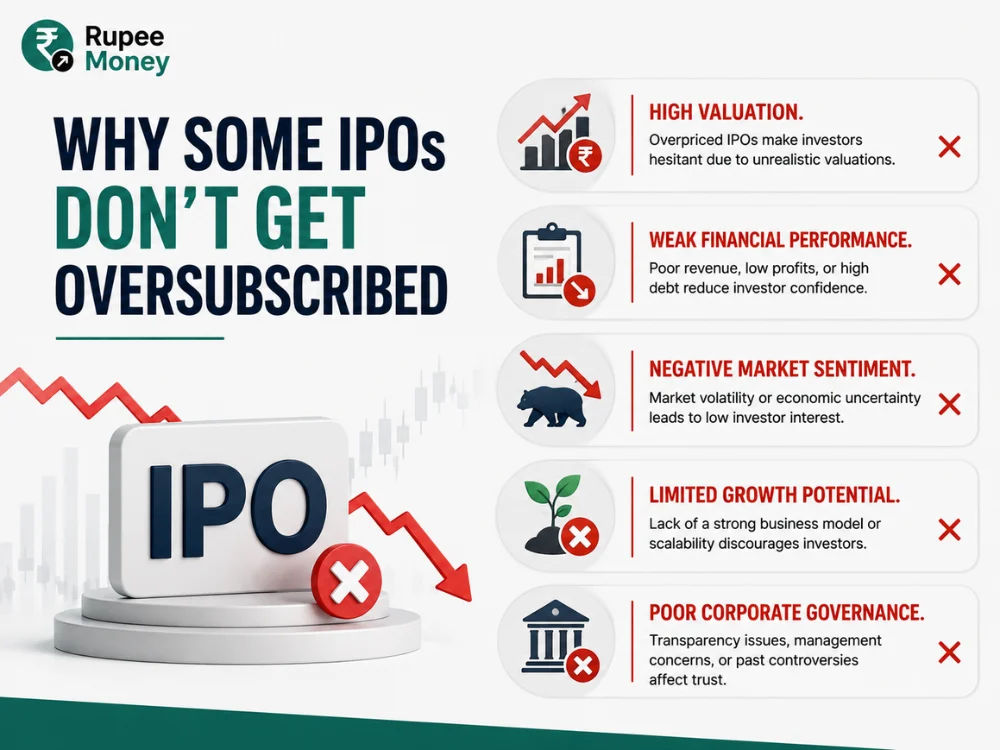
While some IPOs draw huge demand, others struggle to attract enough applications. A weakly subscribed IPO doesn’t always signal a poor business. It often reflects investor concerns about valuation, market conditions, or growth prospects instead. Here are the most common reasons.
High valuation. Investors compare the IPO price against earnings, competitors, and future growth. If the valuation looks too expensive, many investors skip applying, even for genuinely profitable businesses. Reasonable pricing usually draws more participation than aggressive pricing.
Weak financial performance. Companies with inconsistent revenue or declining profits face lower interest. Investors study the financial statements in the Red Herring Prospectus (RHP) carefully. Poor performance raises real concerns about future growth, so investors often avoid the issue.
Negative market sentiment. The overall market mood affects IPO demand too. When markets stay volatile or investors expect a correction, many prefer to wait instead of investing. Even fundamentally strong companies can see lower subscription during uncertain conditions.
Limited growth potential. Some companies operate in industries with limited expansion room. If investors expect slow future earnings, they often look elsewhere for better opportunities. Scalable business models generally attract stronger demand than saturated markets do.
Poor corporate governance. Investors evaluate management quality closely too. Weak governance, regulatory concerns, and frequent legal disputes hurt investor confidence. Companies with experienced leadership and strong governance usually see better subscription levels.
Is an Oversubscribed IPO Always a Good Investment?
No. Many beginners assume every oversubscribed IPO delivers excellent listing gains. That assumption doesn’t always hold up.
Oversubscription only shows that demand exceeded available shares during the IPO window. It doesn’t guarantee long-term business success. Several oversubscribed IPOs have listed at a premium, then declined once earnings missed expectations. Similarly, some moderately subscribed IPOs have delivered excellent long-term returns through strong business growth.
Always evaluate the company’s fundamentals rather than relying on subscription numbers alone. Consider revenue growth, profitability, and industry outlook. Debt levels, valuation, management quality, and competitive position matter just as much. Our guide on Return on Assets (ROA) can help you judge a company’s efficiency before applying. Long-term investing depends on business performance, not short-term market excitement.
Should You Apply for an Oversubscribed IPO?
Applying for an oversubscribed IPO can make sense with strong fundamentals and reasonable valuation behind it. Still, avoid applying just because everyone else is doing so.
Before submitting your application, ask a few questions. Does the company show consistent earnings? Is the valuation reasonable? Can the business grow over the next five to ten years? Does management have a solid track record? Do you actually understand the business model?
If your answers stay positive, the IPO deserves further consideration. If not, skipping it may prove the smarter move. If you’d rather secure your allotted shares first, read our explainer on the IPO lock-in period. It covers what restrictions apply once you actually get shares.
Tips Before Applying for Any IPO
Every IPO deserves proper research first. Use this checklist before investing.
Read the Red Herring Prospectus. The RHP covers the company’s business, risks, financial statements, promoters, and planned use of funds.
Check financial performance. Review revenue growth, profits, margins, debt, and return ratios closely. Companies with healthy financials usually offer better long-term potential.
Compare valuation. Weigh the IPO valuation against similar listed companies. Avoid paying excessively high prices without strong business justification behind them.
Understand business risks. Every business faces real risks. Study industry competition, regulatory issues, and future challenges before committing money.
Ignore market hype. Social media chatter and unofficial tips create unnecessary excitement. Base your decision on research, not emotion.
Think beyond listing gains. Many investors focus only on listing-day profits. Long-term wealth creation depends on business quality, not one day’s price move. Our guide on what an IPO is is a good starting point if you’re still new to this process. If you’d rather explore shares before they even list, our piece on unlisted shares covers that alternative route.
Conclusion
IPO oversubscription reflects investor demand, but it should never become your only investment factor. Companies draw strong subscriptions when investors trust their business model, financial performance, growth potential, and valuation. Companies with weak fundamentals or expensive pricing often struggle to attract investors instead.
Successful investing takes patience, research, and real discipline. Instead of chasing every popular IPO, focus on understanding the company’s business and long-term prospects. This approach helps you make better decisions and cuts down unnecessary risk. If you want to build wealth beyond IPOs alone, our guide on building wealth in your 20s is worth reading too. Our SIP Calculator can show how regular monthly investments grow over time. If you’d rather explore SIP as a beginner, that guide breaks the process down further.
Planning a one-time investment instead? Our Lumpsum Calculator estimates your potential future returns. If you prefer lower-risk options over IPO investing, compare expected returns using our FD Calculator before deciding.
Frequently Asked Questions
What does an oversubscribed IPO mean?
It means investors applied for more shares than the company offered. Since demand exceeds supply, the registrar follows SEBI’s allotment rules to distribute shares. Investors who miss out receive a refund or an ASBA fund release per the applicable process.
Why do some IPOs receive heavy subscription?
Several factors drive heavy subscription. Investors favour companies with strong financials, experienced management, and reasonable valuation. Healthy industry growth and positive market sentiment help too. QIB and Anchor Investor participation boosts retail confidence further.
Does an oversubscribed IPO guarantee listing gains?
No. Oversubscription only shows strong demand during the IPO period. Listing price depends on market conditions, investor sentiment, and future prospects. Some oversubscribed IPOs deliver strong gains, while others list lower or underperform later.
Why do some IPOs fail to attract investors?
An IPO may see weak subscription due to high valuation or poor financial performance. Excessive debt, weak prospects, negative market conditions, and low confidence all play a role. Every IPO draws different demand based on these factors.
Should beginners invest in every oversubscribed IPO?
No. Beginners shouldn’t invest just because an IPO became popular. Study the company’s financial statements, valuation, industry outlook, and risks first. A disciplined, research-based approach generally beats following market hype.
Disclaimer: This article is intended for educational and informational purposes only. IPO investments involve market risk, and an oversubscribed IPO doesn’t guarantee listing gains or long-term returns. Read the Red Herring Prospectus, evaluate the company’s financial performance, and understand the associated risks before applying for any IPO. Consult a qualified financial advisor if needed.
ABOUT THE AUTHOR

