
How Does the RBI Repo Rate Affect the Stock Market?
Many investors watch the Reserve Bank of India’s monetary policy announcements closely. A small change in the RBI Repo Rate can shift stock prices, borrowing costs, business growth, and investor confidence across the country.
Are you new to investing? You may wonder why the stock market reacts every time the RBI changes the Repo Rate. The answer lies in how interest rates touch businesses, banks, and consumers all at once.
At RupeeMoney, we simplify financial topics so you can make informed decisions with confidence. This article explains how the RBI Repo Rate influences the Indian stock market, and why every investor should understand its impact. For a deeper foundation, read What Is the Repo Rate? first.
What Is the RBI Repo Rate?
The Repo Rate is the interest rate at which the RBI lends money to commercial banks. Banks borrow against government securities for a short period. They tap this facility whenever they need extra liquidity.
The RBI adjusts the Repo Rate as part of its monetary policy toolkit. It uses this lever to manage inflation, support growth, and maintain financial stability.
As of the RBI’s June 2026 policy meeting, the Repo Rate stands at 5.25%. The Monetary Policy Committee has held it steady since December 2025, maintaining a neutral stance. The Repo Rate directly affects banks first. Its impact eventually reaches businesses, consumers, and the stock market too.
Why Does the RBI Change the Repo Rate?
The RBI adjusts the Repo Rate to balance inflation against economic growth.
When inflation rises too fast, the RBI may raise the Repo Rate. Higher borrowing costs cool spending and help control rising prices. When economic activity slows, the RBI may cut the Repo Rate instead. Lower interest rates encourage borrowing, investment, and consumer spending.
The RBI doesn’t set the Repo Rate with the stock market in mind. Its primary goal stays fixed on price stability and sustainable growth. Even so, investors track every policy decision closely. Interest rate changes ripple into corporate earnings and market sentiment fast.
How Repo Rate Changes Affect the Stock Market
The stock market reacts because interest rates shape business costs, company profits, and investment decisions. The overall impact depends on prevailing economic conditions and investor expectations at the time. A Repo Rate change also hits different sectors differently, rather than moving every stock the same way.
Lower Repo Rate and Stock Market Growth
When the RBI cuts the Repo Rate, banks typically borrow money more cheaply. Commercial banks may then gradually lower lending rates for both businesses and consumers.
Lower borrowing costs tend to trigger several positive effects. Companies expand operations more easily and invest in new projects. Consumers borrow more freely for homes and vehicles. Demand for goods and services picks up as a result. Corporate earnings may improve, and investor confidence often strengthens alongside them.
As business activity increases, many investors expect stronger future profits. This optimism can genuinely support stock market growth.
Banking Stocks
Lower interest rates often boost loan demand across the board. Banks may issue more home loans, vehicle loans, and business loans. Higher lending activity can improve long-term profitability. Lower lending rates, though, may squeeze interest margins somewhat. Investors still often respond positively when they expect stronger credit growth.
Real Estate Stocks
Lower borrowing costs generally support the entire real estate sector. Affordable home loans encourage more people to buy property. Higher housing demand benefits developers, builders, and related industries together. This explains why real estate stocks often rally after Repo Rate cuts. Use a Home Loan Calculator to see how a rate cut actually changes your own EMI.
Automobile Stocks
Vehicle financing becomes noticeably cheaper when loan rates fall. Consumers may buy cars or two-wheelers sooner, since EMIs feel more manageable. Higher vehicle sales tend to lift company revenues and investor confidence together.
Higher Repo Rate and Stock Market Decline
When inflation becomes a real concern, the RBI may raise the Repo Rate. Banks generally raise their lending rates over time in response. Higher borrowing costs then affect businesses and consumers in several ways.
Companies may delay expansion plans, since financing gets more expensive. Consumers may postpone big purchases that require loans. Lower spending can shrink business revenue and profits. As earnings expectations weaken, investors may start selling shares, pushing stock prices lower.
Banking Sector Impact
Higher interest rates create mixed effects for the banking sector. Loan demand may slow, since borrowing costs more now. Some borrowers delay buying homes or vehicles, or expanding their businesses. Banks may still earn better interest spreads in certain conditions. Slower overall credit growth, though, can still hurt broader business performance.
Consumer Goods Sector
Companies selling discretionary products often see slower demand during high-rate periods. Consumers tend to prioritise essentials and delay luxury purchases instead. Businesses facing slower sales growth may report weaker earnings. This often dents investor confidence in consumer-focused companies specifically. Try the EMI Calculator to see how rising rates change your own monthly repayments.
Repo Rate and Market Liquidity
Liquidity simply means how much money moves freely through the financial system. Lower Repo Rates generally boost liquidity, since borrowing becomes cheaper across the board. Higher liquidity tends to support business investment, consumer spending, equity investments, and corporate expansion together.
Higher Repo Rates usually shrink liquidity instead, since borrowing gets costlier. Reduced liquidity can slow economic activity and limit investment across sectors. Investors watch liquidity closely, since it strongly shapes stock market sentiment.
Repo Rate and Investor Sentiment
Investor sentiment reflects how optimistic or cautious the market feels about the future. Repo Rate decisions shape sentiment because they signal the RBI’s broader economic outlook.
Positive sentiment tends to build when inflation stays under control. It also grows when economic growth improves and businesses access cheaper financing. Rising corporate earnings expectations add further fuel to that optimism.
Negative sentiment tends to build when inflation stays high instead. It also grows when borrowing costs rise and business investment slows down. Weakening consumer spending adds to that pessimism further.
Markets sometimes react more to expectations than to the actual decision itself. Say investors expect a rate cut, but the RBI holds rates steady. Markets may still fall, simply because expectations went unmet.
Which Sectors Benefit Most from Lower Repo Rates?
Some sectors respond more strongly than others to rate cuts. These include banking, financial services, and housing finance. Real estate, automobile, consumer durables, infrastructure, and capital goods follow closely behind. These industries lean heavily on borrowing and consumer financing to grow. Lower interest rates generally support their long-term growth prospects directly.
Which Sectors Face Pressure from Higher Repo Rates?
Not every industry reacts to rate changes the same way. Some sectors depend heavily on borrowing and consumer financing specifically. These sectors often struggle when the RBI raises the Repo Rate.
Real estate, automobile, and consumer durables typically feel this pressure first. Infrastructure, capital goods, and highly leveraged small and mid-sized businesses follow close behind. Higher borrowing costs can shrink consumer demand and raise business expenses at once. Investors often turn cautious on these sectors until borrowing conditions ease.
A higher Repo Rate, though, doesn’t automatically make every company here a bad bet. Businesses with strong balance sheets and healthy cash flows can still perform well, even through tighter rate cycles.
Repo Rate vs Reverse Repo Rate: What’s the Difference?
Many investors confuse the Repo Rate with the Reverse Repo Rate. Both sit within the RBI’s monetary policy toolkit, but they serve different purposes.
| Repo Rate | Reverse Repo / SDF | |
| Definition | Rate at which the RBI lends to banks | Rate at which banks park surplus funds with the RBI |
| Main Role | Shapes borrowing costs economy-wide | Helps manage excess banking liquidity |
| Impact | Affects loans, investments, business activity | Mainly controls liquidity held by banks |
One important update worth knowing: the RBI now primarily uses the Standing Deposit Facility (SDF) rate, not the older reverse repo rate, to absorb excess liquidity. As of June 2026, the SDF rate stands at 5%, while the Marginal Standing Facility and Bank Rate both sit at 5.5%. Understanding this distinction helps you read RBI policy announcements more accurately going forward.
Repo Rate and Inflation
Inflation remains one of the biggest reasons the RBI adjusts the Repo Rate at all. When inflation climbs sharply, the RBI may raise rates to slow borrowing and spending. Lower demand then helps stabilise prices over time.
When inflation stays controlled but growth weakens, the RBI may cut rates instead. Cheaper borrowing then encourages businesses and consumers to spend more freely. This constant balancing act plays a real role in long-term financial stability. To understand this connection more deeply, read What Is Inflation and Why Does It Matter?
Repo Rate and Long-Term Investors
Long-term investors should understand Repo Rate changes, but shouldn’t lean on one announcement alone. Stock markets often react quickly right after an RBI policy meeting concludes. The market’s long-term direction, though, depends on far more than that single decision.
Corporate earnings, economic growth, and government policy all shape that direction too. Global economic conditions, investor confidence, and individual company fundamentals matter just as much. A disciplined investment strategy usually beats reacting to every single rate announcement. If you’re still weighing equity against fixed-income options during rate cycles like this, SIP vs FD breaks down that comparison directly.
Should SIP Investors Stop Investing After a Repo Rate Hike?
Many beginners worry when markets dip after a Repo Rate increase. Pausing a Systematic Investment Plan during market volatility rarely proves to be the smart move.
Market corrections actually let SIP investors buy more mutual fund units at lower prices. Over a long investment period, this averaging effect can genuinely boost wealth creation. If you’re weighing how SIP frequency plays into this, read Daily, Weekly or Monthly SIP for more detail.
Instead of timing the market, focus on investing consistently through the noise. Review your financial goals regularly, and keep your asset allocation on track. Avoid emotional decisions, and stay invested for the genuinely long term. Run your numbers through the SIP Calculator to see how staying invested through volatility plays out over time. Patience tends to reward long-term investors far more than short-term timing ever does.
Common Myths About the RBI Repo Rate
Many investors misread how the Repo Rate actually shapes financial markets.
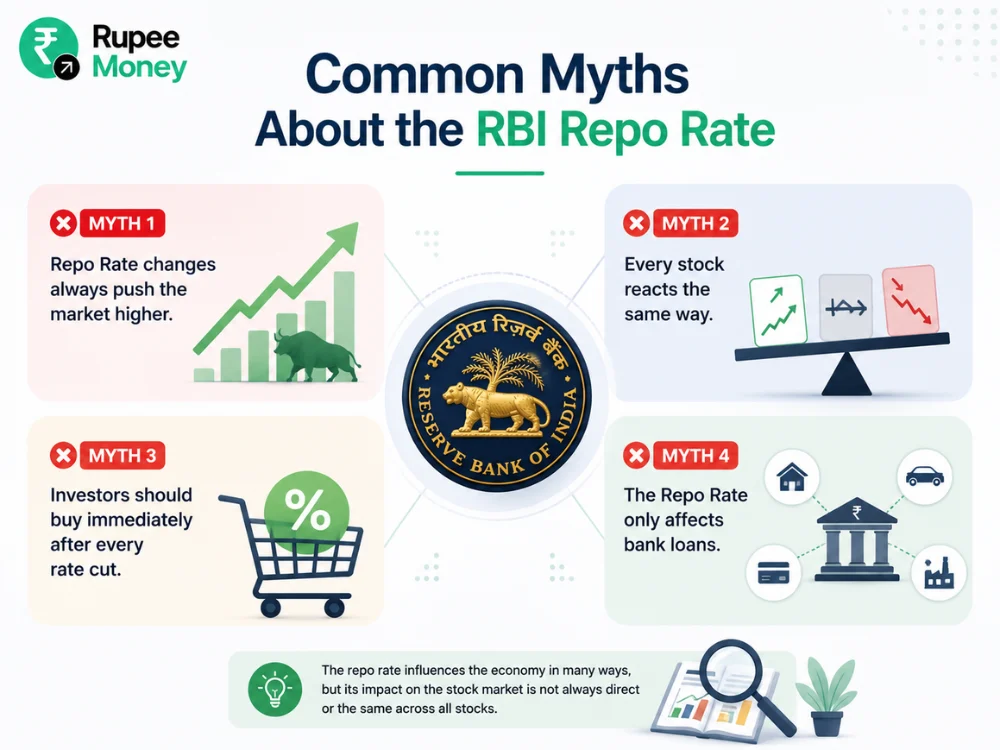
Myth 1: Repo Rate changes always push the market higher. Markets react to expectations, not just to the announcement itself. Even a rate cut can fail to lift markets if investors wanted a bigger one.
Myth 2: Every stock reacts the same way. Different industries respond quite differently to rate changes. Banking, real estate, and automobile stocks usually move more than low-borrowing sectors.
Myth 3: Investors should buy immediately after every rate cut. A rate cut supports economic activity generally. You should still weigh company fundamentals, valuations, and long-term growth potential first.
Myth 4: The Repo Rate only affects bank loans. It actually shapes borrowing costs, business investment, and consumer spending broadly. It touches inflation, liquidity, and overall stock market sentiment too, well beyond banking alone.
Conclusion
The RBI Repo Rate shapes far more than just your home loan interest rate. It touches borrowing costs, business expansion, consumer spending, inflation, and investor confidence economy-wide.
Lower Repo Rates generally encourage investment and economic growth. Higher Repo Rates help control inflation by cooling excessive borrowing instead. The stock market does react to RBI policy announcements, no question. Long-term investors, though, should avoid decisions based purely on interest rate moves.
Company quality, financial strength, and economic fundamentals still drive long-term wealth creation the most. Understanding how the Repo Rate works helps you read market movements with real confidence. If you’re building a broader financial plan around these fundamentals, Building Wealth in Your 20s is a solid next read.
Frequently Asked Questions (FAQs)
What is the RBI Repo Rate?
The RBI Repo Rate is the interest rate at which the Reserve Bank lends to commercial banks against government securities. It works as one of the RBI’s primary monetary policy tools. The RBI uses it to control inflation, manage liquidity, and support growth. Changes here influence borrowing costs across the economy and touch businesses, consumers, and the stock market indirectly.
Why does the stock market react to Repo Rate changes?
The market reacts because interest rates shape corporate borrowing costs, consumer spending, and future profits. Lower Repo Rates often boost business expansion and economic activity. Higher Repo Rates raise borrowing costs and can slow growth instead. Investors adjust their expectations around these shifts, which moves stock prices.
Which sectors benefit the most from a Repo Rate cut?
Banking, financial services, and housing finance typically benefit the most. Real estate, automobile, infrastructure, and consumer durables often follow close behind. These sectors depend heavily on loans and financing to operate. Lower rates encourage more borrowing, which lifts demand for their products and services.
Should investors sell shares after a Repo Rate increase?
Not necessarily, no. A rate increase alone doesn’t mean you should exit the stock market. The broader market depends on corporate earnings, economic growth, inflation, and global conditions together. Long-term investors should keep evaluating company fundamentals instead of reacting to short-term moves.
Does the Repo Rate affect SIP investments?
Yes, but indirectly through the broader market. Repo Rate changes can influence stock market performance, which shapes mutual fund returns over time. SIP investors, though, generally benefit from volatility, since regular investments buy more units when prices fall. Staying disciplined usually beats stopping your SIP during uncertain periods.
How often does the RBI change the Repo Rate?
The RBI reviews the Repo Rate during Monetary Policy Committee meetings, held roughly every two months. The committee weighs inflation, growth, and other macroeconomic conditions before deciding. The rate doesn’t change at every meeting. It depends entirely on prevailing economic conditions at that time, as the June 2026 pause at 5.25% shows.
Disclaimer: This article is for educational and informational purposes only. It does not constitute investment, financial, legal, or tax advice. Multiple economic factors influence the stock market and interest rates. Investors should conduct their own research and consult a qualified financial advisor before making investment decisions.
ABOUT THE AUTHOR

