
What Is the Difference Between NSE and BSE?
If you plan to invest in the stock market, you’ll come across two names often. NSE and BSE. Every listed Indian company trades on one or both of these exchanges. Whenever you buy or sell shares through your broker, the trade happens somewhere specific. That’s either the National Stock Exchange (NSE) or the Bombay Stock Exchange (BSE).
Many beginners assume both exchanges work exactly the same way. They do share the same core function. But they differ in history, benchmark indices, trading volumes, and liquidity.
At RupeeMoney, we believe understanding these basics builds real investing confidence. This guide explains the difference between NSE and BSE. You’ll also learn how each exchange works and which one might suit your investing style.
What Is the Bombay Stock Exchange (BSE)?
The Bombay Stock Exchange is India’s oldest stock exchange. It’s also one of Asia’s oldest exchanges overall. It began operations in 1875. It has shaped India’s capital markets for well over a century.
Thousands of companies list their shares on the BSE. Investors buy and sell these shares through registered brokers using a Demat and Trading Account.
The Sensex serves as the BSE’s benchmark index. It tracks 30 large, financially strong companies across different sectors.
The BSE offers trading in equity shares, mutual funds, and Exchange Traded Funds (ETFs). It also covers debt securities, bonds, IPOs, and derivative products.
Today, the BSE continues serving millions of investors. It remains one of India’s most important financial institutions.
What Is the National Stock Exchange (NSE)?
The National Stock Exchange began its operations in 1994. Its goal was bringing greater transparency and electronic trading to India’s market.
Earlier exchanges relied on traditional floor trading. The NSE introduced a fully electronic platform instead. This made trading faster, more efficient, and accessible nationwide.
The Nifty 50 serves as the NSE’s benchmark index. It tracks 50 leading companies listed on the exchange. Our detailed guide on what the Sensex is and how it’s calculated explains this calculation method in full.
The NSE provides trading in equity shares and equity derivatives. It also covers currency derivatives, commodity derivatives, ETFs, debt instruments, and IPOs.
Because of its high volumes and strong liquidity, the NSE ranks among the world’s largest stock exchanges.
NSE vs BSE: Key Differences
Both exchanges perform similar functions. Still, they differ in several important ways.
| Feature | NSE | BSE |
| Full Name | National Stock Exchange | Bombay Stock Exchange |
| Established | 1994 | 1875 |
| Benchmark Index | Nifty 50 | Sensex |
| Trading System | Electronic | Electronic |
| Main Focus | High liquidity and derivatives | Large number of listed companies |
| Popular Among | Active traders | Long-term investors, listed companies |
| Regulator | SEBI | SEBI |
Both exchanges follow regulations set by the Securities and Exchange Board of India (SEBI).
NSE vs BSE: Comparing Liquidity
Liquidity refers to how quickly and easily shares can be bought or sold in the market. Good liquidity avoids major price swings during a trade.
The NSE generally records higher daily trading volumes than the BSE. Higher activity usually means better liquidity overall.
Better liquidity brings real advantages. You get faster order execution and lower bid-ask spreads. It also supports better price discovery and easier buying and selling. It reduces sudden price swings caused by thin trading.
Because of this, many active traders prefer the NSE. That said, several BSE stocks maintain strong liquidity too. This applies especially to large-cap companies listed on both exchanges.
NSE vs BSE: Number of Listed Companies
Both exchanges host thousands of listed companies. The BSE has traditionally hosted more companies, thanks to its long history.
The NSE attracts heavy trading activity despite having fewer listings. Many large Indian companies choose to list on both exchanges. This lets investors buy or sell the same company’s shares on either platform.
Share prices stay almost identical across both exchanges. Traders quickly close any price gaps through active trading.
Sensex vs Nifty 50
One major difference between the exchanges lies in their benchmark indices.
Sensex: represents the Bombay Stock Exchange. It tracks 30 financially strong companies across different sectors. Investors use it to gauge the BSE’s overall performance.
Nifty 50: represents the National Stock Exchange. It tracks 50 large companies across multiple sectors. Since it covers more companies, many investors see it as a broader market gauge. Both indices use the Free Float Market Capitalisation Method for their calculations.
Trading on NSE and BSE
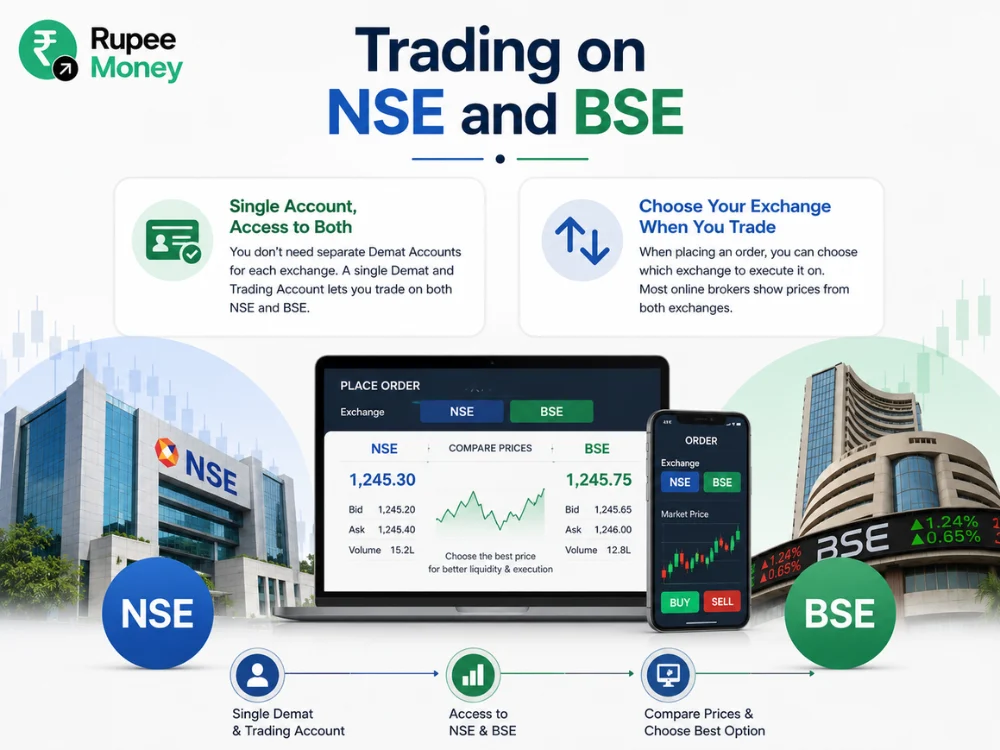
You don’t need separate Demat Accounts for each exchange. A single Demat and Trading Account lets you trade on both, as long as your broker offers that access.
When placing an order, you can choose which exchange to execute it on. Most online brokers show prices from both exchanges. This helps you pick whichever offers better liquidity or execution.
Can You Buy on NSE and Sell on BSE?
Yes, in many cases you can buy on one exchange and sell on the other. This is called inter-exchange trading.
Certain conditions still apply. These involve settlement cycles, broker policies, and stock eligibility. For most retail investors, brokers handle this settlement process automatically. The whole process usually stays smooth and simple.
Which Is Better: NSE or BSE?
There’s no single right answer here. Both exchanges serve slightly different purposes. Your choice depends on your investing style, the stock you want, and your broker’s services.
If you trade often, the NSE may suit you better. It generally offers higher liquidity and faster execution. If you invest for the long term, either exchange works fine. Many leading companies list their shares on both platforms anyway.
Rather than picking a “better” exchange, compare liquidity, trading costs, and stock availability first. Comparing equity returns against fixed-income options can also help — our FD Calculator is useful for that side-by-side view.
Advantages of the NSE
The NSE has become a favourite for many retail and institutional investors. Its high trading activity drives most of this appeal.
Key advantages include high liquidity for actively traded stocks and faster order execution. It also offers narrow bid-ask spreads and a large derivatives market. The Nifty 50 gives it a widely followed benchmark index. It also draws strong participation from both domestic and foreign investors.
These strengths make the NSE popular with frequent traders.
Advantages of the BSE
The Bombay Stock Exchange remains a key part of India’s financial system.
Its strengths include a long history as India’s oldest exchange. It also hosts a large number of listed companies. It’s home to the Sensex index and works well for investors looking beyond large-cap names. It offers a strong IPO listing platform and supports trading across many financial products. Companies going public often choose this route, and our guide on what an IPO is explains that process in detail.
Many investors use the BSE alongside the NSE, rather than picking only one.
Common Myths About NSE and BSE
Beginners often believe a few misconceptions about these exchanges. Knowing the facts helps you invest with more confidence.
Myth 1: Shares on NSE and BSE are different. This is false. If a company lists on both, you’re buying the same underlying ownership. Only the trading platform differs.
Myth 2: One exchange is always cheaper. Share prices stay nearly identical on both exchanges. Brief gaps may appear, but they close quickly through trading.
Myth 3: You need two Demat Accounts. You only need one Demat and one Trading Account. Most brokers give you access to both exchanges through it.
Myth 4: Beginners should use only one exchange. Beginners can trade on either exchange freely. Focus on understanding the stock, not the exchange itself.
Conclusion
The NSE and BSE together form the backbone of India’s stock market. Both help companies raise capital. Both give investors a real chance to build wealth through equities.
The NSE generally draws higher trading volumes and liquidity, appealing to active traders. The BSE, with its long history and vast company list, remains vital to India’s financial markets. For a broader view of these pieces, read our guide on how the stock market works in India.
As a beginner, don’t stress over picking one exchange. Learn how the market works, open a reliable Demat and Trading Account, and research companies carefully. Invest according to your own financial goals, ideally through consistent, disciplined habits like SIP investing. You can estimate your potential growth using our SIP Calculator or Lumpsum Calculator. Building these habits early matters — our guide on building wealth in your 20s can help you get started right.
Frequently Asked Questions (FAQs)
How Do NSE and BSE Differ from Each Other?
The biggest differences lie in history, benchmark indices, and trading volumes. The BSE started in 1875 and uses the Sensex. The NSE began in 1994 and uses the Nifty 50. The NSE usually sees higher daily volumes, while the BSE hosts more listed companies. Both operate under SEBI’s regulations.
Which Exchange Is Better for Beginners: NSE or BSE?
Both exchanges are equally suitable for beginners because they operate under the same regulatory framework and follow similar trading rules. Many large companies list on both exchanges anyway. Focus on picking quality companies and investing consistently, rather than worrying about the exchange. The NSE may offer a slight edge in liquidity.
Can Shares Purchased on NSE Be Sold on BSE?
Yes. If a company lists on both exchanges, you can often buy on one and sell on the other. This depends on your broker’s facilities and the settlement process. Modern brokers usually manage this automatically.
Do I Need Different Demat Accounts for NSE and BSE?
No. One Demat Account and one Trading Account gives you access to both exchanges. Most registered brokers support trading on both through the same account.
Why does the same stock show two different prices?
Prices can differ slightly because trading volumes and demand vary by exchange. These gaps are usually tiny and close quickly as traders act on them. In normal conditions, you’ll rarely notice any meaningful difference.
Which index is better, Sensex or Nifty?
Neither one is objectively better. They simply track different groups of leading companies. The Sensex covers 30 BSE-listed companies, while the Nifty 50 covers 50 NSE-listed companies. Many investors follow both to read the market’s overall direction.
Disclaimer: This article is intended for educational and informational purposes only and should not be treated as investment, financial, legal, or tax advice. Investing in the stock market involves market risk, and share prices may increase or decrease based on various market factors. Always research thoroughly and seek advice from a qualified financial advisor before making any investment decisions.
ABOUT THE AUTHOR

