
How Does the Stock Market Work in India? A Beginner’s Guide
Every day, millions of investors buy and sell shares in the Indian stock market. Some walk away with profits, others face losses, and plenty of beginners still wonder what actually happens behind each trade.
The stock market can look intimidating at first glance, but once you understand the basic process, investing becomes far less mysterious. You really just need to know how companies raise money, how investors buy shares, and how exchanges settle every transaction.
At RupeeMoney, we believe every investor should understand how the stock market actually works before putting in their hard-earned money. A clear understanding helps you make informed decisions instead of chasing rumours or market hype — and it’s a habit worth building early, as our guide on building wealth in your 20s explains.
This guide covers how the stock market works in India, the roles SEBI, NSE, and BSE play, what Demat and Trading Accounts do, and how shares move between buyers and sellers.
What Is the Stock Market?
The stock market is a marketplace where investors buy and sell ownership stakes in publicly listed companies. When you buy a company’s shares, you become one of its shareholders, giving you partial ownership in that business.
If the company performs well, your shares may rise in value, and some companies also reward shareholders through dividends. The stock market gives businesses a way to raise money while giving investors a chance to grow their wealth over time.
Why Do Companies List on the Stock Market?
Growing companies often need capital to expand — opening new factories, scaling operations, developing products, buying machinery, entering new markets, or paying down debt. Instead of borrowing from banks, they can sell shares to the public through an Initial Public Offering (IPO). Once listed, investors can freely buy and sell those shares on recognised stock exchanges.
How the Stock Market Works in India
The Indian stock market runs on a structured system involving several participants, each playing a specific role to keep trading secure and transparent. The basic process looks like this:
- A company lists its shares through an IPO.
- Investors open a Demat Account and a Trading Account.
- Investors place buy or sell orders.
- Stock exchanges match buyers and sellers.
- Shares move electronically into the buyer’s Demat Account.
- Money transfers to the seller after settlement.
The process looks simple from an investor’s chair, but several institutions coordinate behind the scenes to make it happen.
Main Participants in the Stock Market
- Investors buy shares to build long-term wealth — some hold stocks for years, others trade actively for short-term gains. Retail investors, institutions, mutual funds, FIIs, and DIIs all participate side by side.
- Listed companies issue shares to raise capital, and their financial performance directly shapes their share prices. Better earnings usually lift investor confidence, while weak results can dampen demand.
- Stock brokers give you access to trading platforms, since you can’t trade directly on an exchange. A registered broker executes your buy and sell orders and often adds research reports, market analysis, investment tools, mobile trading apps, and portfolio tracking on top.
Stock Exchanges in India
Stock exchanges provide the platform where buyers and sellers actually meet. India has two major ones.
National Stock Exchange (NSE): India’s largest exchange by trading volume, where most equity trading happens thanks to its strong liquidity. Its benchmark index is the Nifty 50.
Bombay Stock Exchange (BSE): Asia’s oldest stock exchange, home to thousands of listed companies. Its benchmark index is the Sensex.
Both NSE and BSE operate under SEBI’s regulatory oversight.
SEBI’s Role in the Stock Market
The Securities and Exchange Board of India (SEBI) regulates India’s securities market, protecting investor interests while ensuring fair, transparent trading. Its core responsibilities include regulating stock exchanges, registering brokers, preventing insider trading, monitoring listed companies, protecting investors, and promoting market transparency. Without SEBI, investor confidence in the market would take a real hit.
Demat Account and Trading Account
Many beginners mix these two up, but they serve completely different purposes.
Demat Account: stores your shares electronically instead of as physical certificates, linked either to NSDL (National Securities Depository Limited) or CDSL (Central Depository Services Limited). Every investor needs one before buying shares.
Trading Account: lets you place buy and sell orders. When you purchase shares, your Trading Account executes the transaction while your Demat Account stores what you bought — the two work together during every stock market transaction.
How Shares Are Bought and Sold
Buying shares follows a fairly simple sequence:
- Open a Demat and Trading Account — pick a SEBI-registered broker, complete your KYC, and link your PAN, Aadhaar, and bank account.
- Add money — transfer funds from your bank account into your trading account so the balance is ready to invest.
- Place a buy order — search for the company, enter the quantity, choose your price, and confirm.
- Order matching — the exchange compares your order with available sellers, and once prices match, the trade executes instantly.
- Settlement — the shares move into your Demat Account, and the seller receives their payment. India currently runs on the T+1 settlement cycle, which settles trades faster than the older systems it replaced.
What Decides Share Prices in the Stock Market?
Stock prices keep shifting throughout the trading session, driven fundamentally by demand and supply. When more investors want to buy a stock than sell it, the price usually rises; when more want to sell than buy, it generally falls. A few key factors shape this every day:
- Company performance: companies reporting higher profits tend to attract more investors, with strong revenue growth, rising earnings, and healthy cash flow supporting higher valuations, while poor results often shake confidence. Our guide on Return on Assets (ROA) can help you judge company performance more precisely before you invest.
- Economic conditions: inflation, interest rates, GDP growth, government policies, employment levels, and foreign investment all play a role — a strong economy generally supports long-term market growth.
- Investor sentiment: markets react to emotion too. Positive news encourages buying, negative news increases selling pressure, and sentiment often drives short-term price swings more than fundamentals do.
Types of Orders in the Stock Market
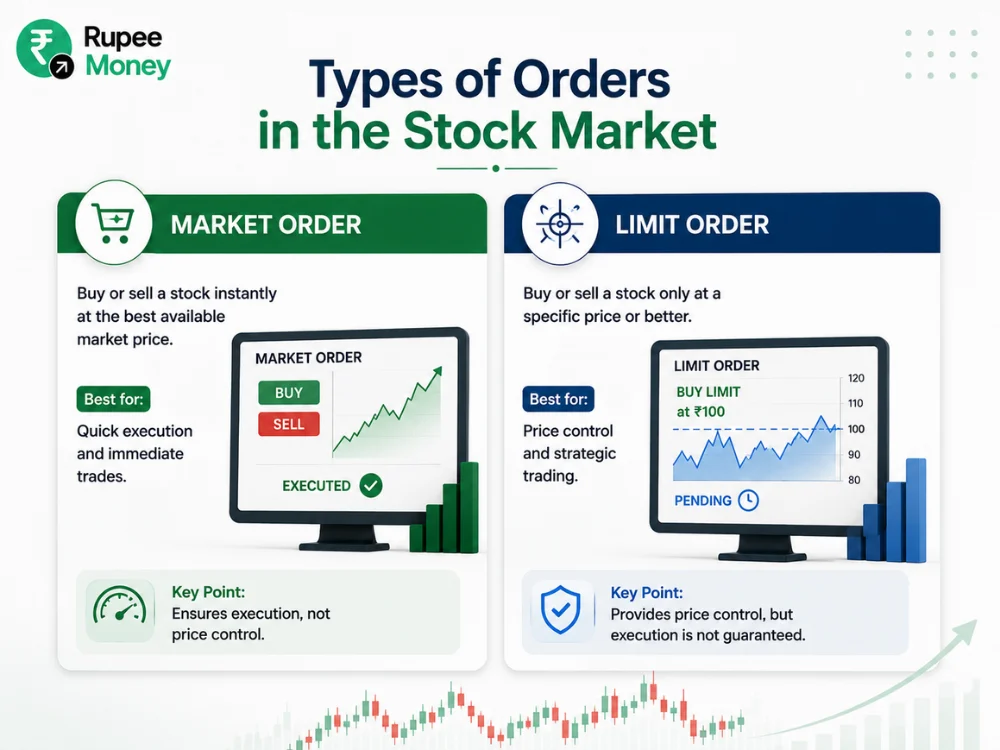
Understanding order types helps you trade more effectively:
- Market order: executes immediately at the best available price — useful when getting the trade done matters more than the exact price.
- Limit order: executes only at your chosen price or better, giving you more control over your buying and selling price.
Trading Sessions in India
The Indian stock market runs on fixed hours:
| Session | Time |
| Pre-open Session | 9:00 AM – 9:15 AM |
| Normal Trading | 9:15 AM – 3:30 PM |
| Closing Session | After 3:30 PM |
Trading runs Monday to Friday, except on exchange-declared holidays.
Why Investors Use the Stock Market
People invest for different reasons — retirement, long-term wealth, or passive income through dividends. Common goals include wealth creation, beating inflation, retirement planning, funding a child’s education, achieving financial independence, and portfolio diversification. Our guide to large-cap mutual funds is a good starting point if diversification is your main goal, and long-term investing generally softens the impact of short-term market volatility along the way.
Risks of Investing in the Stock Market
Every investment carries some risk, and understanding these helps you make better calls:
- Market risk: share prices can rise or fall based on market conditions — no investment guarantees profit.
- Company risk: poor management, weak earnings, or business challenges can reduce a company’s value.
- Economic risk: global events, inflation, wars, pandemics, and policy shifts can all move stock prices.
- Emotional investing: fear and greed often push investors toward poor decisions. Successful investors tend to follow disciplined strategies rather than react emotionally.
Tips for Beginners Investing in the Stock Market
If you’re just starting out, these practical habits help:
- Learn the basics before investing.
- Define your financial goals first.
- Diversify your portfolio.
- Avoid chasing quick profits.
- Research companies carefully.
- Focus on long-term wealth creation.
- Invest regularly through SIPs when it suits your goals — you can project potential growth using our SIP Calculator.
- Never invest borrowed money.
- Review your portfolio periodically.
- Stay updated on market developments.
Patience and consistency usually deliver better results than frequent trading.
Common Mistakes Beginners Should Avoid
Many first-time investors repeat the same errors: investing without research, following social media tips blindly, trying to time the market, ignoring diversification, buying penny stocks without understanding the risk, selling during every correction, and investing without clear financial goals. Building wealth takes discipline, not shortcuts.
Conclusion
The stock market gives individuals a real opportunity to participate in the growth of Indian businesses. Every transaction follows a structured process involving investors, brokers, stock exchanges, depositories, and regulators working together.
Understanding how the stock market works in India helps you invest with genuine confidence. Once you grasp the roles of SEBI, NSE, BSE, your Demat Account, and your Trading Account, the whole process becomes far easier to follow. Instead of chasing market rumours, focus on learning, investing regularly — you can compare that against a one-time investment approach using our Lumpsum Calculator, or explore a safer, government-backed option through our PPF Calculator — and maintaining a long-term perspective. A disciplined approach generally creates better outcomes than short-term speculation.
Frequently Asked Questions (FAQs)
How Does India’s Stock Market Operate? The stock market connects buyers and sellers through recognised exchanges like the NSE and BSE. Investors place buy or sell orders through registered brokers, and once the exchange matches a buyer with a seller, the transaction completes electronically. Purchased shares move into the investor’s Demat Account, while the payment reaches the seller after settlement.
How Does SEBI Help Manage the Stock Market? SEBI regulates India’s securities market — protecting investors, monitoring listed companies, supervising brokers, preventing unfair trading practices, and ensuring exchanges operate transparently. It plays a crucial role in maintaining both investor confidence and market integrity.
Do I need both a Demat Account and a Trading Account? Yes. Your Trading Account lets you buy and sell shares, while your Demat Account stores those shares electronically. Both work together during every transaction, and most brokers now bundle both accounts together when you sign up.
Can beginners invest in the stock market? Yes. Beginners can start once they’ve learned the basics, ideally with financially strong companies or diversified mutual funds. Investing regularly, staying patient, and focusing on long-term goals generally works better than chasing quick profits.
What factors affect share prices in India? Several factors shape share prices — company earnings, demand and supply, economic growth, inflation, interest rates, government policies, global events, investor sentiment, and corporate announcements. Prices keep shifting based on these factors throughout the trading day.
Disclaimer: This article is meant to educate and inform readers and does not provide professional investment, financial, legal, or tax advice. Investing in the stock market carries inherent risks, and previous performance should not be viewed as a guarantee of future returns. Make informed decisions by conducting independent research and consulting a qualified financial advisor.
ABOUT THE AUTHOR

