
How Does Tata Motors Make Money? Business Model and Revenue Sources
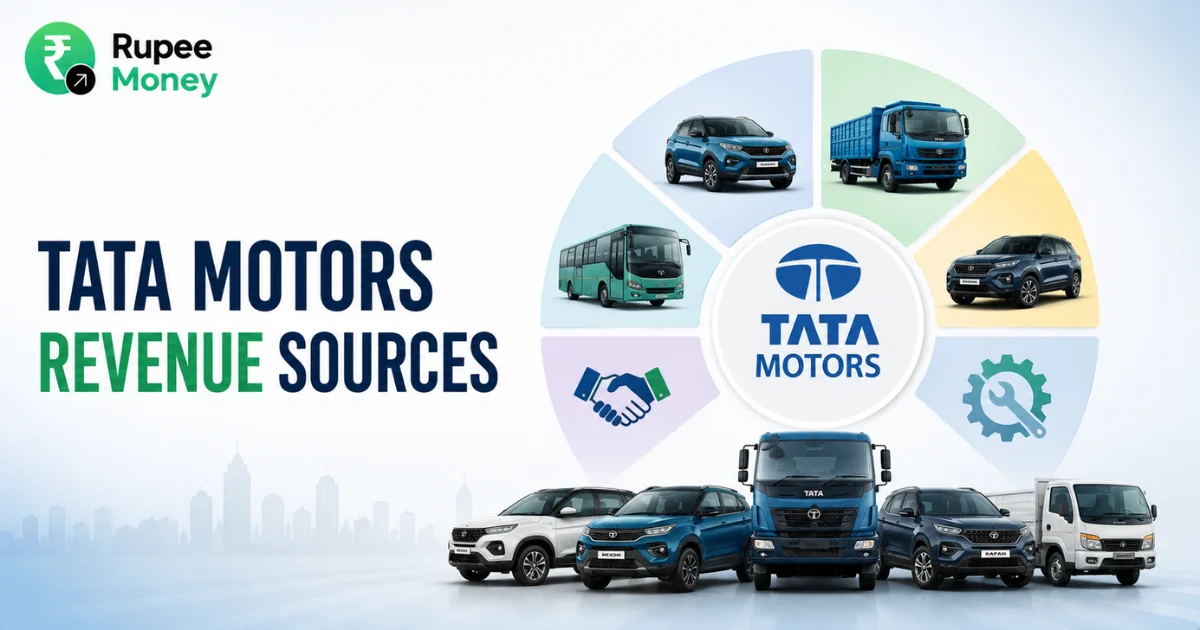
When you think about Tata Motors, cars probably come to mind first. Cars, though, are only one part of a genuinely larger business. Tata Motors has built a diversified automotive presence across India and global markets, spanning commercial vehicles, passenger vehicles, electric vehicles, and luxury cars through Jaguar Land Rover.
The company’s structure changed fundamentally after a major demerger completed in 2025, though, and FY2026 brought real turbulence too, including a significant cyber incident at JLR. At RupeeMoney, we believe understanding a company’s actual structure matters before you evaluate it as an investment. So how does Tata Motors actually make money today? Let’s walk through its major revenue sources, business segments, and what genuinely changed this year.
How Tata Motors Makes Money
Tata Motors earns money mainly by selling vehicles across different automotive segments, alongside related products, services, and mobility solutions.
Historically, three major businesses drove consolidated revenue: Jaguar Land Rover, commercial vehicles, and passenger vehicles. JLR generated the largest single share before the 2025 demerger. In FY25, Tata Motors reported segment revenue of roughly ₹4.40 lakh crore, with JLR contributing about ₹3.14 lakh crore, or 71% of total segment revenue. Commercial vehicles generated around ₹75,055 crore, and passenger vehicles around ₹48,445 crore.
The business structure changed significantly from October 1, 2025, when Tata Motors separated its commercial vehicle business from its passenger vehicle business entirely. This makes older revenue comparisons genuinely harder to interpret directly.
Tata Motors Business Segments After the Demerger
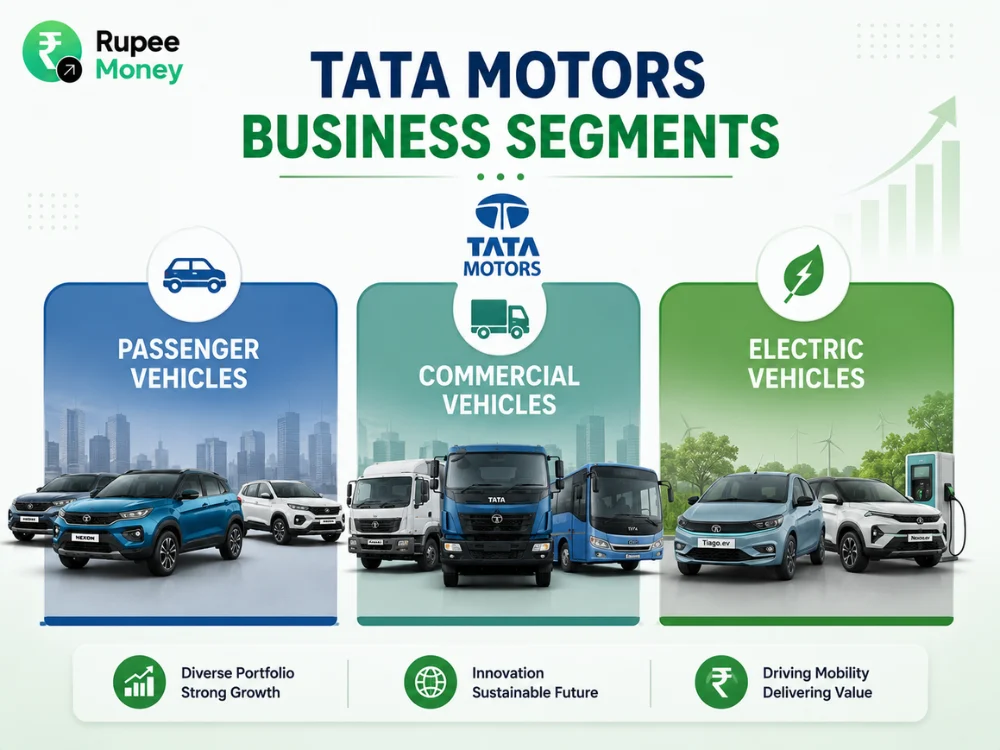
Tata Motors now operates through separate listed businesses. The commercial vehicle business runs under Tata Motors Limited (TML), formerly the demerged entity known as TMLCV. The passenger vehicle business, including Jaguar Land Rover, sits within Tata Motors Passenger Vehicles (TMPV). This split gives each business sharper strategic focus, and makes segment-level performance considerably easier for investors to track independently.
Commercial Vehicles
Commercial vehicles remain one of Tata Motors’ most important businesses. The company sells trucks, buses, pickups, and small commercial vehicles, serving logistics, construction, infrastructure, agriculture, and public transportation together. Fleet operators form a key customer group here, while small businesses drive demand for pickups and last-mile delivery vehicles specifically.
The company also sells electric commercial vehicles across different payload capacities. Tata Motors reported ₹77,399 crore in standalone FY26 revenue, with consolidated FY26 revenue reaching ₹83,855 crore. The business delivered genuinely strong profitability too, with FY26 EBITDA at ₹10,198 crore and a 13.2% EBITDA margin.
Passenger Vehicles
Passenger vehicles form another major revenue stream, spanning hatchbacks, SUVs, and electric cars. Popular Tata models have built the company a strong position in India, and its growing EV portfolio adds a genuine additional growth lever. Higher-value SUVs and premium variants can improve revenue per vehicle too, though intense competition in India’s auto market means product launches and demand shifts strongly influence outcomes here.
The India passenger vehicle business was genuinely a bright spot in FY26, posting record annual sales exceeding 6.4 lakh units, driven by strong SUV and EV demand. Tata Motors reported 63,760 passenger vehicle sales in July 2026 alone, a 59% jump over July 2025.
Electric Vehicles
EVs have become genuinely central to Tata Motors’ strategy. The company sells electric passenger vehicles under its Tata.ev brand, alongside developing electric commercial transportation solutions. EV sales drive direct vehicle revenue, with charging infrastructure and battery technology forming important parts of the broader ecosystem around it.
EV sales crossed 92,000 units in FY26, giving Tata Motors a 40.2% share of India’s EV market, a genuinely dominant position. July 2026 continued that momentum with strong EV growth too, as India’s EV demand keeps creating real opportunity for manufacturers with established portfolios.
How Jaguar Land Rover Makes Money And What Went Wrong in FY26
JLR remains a genuinely crucial part of Tata Motors’ automotive business, selling premium vehicles under Range Rover, Defender, Discovery, and Jaguar. Luxury vehicles command far higher prices than mass-market cars, creating significant revenue potential per unit sold, across major markets in Europe, North America, and China.
FY2026, though, was genuinely difficult for JLR. A major cyber incident disrupted production for an extended period, compounding pressure from significant new US trade tariffs and luxury tax changes in China. The impact was severe: JLR’s Q2 FY26 revenue fell 24.3% to £4.9 billion, with EBIT margins collapsing to -8.6%, a 1,370 basis point swing. For the full year, JLR revenue fell 20.9% to £22.9 billion, with EBITA margin contracting 760 basis points to 6.7%. Rising commodity costs and increased marketing spend added further pressure on top of the cyber disruption itself.
This genuinely matters for anyone evaluating Tata Motors today, since JLR’s struggles directly explain much of the passenger vehicle entity’s weaker FY26 numbers, even while the standalone India PV business performed strongly in the same period.
Tata Motors Revenue Breakdown: FY26 in Full
Investors need to understand one critical point about Tata Motors’ revenue figures: FY25 consolidated numbers don’t directly compare to post-demerger figures, given the structural split.
The current commercial vehicle company (TML) reported ₹83,855 crore consolidated revenue for FY26. The current passenger vehicle business (TMPV) reported ₹3,35,582 crore revenue for FY26, actually down 8.3% year-on-year, with EBITDA margin falling sharply from 13.4% to just 6.8%, almost entirely due to the JLR disruption described above.
Interestingly, net profit for TMPV jumped 194% to ₹82,645 crore, but this reflects a one-time ₹82,616 crore accounting gain from the demerger itself, not stronger underlying operations. Strip that out, and profit before tax and exceptional items actually dropped sharply to ₹2,519 crore, from ₹28,650 crore the year before. That distinction matters enormously for anyone reading the headline profit figure at face value.
| Revenue Source | Business | Main Revenue Source |
| Commercial Vehicles | Tata Motors Limited | Trucks, buses, pickups, small commercial vehicles |
| Passenger Vehicles | Tata Motors Passenger Vehicles | Cars, SUVs, and related products |
| Electric Vehicles | Both entities | Electric cars and commercial EVs |
| Jaguar Land Rover | Within TMPV | Premium cars and luxury SUVs |
How Commercial Vehicles Drive Tata Motors’ Revenue
Commercial vehicles earn revenue through high-volume fleet sales, with demand tied closely to India’s broader economic activity. Construction activity lifts demand for trucks and tippers, e-commerce growth supports smaller delivery vehicles, and infrastructure projects boost heavy commercial vehicle demand. Public transportation adds further support for bus demand too.
Tata Motors’ Q1 FY27 sales reached 1,08,488 units, up 27% year-on-year, with management linking this growth to freight availability, infrastructure activity, and demand from e-commerce, FMCG, and courier businesses specifically.
Tata Motors Revenue Growth Drivers
Several factors will genuinely shape Tata Motors’ revenue ahead. New vehicle launches, particularly SUVs in the passenger segment, can meaningfully lift volumes and product mix. EV growth offers a real new revenue pool, building on Tata’s already-dominant 40%+ EV market share. Commercial vehicle demand stays tightly linked to India’s infrastructure and logistics activity, with e-commerce and government transportation projects adding further support. Premium vehicle demand through JLR gives exposure to global luxury markets, though FY26 showed clearly how vulnerable that exposure can be to operational shocks and geopolitical tariff shifts.
Latest Tata Motors Business Update: FY27 So Far
Tata Motors enters FY27 with genuinely divergent trends across its businesses. The commercial vehicle business reported strong Q1 FY27 sales growth of 27%, reaching 1,08,488 units. July 2026 commercial vehicle sales hit 39,641 units, up 37% year-on-year, alongside a price increase of up to 2.5% effective July 1, 2026, which the company attributed to rising commodity and input costs.
The company also launched new commercial passenger mobility products in July, including the Ultra Prime and Starbus Prime ranges, spanning CNG and electric mobility options. Tata Motors also partnered with UCO Bank for commercial vehicle financing, aiming to widen organised financing access for customers.
Tata Motors’ 2025 Demerger and Revenue Structure
The 2025 demerger fundamentally changed how investors should read Tata Motors. The National Company Law Tribunal (NCLT) Mumbai Bench sanctioned the Composite Scheme of Arrangement on August 25, 2025, with a rectification order following on September 10, 2025. The scheme took legal effect from October 1, 2025, with a record date of October 14, 2025 for shareholders to receive their new commercial vehicle shares.
Tata Motors completed the commercial vehicle listing shortly after, in November 2025. This means investors should genuinely avoid mixing pre- and post-demerger revenue figures when evaluating either business today. Historical articles may still show Tata Motors as one consolidated automotive business, but current financial reports follow the new, separated corporate structure entirely.
Is Tata Motors Still Dependent on JLR?
Historically, yes, heavily. JLR generated around 71% of FY25 segment revenue, making it the single biggest driver of Tata Motors’ consolidated performance for years. The demerger changes how investors should frame this dependency today, though not the underlying exposure itself, since JLR now sits fully within Tata Motors Passenger Vehicles, while the commercial vehicle business operates as an entirely separate listed company.
Investors should therefore evaluate each listed entity on its own merits now. TMPV investors specifically carry real JLR-linked risk, as FY26’s cyber incident and tariff pressure demonstrated clearly.
What Makes Tata Motors’ Business Model Strong And What Puts It at Risk
Tata Motors benefits from a genuinely diversified vehicle portfolio, spanning mass-market and premium categories together. Its commercial vehicle business offers direct exposure to India’s economic activity, while its passenger vehicle business taps Indian consumer demand specifically. JLR adds global luxury vehicle exposure, and its EV portfolio provides a further growth engine layered on top.
Each segment, though, carries genuinely distinct risks. Commodity prices affect manufacturing costs across the board. Currency movements shape JLR’s international results directly. Tariffs can hit JLR’s global profitability hard, as FY26 proved. Consumer demand swings affect passenger vehicle sales meaningfully too. And as this year showed starkly, operational disruptions like cyberattacks can hit an entire business segment’s results for months. Investors should study revenue alongside margins and cash flow together, rather than headline revenue alone. If you’re weighing a company like this within a broader portfolio, understanding metrics like Return on Assets helps you judge efficiency beyond just top-line growth.
Conclusion
Tata Motors makes money across several genuinely distinct automotive businesses. Commercial vehicles earn through trucks, buses, pickups, and fleet solutions. Passenger vehicles earn through cars, SUVs, and electric vehicles. JLR earns through premium cars and luxury SUVs, though FY26 showed just how exposed that segment is to operational and geopolitical shocks.
The 2025 demerger changed how investors must study these businesses, and FY26’s results, a strong commercial vehicle performance alongside a JLR-driven passenger vehicle slump, showed exactly why that separation genuinely matters for clearer analysis. Investors should study revenue, margins, cash flow, and segment performance together, rather than assuming a growing headline number guarantees stronger shareholder returns. If you’re building your broader investing foundation, Building Wealth in Your 20s is worth reading alongside company research like this. Try the SIP Calculator to see how disciplined, regular investing could grow your wealth over time, or explore Large Cap Mutual Funds if you’d rather gain diversified exposure to companies like Tata Motors instead of picking individual stocks.
Frequently Asked Question:
How does Tata Motors make money?
Mainly by selling vehicles across commercial and passenger categories, including trucks, buses, pickups, cars, SUVs, and electric vehicles. Jaguar Land Rover adds premium and luxury vehicles. Since the 2025 demerger, commercial and passenger vehicle businesses operate through separate listed entities.
What is Tata Motors’ biggest source of revenue?
Historically, Jaguar Land Rover, contributing around 71% of FY25 segment revenue. Post-demerger, JLR sits within Tata Motors Passenger Vehicles, which reported ₹3,35,582 crore in FY26 revenue, down 8.3% due largely to JLR’s cyber incident and tariff pressures that year.
Does Tata Motors make money from electric vehicles?
Yes, directly through Tata.ev passenger vehicles and electric commercial vehicles. EV sales crossed 92,000 units in FY26, giving Tata Motors a dominant 40.2% share of India’s EV market.
How does Jaguar Land Rover contribute to Tata Motors?
Through premium and luxury vehicle sales under Range Rover, Defender, Discovery, and Jaguar. JLR usually commands higher margins than mass-market vehicles, but FY26 revenue fell 20.9% to £22.9 billion after a major cyber incident, US tariffs, and China luxury tax pressures hit results hard.
How did the 2025 demerger change Tata Motors’ business?
It separated commercial and passenger vehicles into two distinct listed entities, effective October 1, 2025. The commercial vehicle business now trades as Tata Motors Limited, while JLR and passenger vehicles sit within Tata Motors Passenger Vehicles. Investors should use post-demerger figures for any current comparison.
Is Tata Motors still dependent on Jaguar Land Rover?
JLR remains central to Tata Motors Passenger Vehicles specifically, though the commercial vehicle business now operates entirely independently. FY26’s results showed this dependency clearly, as JLR’s operational troubles dragged down the whole passenger vehicle entity’s numbers.
Disclaimer: This article provides general educational information about Tata Motors and its business model. It does not constitute investment, financial, legal, or tax advice. Revenue figures can shift with accounting treatment and corporate restructuring, and Tata Motors completed a major demerger in October 2025. Readers should check the latest company filings before making investment decisions. Stock market investments carry market risk and can result in financial losses. Always conduct independent research before investing in any company.
ABOUT THE AUTHOR

