
Mainboard IPO vs SME IPO: What Is the Difference?
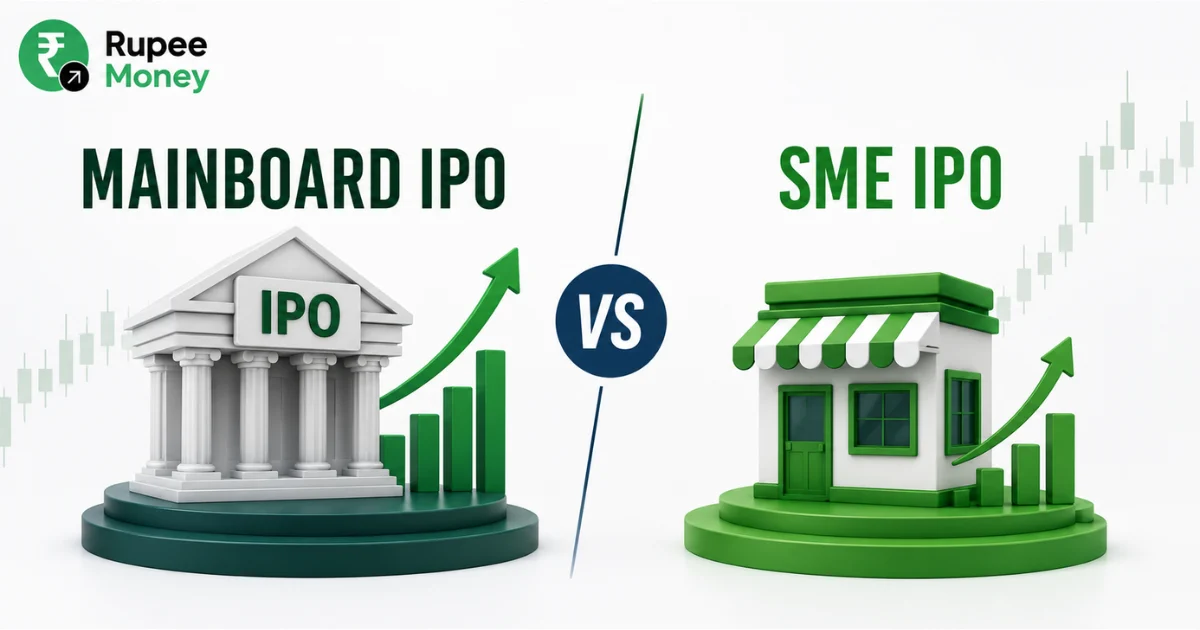
Two companies can launch an IPO in the same week, yet the rules can look completely different. One may list on the mainboard, and the other may list on an SME platform. This difference affects eligibility, application size, trading conditions, and risk. That makes Mainboard IPO vs SME IPO an important comparison for every Indian investor.
At Rupeemoney, we regularly get questions from readers who confuse these two categories. This guide breaks down the real differences with verified 2025-26 data, so you can apply with confidence. If you are new to IPOs, start with our guide on what an IPO is and how companies go public.
What Is a Mainboard IPO?
A mainboard IPO lists a company on the main segment of NSE or BSE. These companies generally operate at a larger scale and attract wider investor participation.
NSE sets clear eligibility rules for mainboard IPOs. A company needs net tangible assets of at least ₹3 crore in each of the last three years. It also needs an average operating profit of ₹15 crore over the same period. Post-issue paid-up capital must reach at least ₹10 crore. Retail investors, institutional investors, and other categories can all apply for mainboard IPOs.
What Is an SME IPO?
An SME IPO lets a small or medium-sized company raise money from public investors. NSE runs this segment through its NSE Emerge platform, and BSE runs a separate BSE SME platform.
The eligibility bar sits lower here, but it still exists. Post-issue paid-up capital cannot exceed ₹25 crore. The company needs net tangible assets and net worth of at least ₹3 crore each. It also needs an operating profit of ₹1 crore in at least two of the last three years. These rules give smaller businesses a real path to public funding.
Mainboard IPO vs SME IPO: Key Differences
| Factor | Mainboard IPO | SME IPO |
| Target companies | Larger, established businesses | Small and medium enterprises |
| NSE platform | NSE Mainboard | NSE Emerge |
| BSE platform | BSE Mainboard | BSE SME |
| Post-issue paid-up capital | At least ₹10 crore | Up to ₹25 crore |
| Minimum application | Often near ₹15,000 | Above ₹2 lakh (2 lots minimum) |
| Trading structure | Standard market trading | SME-specific trading rules |
| Market making | Not compulsory | Compulsory for 3 years post-listing |
| Migration | Not applicable | Eligible firms can move to mainboard |
Exchange rules can change, so always check the latest offer document before you apply.
SME IPO Minimum Investment: What Changed in 2025
Your minimum investment amount marks the biggest practical difference between these two categories. NSE and BSE revised the SME bidding process from July 1, 2025. The earlier Retail Individual Investor category no longer exists. Individual investors must now bid for at least two lots, worth more than ₹2 lakh.
This change came from a SEBI move to filter out casual, speculative bidders. The regulator wanted the SME segment to attract investors with genuine risk capacity. Mainboard IPOs, by contrast, often let you apply with amounts closer to ₹15,000. That gap makes SME IPOs far less accessible for small investors.
Planning a larger, one-time IPO application? The Lumpsum Calculator helps you estimate potential returns on that capital.
SME IPO Trading Lot Size and Market Making
SME stocks often trade in larger lot sizes than mainboard stocks. Each SME IPO sets its own bid lot and minimum order quantity, so check this before applying. A large lot size can make it harder to manage a small position.
Market making adds another layer of support. NSE requires merchant bankers on Emerge issues to act as market makers for three years after listing. A market maker provides buy and sell quotes to support trading activity. This mechanism helps liquidity, but it does not guarantee it. You should still check trading volumes and spreads before you buy SME shares after listing.
Mainboard IPO vs SME IPO: Risk and Liquidity
SME companies often operate at a smaller scale, with fewer customers and a shorter track record. Their earnings can react more sharply to changing business conditions. SEBI has flagged concerns here too. In 2024, it warned investors about misleading claims and manipulative practices at some SME-listed firms. It urged investors to research properly, rather than follow social media tips.
Liquidity follows the same pattern. Mainboard stocks usually have a wider investor base, which supports smoother trading. SME stocks can see thinner volumes, making it harder to exit a position at your expected price. None of this means every SME stock carries excess risk. It simply means SME investing demands deeper research into financials, promoters, and cash flow. Our article on unlisted shares and their risks covers a related set of risk factors worth understanding.
Can an SME Company Move to the Mainboard?
Yes, eligible SME companies can migrate to the mainboard. NSE tightened its migration rules in 2025. A company must show at least ₹100 crore in revenue for the last financial year. Its average market capitalisation over the past three months must also reach ₹100 crore. The company needs positive operating profit in at least two of the last three years. Promoter holding also cannot fall below 50% at the time of application.
Recent examples confirm this path stays active. QMS Medical Allied Services migrated from NSE Emerge to the NSE Mainboard on June 18, 2026. The company first listed on Emerge back in October 2022. This shows SME listing can serve as an early stage in a longer growth story. Migration still depends on meeting every requirement, though, so never buy an SME stock purely on migration hopes.
Mainboard IPO vs SME IPO: 2025-26 Market Snapshot
Real numbers make this comparison clearer. NSE’s own data for calendar year 2025 shows the scale gap between these segments.
- Mainboard IPOs rose to 103 in 2025, up from 90 in 2024.
- These mainboard issues together raised about ₹1.72 lakh crore.
- The average mainboard IPO size stood near ₹1,672 crore.
- SME IPOs fell to 117 in 2025, down from 178 in 2024.
- SME issues together raised about ₹5,784 crore for the year.
- The average SME IPO size rose to roughly ₹49 crore.
These figures show why SME IPOs suit a very different investor profile than mainboard issues. The fundraising scale, and the risk that comes with it, differs enormously between the two segments.
What Should You Check Before an SME IPO?
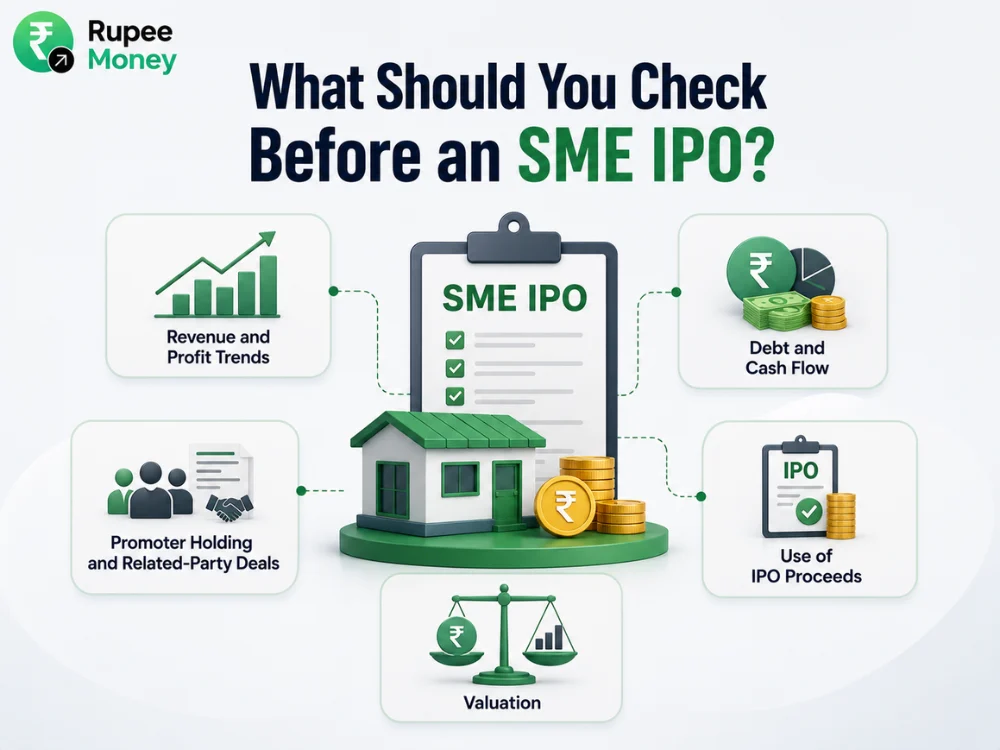
Revenue and Profit Trends
Check several years of data, not just one strong year. Confirm that profit growth comes from core operations, not one-off gains.
Debt and Cash Flow
Compare borrowings against revenue and operating cash flow. A company with manageable debt can handle a tough year more easily. Profit and cash flow can tell different stories, so review both.
Promoter Holding and Related-Party Deals
Study promoter shareholding levels and any share pledging. Also review related-party transactions disclosed in the offer document.
Use of IPO Proceeds
Read exactly how the company plans to spend the money raised. Funds may go toward expansion, working capital, or debt repayment.
Valuation
Compare the IPO price with similar listed peers using P/E and P/B ratios. A lower share price does not always mean a cheaper valuation.
Prefer steady wealth building over SME-level risk? The SIP Calculator can help you plan regular, long-term investments. Our guide on building wealth in your 20s covers this approach in more depth.
How to Choose Between Mainboard and SME IPO
Start with your entry budget. Mainboard IPOs need far less capital upfront. Next, assess your risk capacity honestly, since SME investments carry higher business and liquidity risk. Always study the business itself, rather than chasing high subscription numbers alone. Compare valuation against listed peers before you apply. Finally, decide your investment horizon, because listing gains and long-term returns are two very different goals. Want to compare equity risk against a safer, fixed-return option? The FD Calculator offers a useful reference point.
Key Takeaways
- Mainboard IPOs generally involve larger, established companies.
- SME IPOs target smaller businesses through NSE Emerge or BSE SME.
- SME IPOs now need a minimum investment above ₹2 lakh.
- SME shares can carry larger trading lots and thinner liquidity.
- Market makers support SME trading, but do not guarantee quick exits.
- Eligible SME firms can migrate to the mainboard over time.
- Company fundamentals matter more than the IPO category itself.
Conclusion
The Mainboard IPO vs SME IPO comparison becomes easier when investors focus on size, access, liquidity, risk, and company fundamentals. Mainboard IPOs generally involve larger businesses and offer broader participation. SME IPOs allow smaller companies to raise public capital. They can also offer investors exposure to growing businesses at an earlier stage. However, higher application requirements and potentially lower liquidity make SME IPOs different from mainboard issues. Investors should not assume that SME IPOs always provide higher returns. They should also avoid assuming that mainboard IPOs are automatically safer. The company’s financial health, valuation, business model, management, and growth prospects should remain the main focus.
Frequently Asked Questions:
What is the main difference between a mainboard IPO and an SME IPO?
A mainboard IPO involves a larger company listing on the main segment of NSE or BSE. An SME IPO involves a smaller business listing through NSE Emerge or BSE SME. The two segments follow different eligibility rules, investor requirements, and minimum application sizes.
Is an SME IPO riskier than a mainboard IPO?
SME IPOs can carry higher risk because these companies often operate at a smaller scale with a shorter track record. Risk still depends on the individual company, though. A well-managed SME can outperform a poorly managed large company, so always study the fundamentals.
What is the minimum investment for an SME IPO?
Since July 1, 2025, individual investors must apply for at least two lots in an SME IPO. This pushes the minimum application size above ₹2 lakh. The exact amount depends on the issue price and lot size, so check the offer document for current figures.
Can an SME IPO move to the mainboard?
Yes, if the company meets NSE’s migration criteria. This includes at least ₹100 crore in annual revenue and a market cap of ₹100 crore. It also needs positive operating profit in two of the last three years. QMS Medical Allied Services completed this migration in June 2026.
Which is better for beginners, mainboard IPO or SME IPO?
Mainboard IPOs usually suit beginners better, since they need less capital and offer wider trading participation. SME IPOs demand deeper research because of their higher business and liquidity risk. New investors should understand a company fully before committing significant money.
Disclaimer: This article is for educational and informational purposes only, and it does not constitute investment advice. IPO investments carry market risk, and returns are never guaranteed. SME IPOs can involve additional business, liquidity, and valuation risks beyond those seen in mainboard issues. Eligibility rules, minimum application amounts, and listing conditions can change through SEBI or exchange circulars. Please verify the latest requirements from SEBI, NSE, BSE, and the company’s official offer documents before investing. Rupeemoney does not provide personalised investment advice or guarantee any returns. All figures in this article reflect publicly reported data as of August 2026.
ABOUT THE AUTHOR

