
What Is the Sensex and How IS Calculated?
The Indian stock market moves every business day, and one number tends to dominate the financial headlines — the Sensex. When you hear “the market gained 500 points” or “fell by 800 points,” people are usually talking about this exact figure. But what does that number actually represent, and why do investors, analysts, and businesses watch it so closely?
If you’re new to investing, understanding the Sensex helps you make better financial decisions and gives you a clearer sense of how India’s economy and stock market perform over time.
At RupeeMoney, we believe learning the basics of investing should be simple and practical. This guide covers what the Sensex is, how it gets calculated, why it moves every day, and why every Indian investor should understand it before putting money into the market.
What Is the Sensex?
The Sensex, also called the BSE Sensex, is the benchmark stock market index of the Bombay Stock Exchange (BSE). It tracks the performance of 30 financially strong, actively traded companies listed on the BSE across different industries.
These companies represent major sectors of the Indian economy — banking, information technology, automobiles, pharmaceuticals, energy, FMCG, financial services, and manufacturing. Since these businesses carry significant weight in the economy, their share price movements shape the overall direction of the Sensex.
The exchange introduced the Sensex in 1986, making it India’s oldest stock market index. Investors, financial institutions, policymakers, and analysts all use it as a barometer for the health of the Indian equity market. Even though it includes just 30 companies, those companies together account for a large share of the total market value listed on the BSE.
Why Does the Sensex Matter to Investors?
The Sensex works as a quick read on market sentiment. Rather than tracking thousands of listed companies individually, you can glance at one number to gauge whether the market is generally doing well or poorly.
A rising Sensex usually signals that investors feel optimistic about company earnings, economic growth, and business conditions. A falling Sensex often reflects concerns like weak corporate earnings, global uncertainty, inflation, higher interest rates, or geopolitical tension.
The Sensex also helps you understand broader market trends, compare mutual fund performance, measure your own portfolio returns, read economic conditions, and track overall investor confidence — all useful inputs for making informed investment decisions. That said, long-term investors should avoid reacting to daily Sensex swings and instead focus on long-term wealth creation through disciplined investing. Our guide on what SIP is and how it works covers exactly that kind of steady, long-term approach.
How Does the Sensex Work?
The Sensex tracks the combined market performance of its 30 constituent companies. Whenever the share price of any of these companies changes, their market value shifts too, and that ripples through into the overall index value.
Not every company carries equal weight, though — larger companies with higher market capitalisation influence the Sensex more than smaller ones. If a company with a very high market value posts a sharp price increase, it can push the Sensex higher even while several smaller companies decline. Similarly, if a major banking or technology company falls significantly, the Sensex can drop despite gains elsewhere in the index.
How Is the Sensex Calculated?
The BSE calculates the Sensex using the Free Float Market Capitalisation Method, which considers only the shares investors can freely buy and sell in the market. It excludes shares held by promoters, governments, founders, or other strategic investors, since these typically stay unavailable for public trading.
The calculation follows three steps:
- Calculate free float market capitalisation — each company’s market value comes from its current share price multiplied by its publicly available shares: Free Float Market Cap = Share Price × Publicly Available Shares. Only freely traded shares count toward this figure.
- Add up the free float market value — the free float market capitalisation of all 30 Sensex companies gets combined into one total figure.
- Apply the index divisor — the BSE divides this combined market cap by a fixed number called the Index Divisor, which adjusts for stock splits, bonus issues, rights issues, mergers, and other corporate actions. This keeps the index reflecting genuine price changes rather than artificial shifts caused by corporate events.
What Is Free Float Market Capitalisation?
Free float market capitalisation refers to the total market value of shares that stay available for public trading. It excludes shares held by company promoters, government holdings, founders, strategic investors, employee trusts, and locked-in shares.
This approach gives a more realistic picture of the market since it measures only the shares investors actively trade every day. Most major global indices use this same free float methodology because it better reflects real market activity.
How Are Sensex Companies Selected?
The BSE regularly reviews the companies included in the Sensex, and a dedicated committee picks companies based on several factors — not simply the largest businesses by size.
Companies generally qualify based on large free float market capitalisation, high daily trading volume, strong liquidity, consistent financial performance, good corporate governance, representation across different sectors, and a solid listing history on the BSE.
The committee reviews this list periodically, and if another company outperforms and meets the eligibility criteria, it may replace an existing constituent. This process keeps the Sensex representative of India’s evolving economy and business landscape.
Why Does the Sensex Go Up and Down?
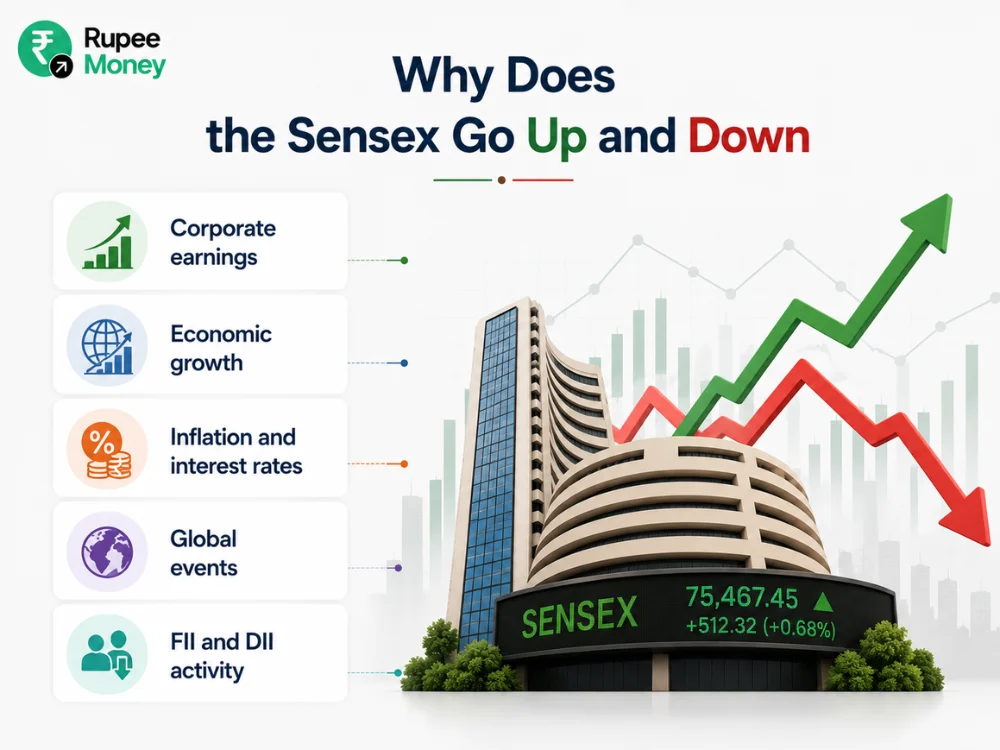
The Sensex changes every trading day because share prices of its constituent companies keep shifting, driven by investor demand and supply. When buyers outnumber sellers, prices generally rise; when sellers dominate, prices often fall. Several factors drive this:
- Corporate earnings: quarterly and annual results play a major role in shaping share prices. Companies reporting higher revenue, better profits, and stronger guidance tend to attract more buying interest, which can lift the Sensex — poor earnings or a weak outlook typically have the opposite effect.
- Economic growth: a growing economy generally supports higher corporate profits. Strong GDP growth, rising consumer spending, and increasing industrial production tend to boost investor confidence and push the Sensex up.
- Inflation and interest rates: higher inflation eats into purchasing power and raises business costs. If the Reserve Bank of India raises rates to control inflation, borrowing gets more expensive for both companies and consumers, which can slow growth and affect the market.
- Global events: international factors also move the Indian market — oil prices, geopolitical conflicts, global recessions, and major central bank decisions can all shift investor sentiment and trigger sharp Sensex movements.
- FII and DII activity: Foreign and Domestic Institutional Investors move large sums into Indian equities. Heavy buying tends to support market rallies, while large-scale selling can put real pressure on stock prices.
Sensex vs Nifty: What’s the Difference?
Many beginners mix up the Sensex with the Nifty. Both track the Indian stock market, but they differ in a few key ways.
| Feature | Sensex | Nifty 50 |
| Exchange | Bombay Stock Exchange (BSE) | National Stock Exchange (NSE) |
| Number of Companies | 30 | 50 |
| Launch Year | 1986 | 1996 |
| Method | Free Float Market Capitalisation | Free Float Market Capitalisation |
| Purpose | Benchmark Index of BSE | Benchmark Index of NSE |
Both indices usually move in the same direction since they represent India’s largest listed companies, but the percentage movement can differ slightly because of the different companies each one includes.
Advantages of Tracking the Sensex
Following the Sensex offers real benefits, especially for beginners: it gives you a quick overview of the Indian stock market, reflects investor confidence, represents multiple economic sectors, helps you compare mutual fund performance, supports long-term investment decisions, acts as a benchmark for your own portfolio, and helps you understand broader market cycles. Just remember that the Sensex works as an indicator, not an investment product you can buy directly.
Limitations of the Sensex
The Sensex remains one of India’s most important market indicators, but it has real limits too. It includes only 30 companies, leaving smaller businesses out entirely, so it can’t represent every listed company. Sector weights can also grow uneven over time, and short-term movements often reflect market sentiment more than actual economic conditions. Because of this, pair the Sensex with proper company research and financial analysis rather than relying on it alone. Metrics like Return on Assets (ROA) can add real depth to that research by showing how efficiently a company actually uses its assets.
How Should Beginners Use the Sensex?
New investors often get nervous when the Sensex falls sharply, but daily fluctuations are a completely normal part of investing. Instead of reacting to every move, beginners should focus on long-term investing, diversify across different asset classes — our guide to large-cap mutual funds is a solid starting point for that — invest regularly through SIPs, avoid emotional buying and selling, study company fundamentals before investing, and monitor economic trends rather than daily market noise. A disciplined strategy usually beats trying to predict short-term movements. If you’re just starting to build good financial habits, our guide on building wealth in your 20s pairs well with this approach.
Common Mistakes Investors Make While Following the Sensex
Plenty of investors misunderstand what the Sensex actually represents. Common mistakes include assuming every stock moves in step with the Sensex, buying shares simply because the index rises, selling investments during temporary corrections, ignoring company fundamentals, focusing only on index levels, and believing a rising Sensex guarantees profits. Successful investing takes patience, research, and realistic expectations — not shortcuts based on a single headline number.
Conclusion
The Sensex remains one of the most widely followed indicators of the Indian stock market, representing the performance of 30 leading companies listed on the BSE and reflecting overall market sentiment. Understanding how it works helps you interpret market movements with real confidence.
While daily fluctuations grab headlines, long-term wealth creation depends on disciplined investing, proper diversification, and picking quality businesses rather than reacting to every rise or fall in the index. If you’re weighing how a lump-sum investment might grow over time, our Lumpsum Calculator can help, and if you’d rather compare market-linked returns against fixed-income options, our FD Calculator offers a useful side-by-side. Whether you’re investing for the first time or building a long-term portfolio, knowing how the Sensex gets calculated helps you make better financial decisions overall. For a broader sense of how the market itself functions before you dive in, our guide on how the stock market works in India is worth a read too.
Frequently Asked Questions
What is the Sensex in simple words?
The Sensex is the benchmark stock market index of the Bombay Stock Exchange, tracking the performance of 30 large, financially strong companies across different Indian industries. Investors use it to gauge the overall direction of the market — a rising Sensex usually signals positive sentiment, while a falling one often reflects weaker confidence or negative economic developments.
How is the Sensex calculated?
The Sensex uses the Free Float Market Capitalisation Method, considering only shares available for public trading and excluding promoter or government-owned shares. The BSE calculates the combined free float market value of all 30 companies and divides it by a standard index divisor to arrive at the Sensex value.
Why does the Sensex change every day?
The Sensex changes because share prices of its constituent companies shift throughout the trading session. Corporate earnings, economic data, interest rates, inflation, foreign investment flows, company news, and global events all influence investor demand and stock prices, moving the Sensex up or down.
What’s the difference between the Sensex and the Nifty?
The Sensex tracks 30 major companies on the BSE, while the Nifty 50 tracks 50 large companies on the NSE. Both use the Free Float Market Capitalisation Method and serve as benchmark indices, differing mainly in the number of companies and which exchange they represent.
Can beginners use the Sensex to make investment decisions?
Yes, beginners can use it to understand overall market trends and sentiment, but shouldn’t base decisions purely on index movements. Pair it with a look at company fundamentals, your financial goals, and your own risk tolerance before investing.
Does a rising Sensex mean every stock is going up?
No. The Sensex represents only 30 selected companies, and plenty of stocks outside the index can move quite differently. Even within the index itself, some companies may fall while others rise — the overall figure reflects the combined weighted performance of all 30 constituents.
Disclaimer: This article is meant to educate and inform readers and does not provide professional investment, financial, legal, or tax advice. Investing in the stock market carries inherent risks, and previous performance should not be viewed as a guarantee of future returns. Make informed decisions by conducting independent research and consulting a qualified financial advisor.
ABOUT THE AUTHOR

