
What Is a Dividend and How Does It Work? A Beginner’s Guide

If you’ve ever invested in shares or mutual funds, you’ve probably heard people talk about earning dividends. Plenty of new investors assume stock market returns come only from rising share prices, but many companies also reward shareholders by sharing a slice of their profits directly — that’s a dividend.
For long-term investors, dividends can become an extra income stream while boosting your overall returns. Understanding how they work helps you pick better investments and build a stronger portfolio. At RupeeMoney, we believe every investor should get these basics right before putting money into the stock market.
In this guide, you’ll learn what dividends are, how companies pay them, the different types you’ll come across, the key dates worth remembering, and whether dividend-paying stocks deserve a spot in your portfolio.
What Is a Dividend?
A dividend is a portion of a company’s profits that it pays out to its shareholders. Rather than keeping every rupee of earnings for business expansion, the company shares part of its profit with the investors who own its shares.
Companies typically pay dividends only after their board of directors approves the payout, and not every company pays one — many growing businesses would rather reinvest profits into expansion, research, or acquisitions than distribute cash. You’ll usually see dividend payments from financially stable companies that generate consistent profits year after year.
For example, if you own 500 shares of a company that announces a dividend of ₹8 per share, you receive 500 × ₹8 = ₹4,000, credited directly to your registered bank account after the payment date.
How Do Dividends Work?
Understanding the dividend process helps you know whether you actually qualify to receive a payout.
- The company earns profits — it completes its financial year or quarter and reports its earnings.
- The board approves the dividend — the board decides whether to distribute part of the profits, along with the amount, dividend type, key dates, and payment schedule.
- The company announces it — the announcement goes out publicly through stock exchanges like the National Stock Exchange (NSE) and the Bombay Stock Exchange (BSE).
- Eligible shareholders get paid — investors who qualify based on the announced dates receive the dividend straight into their bank accounts.
Important Dividend Dates Every Shareholder Should Know
Many beginners buy shares right after hearing a company has announced a dividend, only to find out timing matters more than they expected — buying at the wrong moment means you might not actually receive it. These dates decide your eligibility.
Declaration Date
This is the day the company officially announces the dividend, including the amount, record date, ex-dividend date, and payment date. It’s the day investors first learn about the payout.
Ex-Dividend Date
The ex-dividend date ranks among the most important dates for any investor. You must buy the shares before this date to qualify for the dividend — if you buy on or after it, the previous shareholder receives the payout instead, since stock settlements need time before ownership officially transfers.
Record Date
The record date is when the company checks its shareholder records; only investors whose names appear on record that day qualify for payment. Since Indian markets follow the T+1 settlement cycle, you typically need to buy shares before the ex-dividend date to make the cut.
Payment Date
The payment date is when the company actually transfers the dividend to eligible shareholders, usually reaching your registered bank account through electronic transfer.
Types of Dividends
Companies reward investors in different ways. Cash dividends remain the most common, but companies sometimes choose other methods depending on their financial position.
- Cash dividends: the most popular type — companies transfer cash directly into shareholders’ bank accounts, giving investors immediate income without selling any shares.
- Stock dividends: instead of cash, some companies issue additional shares. If a company announces a 10% stock dividend, an investor holding 100 shares receives 10 more — though the overall investment value usually stays similar since the share price adjusts accordingly.
- Special dividends: companies that earn exceptionally high profits, often after selling assets or completing major transactions, may distribute a one-time special dividend instead of raising regular payouts permanently. These don’t happen every year.
- Interim dividends: paid before the financial year wraps up, based on current profits rather than waiting for annual financial statements.
- Final dividends: declared after the company prepares its annual financial statements and shareholders approve it at the Annual General Meeting (AGM) — many Indian companies follow this practice every year.
Dividend Yield and Why It Matters
It tells you how much dividend income you receive relative to the current share price.
Dividend Yield = (Annual Dividend Per Share ÷ Current Share Price) × 100
For example, if a share trades at ₹500 and pays an annual dividend of ₹20, the yield works out to (20 ÷ 500) × 100 = 4%.
A higher yield might look attractive, but you shouldn’t pick a stock based on this number alone. Sometimes a company’s share price falls sharply, which artificially inflates the yield — and that’s rarely a sign of a strong investment. A genuinely healthy dividend-paying company should also show stable earnings, manageable debt, consistent cash flow, and real long-term growth.
How Dividends Affect Share Price and NAV
When a company pays a dividend, it distributes part of its accumulated profits to shareholders, which reduces its available cash. As a result, the share price often adjusts downward by roughly the dividend amount on the ex-dividend date.
Similarly, if a mutual fund declares a payout under the Income Distribution cum Capital Withdrawal (IDCW) option, the Net Asset Value (NAV) falls by approximately the amount distributed. This isn’t a loss — it simply reflects that part of the investment’s value has already been paid out to you as income.
Dividend vs Capital Gains
Investors often mix these two up, but they generate returns in different ways.
| Feature | Dividends | Capital Gains |
| Source | Company distributes profits | Share price increases |
| Income | Regular, if declared | Only when you sell shares |
| Risk | Usually more stable | Depends on market movement |
| Best For | Income-focused investors | Wealth creation, long-term growth |
Say you buy a stock for ₹1,000 and later sell it for ₹1,300 — you earn a capital gain of ₹300. If that same company also paid ₹25 per share as a dividend during your holding period, that ₹25 becomes your dividend income. Together, both contribute to your total investment returns.
Benefits of Dividend Investing
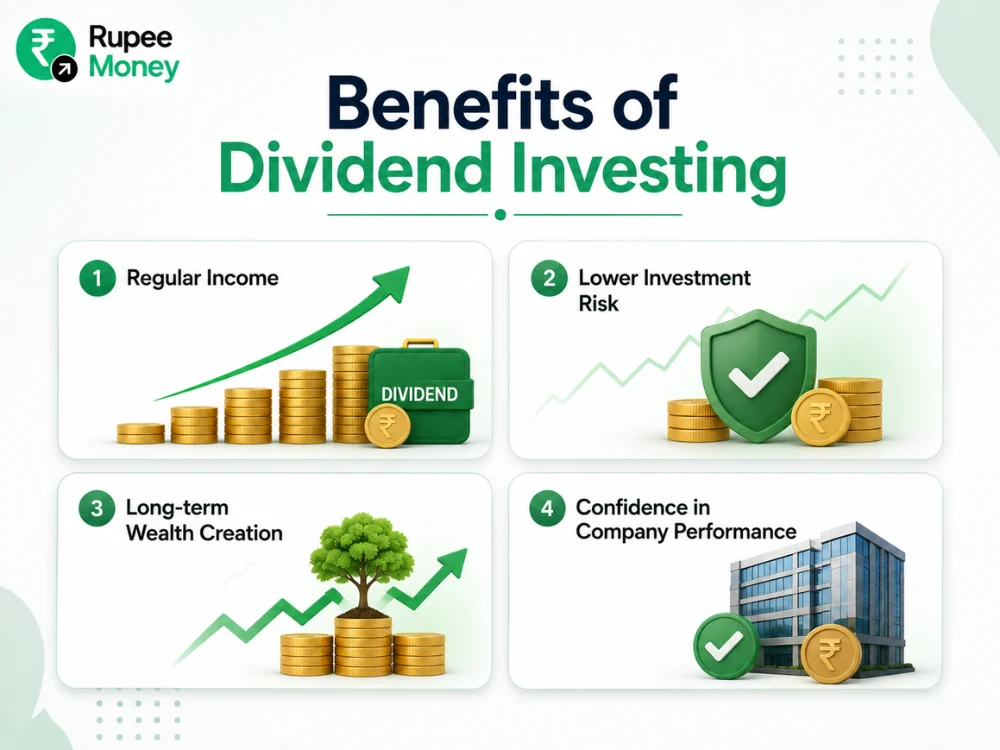
Dividend-paying companies offer real advantages, especially for long-term investors:
- Regular income: you receive cash without selling any shares — a big draw for retirees and income-focused investors.
- Lower investment risk: companies that consistently pay dividends usually show stable earnings and strong financial health, which often helps them hold up better during uncertain markets.
- Long-term wealth creation: reinvesting dividends into more shares lets you benefit from compounding, and over several years this can meaningfully boost your portfolio’s value. Running your own numbers through our SIP Calculator can show how consistent reinvestment compounds over time.
- Confidence in company performance: a company that regularly rewards shareholders often reflects healthy cash flow and consistent profitability — though dividends never guarantee future performance.
Risks of Dividend Investing
Dividends bring real benefits, but you should understand their limits too:
- Dividends aren’t guaranteed: companies can reduce, suspend, or fully stop dividends if profits decline or business conditions worsen.
- A high yield can mislead you: sometimes a falling share price artificially inflates the yield, so always check the company’s financial strength before investing.
- Growth potential can be limited: mature companies that distribute most of their profits instead of reinvesting may see their share prices grow more slowly than fast-expanding businesses.
How to Choose Good Dividend Stocks
Picking dividend-paying companies takes more than just checking the payout amount:
- Look for a consistent dividend payment history.
- Review profit growth over several years.
- Check whether earnings comfortably support the dividend payments.
- Evaluate debt levels and cash flow.
- Study the company’s business model and future growth prospects — our guide on Return on Assets (ROA) can help you judge how efficiently a company uses its assets.
- Compare dividend yield against peers in the same industry instead of chasing unusually high numbers.
A balanced approach like this helps you build a stronger portfolio while cutting down unnecessary risk.
Tax on Dividends in India
Dividend taxation in India has shifted over the years. Currently, dividends you receive from Indian companies become taxable in your hands according to your applicable income tax slab. Companies may also deduct Tax Deducted at Source (TDS) if your dividend payments cross the prescribed threshold in a financial year.
Since tax rules can change through future Union Budgets, always verify the latest provisions before filing your income tax return.
Should You Invest for Dividends?
The right answer depends on your financial goals. Dividend investing suits investors who want regular income alongside long-term wealth creation. If you’re a company shareholder mainly chasing capital appreciation — say, someone who bought in through an IPO — growth-oriented companies might suit you better, while investors nearing retirement often value the stability dividend-paying companies provide.
Instead of picking stocks purely because they pay dividends, build a diversified portfolio that matches your risk tolerance, investment horizon, and financial goals. If you’d rather compare a lump-sum approach to long-term investing, our Lumpsum Calculator can help you estimate potential growth, and if you’re leaning toward a more diversified, professionally managed route, our guide to large-cap mutual funds is worth a read.
Frequently Asked Questions (FAQs)
What is a dividend in simple words?
A dividend is a share of a company’s profit that it pays out to its shareholders. When a company performs well financially, its board may decide to reward investors with a dividend, transferring the amount directly to shareholders’ bank accounts or issuing additional shares depending on the type declared. Companies have no legal obligation to pay dividends every year.
Who’s eligible to receive dividends?
Only investors who own the shares before the ex-dividend date and whose names appear in the company’s records on the record date qualify. If you buy shares on or after the ex-dividend date, you generally won’t receive that particular dividend, since the previous shareholder remains eligible.
Is dividend income taxable in India?
Yes. Dividend income gets taxed according to your applicable income tax slab, and companies may deduct TDS if payments cross the prescribed threshold under current rules. Include dividend income when filing your return, and check the latest provisions for the relevant financial year.
What’s the difference between dividend yield and dividend amount?
The dividend amount is the cash paid per share, like ₹10 per share. Dividend yield compares that amount with the share’s current market price, helping you gauge the income potential relative to its cost. A higher yield doesn’t automatically mean a better investment, since other financial factors matter just as much.
Can mutual funds pay dividends?
Yes, through the Income Distribution cum Capital Withdrawal (IDCW) option. When a fund makes a distribution, its NAV usually drops by roughly the same amount. Investors seeking regular cash flow often pick this option, while those focused on long-term growth tend to prefer the Growth option instead.
Should beginners invest only in dividend-paying stocks?
No. Beginners shouldn’t pick stocks based on dividends alone — evaluate business quality, earnings growth, financial health, valuation, and long-term potential first. A diversified portfolio mixing growth and dividend-paying companies generally manages risk better. Our guide on building wealth in your 20s covers how to build that balance early on.
Conclusion
Dividends can become an important part of a successful investment strategy. They provide regular income, reward long-term shareholders, and can meaningfully add to wealth creation when reinvested over time. That said, never choose a stock solely because it offers a high dividend yield — always evaluate the company’s financial strength, business prospects, and overall investment potential first.
Understanding dividend dates, yield, taxation, and company fundamentals lets you make informed decisions and build a balanced portfolio that supports both income and long-term growth. If fixed-income options interest you as a more conservative complement to dividend stocks, our FD Calculator can help you compare potential returns side by side.
Disclaimer: This article is for educational and informational purposes only. It should not be considered financial, investment, tax, or legal advice. Stock market investments involve risk, and dividend payments are never guaranteed. Always conduct your own research or consult a qualified financial advisor before making investment decisions.
ABOUT THE AUTHOR

