
Banks Give You Credit Cards for Free? – The Reality Behind “Free” Credit Cards
You have probably seen advertisements for credit cards offering zero joining fees, lifetime-free validity, or massive cashback rewards. This naturally leads to a very logical question: if the plastic in your wallet is completely free, how is the issuing bank turning a profit?
The reality is quite straightforward. While acquiring the card might cost you absolutely nothing, the financial ecosystem tied to it transactions, interest rates, hidden charges, and cross-selling opportunities creates a highly profitable revenue engine for financial institutions. Let us trace the money trail to understand the exact mechanics of the credit-card business.
Why Do Banks Give Credit Cards for Free?
Financial institutions do not hand out credit cards out of sheer generosity. A credit card acts as a powerful acquisition tool that pulls a consumer directly into the bank’s broader financial ecosystem.
The moment you activate and swipe that card, you trigger a chain of events that generates revenue for the issuer, the payment network, and the acquiring bank. Beyond direct transaction revenue, issuers use lifetime-free cards as a relationship-building tool. Once a consumer is comfortable with a specific bank’s mobile application and customer service, they are highly likely to return to that same institution when they need a home loan, a high-yield savings account, mutual fund investments, or life insurance.
The primary business is rarely the upfront annual fee; it is the continuous financial activity generated around your spending habits.
How Do Banks Make Money From Credit Cards?
1. Merchant Fees
Every time you swipe your card at a retail store or complete an online checkout, the merchant pays a specific fee to accept that payment. The funds from your transaction do not flow directly from your account to the supermarket. The payment network (like Visa, RuPay, or Mastercard), the merchant’s bank, and your card-issuing bank all take a tiny fraction of that transaction. Because the merchant absorbs this cost to facilitate a smooth sale, issuers can comfortably waive your upfront joining fee.
2. Interest on Unpaid Bills
This remains the most lucrative segment of the credit-card industry. Imagine your monthly statement shows a total due of ₹20,000. If you clear this exact amount before the due date, you enjoy an interest-free credit period.
However, if you opt to pay only the “minimum due” of ₹5,000 and carry forward the remaining ₹15,000, the bank applies a heavy finance charge on the outstanding balance. Revolving credit often attracts annualized interest rates ranging from 36% to 42%, making it a massive profit center for issuers. This is exactly why clearing your total outstanding amount by the due date is critical.
3. Late-Payment Charges
Missing your payment deadline triggers immediate financial penalties. Depending on the outstanding balance and the specific terms and conditions of your issuer, late payment fees can add a substantial amount to your next billing cycle. A card that costs you nothing to join can still generate massive revenue through penalty charges.
4. Annual and Other Fees
Despite the marketing hype, not every card is genuinely free. Many premium and co-branded cards carry annual renewal fees, cash withdrawal penalties, forex markup charges for international spending, and card replacement fees. Even cards marketed as “free” often require you to cross a specific annual spending milestone to get the subsequent year’s fee waived. Always read the fine print before assuming a card is entirely free.
5. EMI and Other Financial Products
A credit card is essentially a gateway to high-margin retail lending. Issuers constantly offer you the option to convert large electronics or travel purchases into equated monthly installments (EMIs). These conversions come with processing fees and interest rates. Additionally, banks cross-sell personal loans pre-approved against your credit limit, or offer balance-transfer facilities, adding layers of auxiliary revenue.
So Where Does Your ₹10,000 Credit-Card Payment Go?
Consider a scenario where you buy a new smartphone for ₹10,000 using your card. On your screen, it looks like a direct transfer of ₹10,000 to the electronics retailer.
However, behind the scenes, a complex settlement process occurs. The transaction runs through the card network’s payment gateway, dividing a small percentage among the acquiring bank (the merchant’s bank), the payment network, and the issuing bank (your bank). This hidden split is exactly why you aren’t just using a complimentary piece of plastic; you are an active participant in a vast, interconnected payment grid where multiple corporate entities monetize your daily spending.
5 Best Credit Cards to Know in India
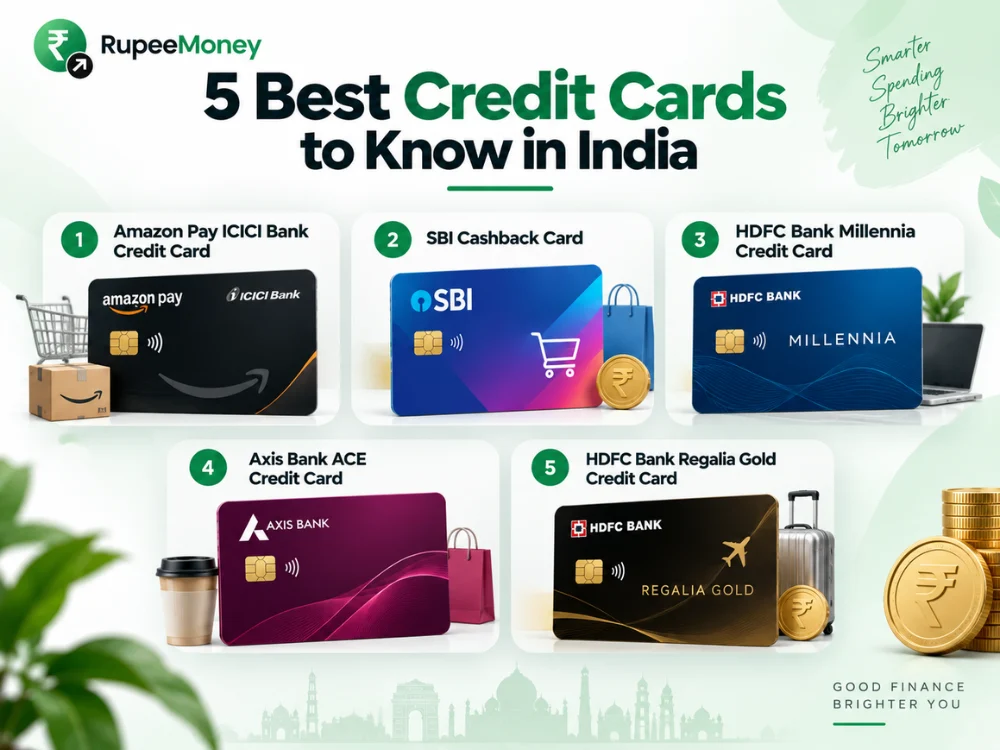
Instead of searching for a universally “perfect” card, Indian consumers should align their card choices with their primary spending habits. Here is a look at five notable options:
1. Amazon Pay ICICI Bank Credit Card
Best known for: Amazon shopping and rewards
Widely recognized for its aggressive cashback structure on Amazon purchases, this co-branded card is a staple for heavy e-commerce shoppers. It is heavily marketed as lifetime-free, though exact reward percentages and eligibility criteria remain subject to the issuer’s updated terms.
Consider it if: A significant part of your household spending happens within the Amazon delivery ecosystem.
2. SBI Cashback Card
Best known for: Online spending and cashback
This option is tailored specifically for digital shoppers, offering direct cashback on eligible online spends rather than complex reward points. Users must carefully review the latest terms from SBI Card, as monthly cashback caps and merchant exclusions frequently update.
Consider it if: You want a card focused primarily on straightforward statement credits for your internet transactions.
3. HDFC Bank Millennia Credit Card
Best known for: Online shopping and brand-based rewards
Designed for the modern consumer, this card targets popular online lifestyle, travel, and fashion brands. Its true value unlocks only if your spending aligns with their list of partnered merchants and how you choose to redeem the accumulated points.
Consider it if your regular discretionary spending matches the card’s targeted reward categories.
4. Axis Bank ACE Credit Card
Best known for: Everyday bills and cashback
For routine household management, this card focuses on generating value from everyday utility bills and basic spending. By offering cashback on routine expenses via partnered platforms, it serves as a solid base card for unavoidable monthly bills.
Consider it if: You want to use a single card to streamline regular household payments and daily spending.
5. HDFC Bank Regalia Gold Credit Card
Best known for: Travel and reward benefits
Operating in the premium segment, Regalia Gold focuses on travel perks, flight upgrades, and accelerated milestone rewards. Because it carries an annual fee and stricter income eligibility requirements, you must weigh the upfront cost against your actual travel frequency.
Consider it if: You spend enough on travel and premium categories to comfortably offset the annual fees.
Which Credit Card Should You Choose?
There is no single financial tool that fits every consumer profile. Your final selection must reflect your personal financial behavior rather than the highest advertised reward rate.
| Your spending pattern | Card to research |
| Amazon shopping | Amazon Pay ICICI |
| Online spending | SBI Cashback |
| Online brands | HDFC Millennia |
| Bills and everyday spending | Axis ACE |
| Travel and premium rewards | HDFC Regalia Gold |
Always conduct thorough research on the latest fee structures, reward capping limits, hidden exclusions, and income eligibility before submitting an application.
The Catch Behind a “Free” Credit Card
A lifetime-free credit card might spare you from an annual renewal charge, but that does not mean the entire borrowing experience is complimentary. The most critical rule of personal finance applies here: free card ≠ free borrowing.
If you clear your entire statement balance by the due date, you can successfully bypass revolving interest on standard retail purchases. However, the moment you carry a balance forward, utilize a cash advance at an ATM, or miss a payment deadline, the associated penalties compound rapidly. This is exactly why a credit card must be utilized strictly as a secure payment and cash-flow management tool, not as an artificial extension of your monthly income.
The Real Business Behind Your “Free” Card
The next time a bank offers you a pre-approved credit card with a ₹0 joining fee, understand the underlying business model. The issuing bank is willingly sacrificing the upfront annual charge because they know the broader ecosystem is incredibly lucrative.
You initiate the spend. The merchants pay the backend processing fees. A certain percentage of users will inevitably carry a balance and pay heavy revolving interest. Others will trigger foreign markup charges or EMI processing fees. Through all of this, the bank successfully locks you into a long-term, multi-product banking relationship.
The piece of plastic in your wallet might be free, but the business model funding it certainly is not.
Conclusion:
A lifetime-free credit card is an effective customer acquisition tool, not corporate charity. Banks willingly forgo joining and annual fees because merchant interchange charges, late fees, and revolving interest rates (often exceeding 36%–42% annually) make the ecosystem highly profitable.
If you pay your statement balance in full every month, a free credit card serves as a secure, rewarding payment method funded by merchants. However, if you revolve balances or pay only the minimum due, compounding interest will quickly outweigh any reward benefits. Treat your card as a convenient payment tool not an extension of your income.
FAQs
How do banks make money if I pay my full balance on time?
Banks earn an interchange fee a percentage of each transaction paid by the merchant’s bank whenever you swipe or pay online. Active cardholders also give banks opportunities to cross-sell loans and savings accounts.
What happens if I only pay the "Minimum Amount Due"?
Paying only the minimum avoids late penalty charges, but it cancels your interest-free period. The remaining balance immediately starts accruing finance charges (typically 3% to 3.75% per month) plus GST until fully cleared.
Are "lifetime-free" credit cards completely free of charges?
They have zero joining and annual renewal fees, but secondary charges still apply. You will still pay for ATM cash advances, late payments, international forex markups, and interest if you carry a balance.
How do "No-Cost EMI" schemes work for banks?
The interest you would normally owe is offered as an upfront merchant discount on the product's price. The bank still earns its regular interest over the repayment period, often alongside a one-time non-refundable processing fee.
Does canceling an unused free card hurt your credit score?
It can. Closing a card reduces your total available credit limit, which can increase your overall credit utilization ratio. If it is your oldest card, closing it can also shorten your average credit history length.
The interest you would normally owe is offered as an upfront merchant discount on the product’s price. The bank still earns its regular interest over the repayment period, often alongside a one-time non-refundable processing fee.
Disclaimer: This content is for educational and informational purposes only and does not constitute financial or credit advice. Credit card fees, interest rates, and terms change periodically. Always verify the latest terms with the card issuer before applying.
ABOUT THE AUTHOR

