
Shakti Polytarp IPO 2026: Business Model & Full IPO Review
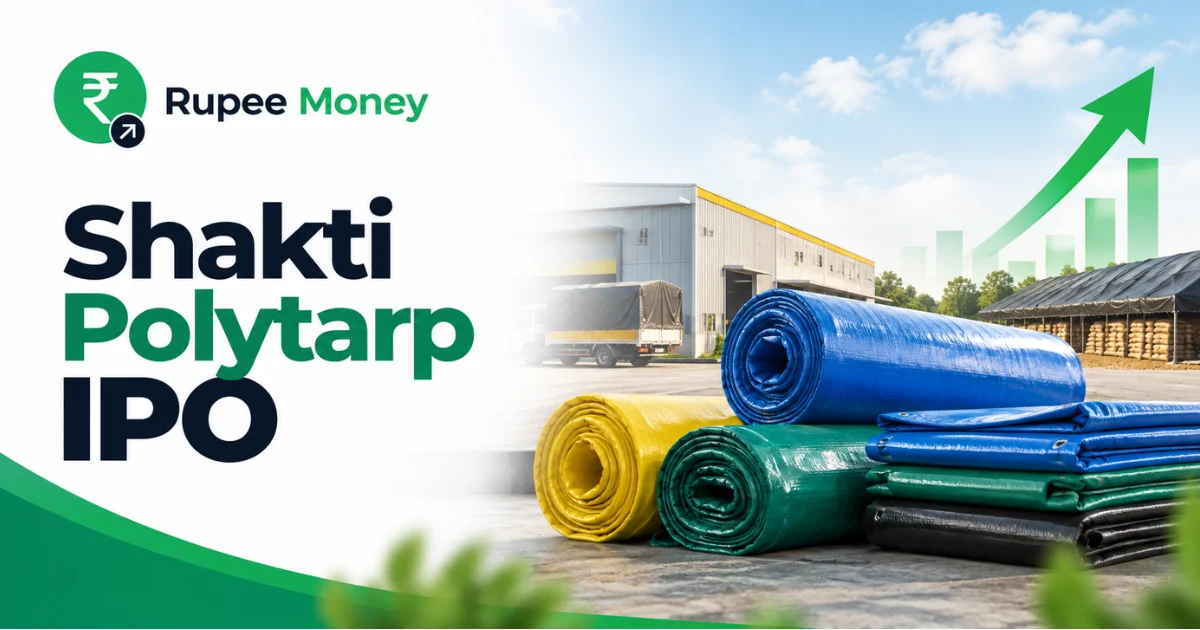
Modern agricultural supply chains, civil construction projects, logistics warehouses, and industrial packaging networks rely extensively on multi-layered, waterproof protective coverings. Capitalizing on India’s rising infrastructure outlays and rural warehousing expansion, Indore-headquartered Shakti Polytarp Limited is entering the primary capital markets with an initial public offering (IPO) on the BSE SME platform. The enterprise aims to raise approximately ₹26.93 crore through a fresh issuance of equity shares to fund plant machinery expansion and scale manufacturing output.
Evaluating a small-cap polymer fabricator demands the same analytical rigor you apply to personal financial planning. Because industrial tarpaulin and shade net manufacturing involves volatile petrochemical input prices, tight operating working capital cycles, and leveraged capacity additions, prudent investors must look past top-line sales growth. You must examine debt service coverage, credit-line utilization, and cash conversion cycles. If you are exploring primary market offerings for the first time, our foundational guide covering what is an IPO outlines fundamental concepts for analyzing corporate share offerings.
This comprehensive review examines the Shakti Polytarp IPO, dissecting its production capabilities, issue timetable, valuation metrics, balance sheet debt profile, and primary investment risks.
Shakti Polytarp IPO: Core Issue Architecture
Shakti Polytarp utilizes a book-built public issue mechanism to raise expansion capital. The offering consists entirely of fresh equity shares without any secondary Offer for Sale (OFS), ensuring that all net proceeds flow directly into the corporate treasury to fund tangible asset expansion.
| Issue Parameter | Official Offer Specification |
| Company Name | Shakti Polytarp Limited |
| Market Segment | SME IPO |
| Listing Exchange | BSE SME |
| Issue Format | Book-Built Public Issue |
| Price Corridor | ₹56 to ₹59 per equity share |
| Face Value | ₹10 per share |
| Gross Issue Size | Approximately ₹26.93 crore |
| Fresh Issue Component | 100% Fresh Capital Issue |
| Offer for Sale (OFS) | Nil |
| Standard Market Lot | 2,000 shares |
| Minimum Retail Application | 2 Lots (4,000 shares) |
| Minimum Retail Outlay | ₹2,36,000 (at upper band) |
| Registrar to the Issue | Skyline Financial Services Pvt. Ltd. |
| Lead Merchant Banker | NEXGEN Financial Solutions Pvt. Ltd. |
(Note: Market timelines and allocation figures remain subject to final regulatory confirmation from the stock exchange.)
Subscription Schedule and Important Dates
Bidders should monitor the official schedule outlined below to ensure timely UPI mandate authorizations:
| IPO Milestone | Scheduled Calendar Date |
| Public Bidding Opens | September 15, 2026 |
| Public Bidding Closes | September 17, 2026 |
| Finalization of Allotment | September 18, 2026 |
| Initiation of Bank Refunds | September 21, 2026 |
| Credit of Shares to Demat | September 21, 2026 |
| Official Exchange Debut | September 22, 2026 |
If your application does not secure an allotment during the share allocation lottery, review our guide explaining what happens if you don’t get IPO allotment to understand the automated banking refund protocol.
Pricing Mechanics and Minimum Capital Allocation
The merchant bankers established the pricing corridor at ₹56 to ₹59 per equity share. To understand how lead managers arrive at these valuation ranges, read our explainer on how IPO share prices are decided in India.
Because Shakti Polytarp lists on the BSE SME platform, exchange rules enforce larger minimum application sizes to deter speculative day-trading. While a single base lot contains 2,000 shares, individual retail participants must bid for a minimum of two lots (4,000 shares).
Calculating the baseline retail financial outlay at the ₹59 cut-off yields:
4,000 shares ✕ ₹59 = ₹2,36,000
Small High Net-Worth Individuals (sHNI) must apply for a minimum of three lots (6,000 shares), locking in an upfront capital commitment of ₹3,54,000. Big High Net-Worth Individuals (bHNI) must bid for at least nine lots (18,000 shares), establishing a ₹10,62,000 threshold. Deploying such substantial capital blocks requires structured budgeting, similar to assessing long-term portfolio compounding via a lumpsum calculator or calculating loan costs using an EMI calculator.
Grey Market Premium (GMP) Overview
As of early September 2026, unlisted tracking portals report the Grey Market Premium (GMP) for Shakti Polytarp as unavailable or trading near parity at ₹0 per share.
A flat GMP reading indicates that unofficial market participants are withholding speculative quotes until early bidding numbers reveal genuine institutional appetite. Investors must remember that grey market quotes reflect unregulated sentiment and never guarantee listing gains. Production metrics, operating cash flows, and balance sheet leverage should guide your investment choices rather than informal premium rumors.
Corporate Operating Model and Manufacturing Engine
Incorporated in March 2018, Shakti Polytarp Limited manufactures heavy-duty tarpaulins, agro-shade nets, and specialized multilayer polymer membranes. Operating primarily on a Business-to-Business (B2B) framework with secondary distribution reaching consumer channels, the company serves clients across agriculture, logistics, construction, transportation, and industrial packaging.
1. Multilayer Tarpaulin and ‘Dinotarp’ Portfolio
The core manufacturing vertical produces heavy-gauge protective fabrics sold under its flagship brand, Dinotarp. These products feature multi-layer bonding (including 6-layer and 8-layer cross-laminated specifications) designed to resist extreme weather, tearing, and UV degradation. Applications range from protecting grain storage and open railway wagons to construction scaffolding covers.
2. High-Density Agro-Shade Nets and Geotextiles
From FY2026, management diversified into agricultural shade nets, pond liners, and geotextile membranes. These specialized textiles provide controlled sunlight and humidity for commercial horticulture, reduce evaporation in rural water retention reservoirs, and stabilize soil embankments on highway projects.
3. Integrated Production Complex at Nimrani
The enterprise concentrates its production at a specialized industrial campus in Nimrani, Khargone district, Madhya Pradesh. According to independent credit evaluations by CRISIL, the company completed a substantial capital expansion during FY2026, scaling its combined manufacturing capacity from 8,000 tonnes per annum (MTPA) to approximately 24,000 MTPA. This tripled capacity allows the enterprise to handle large commercial orders across Madhya Pradesh, Gujarat, Maharashtra, Tamil Nadu, and Rajasthan.
Planned Deployment of IPO Proceeds
Shakti Polytarp directs the fresh capital injection toward expanding manufacturing capabilities:
- Capital Expenditure on Plant & Machinery: Earlier offer documents earmarked approximately ₹19.88 crore toward procuring high-output extrusion lines, lamination machinery, and weaving looms. The updated issue proceeds will fund equipment acquisition and facility modernization to support its expanded 24,000 MTPA run rate.
- General Corporate Purposes: The remaining balance funds public issue administration expenses, working capital buffers, and general operational contingencies.
Financial Track Record and Leverage Profile
Shakti Polytarp displays rapid top-line sales growth, though its aggressive capacity additions have introduced significant debt onto the balance sheet.
| Financial Metric | FY2023 | FY2024 | FY2025 | FY2026 (CRISIL) |
| Operating Income / Turnover | ₹46.23 Cr | ₹62.23 Cr | ₹166.50 Cr | ₹215.65 Cr |
| Operating EBITDA | ₹3.09 Cr | ₹3.83 Cr | ₹10.69 Cr | – |
| Profit After Tax (PAT) | ₹0.56 Cr | ₹0.98 Cr | ₹4.97 Cr | ₹10.06 Cr |
| Total Net Worth | ₹7.35 Cr | ₹10.84 Cr | ₹17.80 Cr | – |
| Total Borrowings | ₹16.77 Cr | ₹23.36 Cr | ₹48.00 Cr | – |
| PAT Margin (%) | 1.21% | 1.57% | 2.99% | 4.66% |
| Adjusted Debt / Net Worth | – | – | 2.70x | 2.60x |
| Interest Coverage Ratio | – | – | 3.78x | 4.54x |
Turnover surged from ₹62.23 crore in FY2024 to ₹166.50 crore in FY2025, reaching ₹215.65 crore in FY2026 according to CRISIL’s rating assessment. Concurrently, reported Profit After Tax scaled from ₹0.98 crore to ₹10.06 crore, lifting the net margin to 4.66%.
However, rapid capacity expansion required heavy debt financing. Total borrowings reached ₹48.00 crore in FY2025, with adjusted debt-to-equity standing at roughly 2.60x in FY2026. Furthermore, CRISIL noted that working capital bank-limit utilization averaged around 91% through May 2026, underscoring tight operational liquidity as the business scales inventory.
Valuation Multiples and Peer Comparison
At the upper price band of ₹59 per share, the Shakti Polytarp IPO commands an implied market capitalization of approximately ₹101.06 crore.
- P/E Multiple (FY2025 historical EPS of ₹4.09): ~14.4x
- P/E Multiple (FY2026 reported PAT of ₹10.06 Cr): Considerably lower on an annualized earnings basis
- Return on Net Worth (RoNW, FY2025): 34.68%
- Return on Capital Employed (ROCE, FY2025): 14.87%
- Debt-to-Equity Ratio: ~2.60x
Comparing Shakti Polytarp to listed peers in the agro-packaging and industrial sack domain:
- Shree Tirupati Balajee Agro Trading: Trades at ~24.26x P/E with an RoNW of 13.49%
- Commercial Syn Bags: Trades at ~43.93x P/E with an RoNW of 16.86%
On trailing multiples, Shakti Polytarp is priced below these listed peers while generating an RoNW of 34.68%. However, investors must recognize that the discount reflects the company’s leveraged balance sheet and smaller operational history. Benchmarking disciplined equity compounding via a SIP calculator helps investors contextualize whether these manufacturing returns compensate for SME market volatility.
Core Competitive Strengths
- Aggressive Capacity Scaling: Tripling capacity to 24,000 MTPA in FY2026 positions the firm to bid for high-volume commercial contracts that smaller regional competitors cannot fulfill.
- Established Brand Presence: Marketing through Dinotarp provides solid product recognition across rural and agricultural trade channels.
- Value-Added Diversification: Adding shade nets, pond liners, and geotextiles expands margins beyond commoditized single-layer plastic sheets.
- Strong Operating Velocity: Scaling turnover to ₹215.65 crore and PAT to ₹10.06 crore demonstrates solid sales execution across key central and western states.
- Input Cost Pass-Through: The firm has maintained historical ability to adjust pricing in response to raw polymer fluctuations, defending gross profits.
Primary Investment Risks
- Elevated Balance Sheet Leverage: An adjusted debt-to-equity ratio of 2.60x leaves the business vulnerable to elevated finance charges during tighter monetary cycles.
- High Working Capital Utilization: Maintaining a 91% average bank-limit utilization indicates thin liquidity buffers for sudden inventory buildups or delayed client receivables.
- Raw Material Sensitivity: High-density polyethylene (HDPE) and polypropylene (PP) comprise 85% to 90% of total manufacturing costs. Unhedged crude oil spikes compress margins if price increases cannot be passed on immediately.
- Customer & Supplier Concentration: The company depends on a limited pool of primary raw material vendors and concentrated institutional buyers, creating counterparty risks.
- Single-Site Manufacturing Exposure: All production is located at Nimrani in Madhya Pradesh, leaving output vulnerable to localized regional disruptions or power interruptions.
- High Retail Application Threshold: The mandatory minimum retail application of ₹2,36,000 restricts participation to well-capitalized accounts and limits trading liquidity on the BSE SME platform.
Shakti Polytarp: Promoters & Ownership
Shakti Polytarp Limited is promoted by Ravi Singhal, Vivek Singhal, Trisha Singhal and Priyal Singhal. Ravi Singhal is the Managing Director, while the Singhal family has been associated with the business and its growth in the tarpaulin manufacturing segment.
The company manufactures tarpaulins and other flexible plastic products used across agriculture, construction, transportation and industrial applications. Its product portfolio has also expanded into shade nets, while the company has increased its manufacturing capacity to meet growing demand.
Conclusion
The Shakti Polytarp IPO presents an industrial growth narrative backed by rising revenues and physical plant expansion. The company has carved out an established position across central India, manufacturing multilayer tarpaulins and modern agricultural shade nets. Financial performance has expanded quickly, with FY2026 operating income reaching ₹215.65 crore and net profits climbing to ₹10.06 crore.
Management’s deployment of fresh capital into manufacturing equipment aligns directly with its expanded 24,000 MTPA capacity, positioning the enterprise to capture larger industrial orders.
However, prospective bidders must carefully weigh the high balance sheet leverage (debt-to-equity of 2.60x), 91% working capital bank-limit utilization, and the steep ₹2.36 lakh retail entry ticket. While priced at a noticeable discount to listed peers on an earnings basis, the company carries higher financial risk. Investors comfortable with small-cap manufacturing debt cycles and SME liquidity dynamics can consider applying with a long-term horizon. To understand secondary market trading patterns once bidding wraps up, review our guide analyzing what happens to IPO shares after listing.
FAQs
What is the official price band and minimum retail investment for the Shakti Polytarp IPO?
The merchant bankers established the pricing corridor between ₹56 and ₹59 per equity share with a face value of ₹10 each. Under BSE SME exchange rules, retail individual investors must bid for a minimum of two lots (4,000 shares), requiring an upfront capital commitment of ₹2,36,000 at the upper cut-off price of ₹59.
When does the Shakti Polytarp IPO open and close for subscription?
The public subscription window opens on September 15, 2026, and officially closes on September 17, 2026. The registrar will finalize the basis of share allotment on September 18, 2026, with equity shares tentatively listing on the BSE SME platform on September 22, 2026.
What core products does Shakti Polytarp Limited manufacture?
Shakti Polytarp fabricates multi-layer plastic tarpaulins (marketed under the flagship brand Dinotarp), agro-shade nets, greenhouse covers, pond liners, and geotextiles. These flexible plastic products serve agriculture, construction, transportation, logistics, and consumer storage applications.
Where is the company's primary manufacturing facility located?
The enterprise operates an integrated manufacturing campus located at Nimrani in the Khargone district of Madhya Pradesh. During FY2026, the company completed a major expansion, lifting its combined production capacity to approximately 24,000 tonnes per annum.
How does the company plan to deploy the fresh IPO proceeds?
Management will utilize the net fresh proceeds primarily to fund capital expenditure for purchasing additional plant machinery and modernizing production lines, with the balance allocated toward general corporate contingencies.
Who are the promoters of Shakti Polytarp Limited?
The promoter group comprises Ravi Singhal, Vivek Singhal, Trisha Singhal, and Priyal Singhal, who collectively hold approximately 90.9% of the pre-issue corporate equity.
Shakti Polytarp fabricates multi-layer plastic tarpaulins (marketed under the flagship brand Dinotarp), agro-shade nets, greenhouse covers, pond liners, and geotextiles. These flexible plastic products serve agriculture, construction, transportation, logistics, and consumer storage applications.
Disclaimer: Equities, derivatives, and initial public offerings (IPOs) carry inherent market risks, including the potential loss of principal capital. The operational metrics, financial ratios, valuations, and grey market premium (GMP) indicators shared in this article are compiled strictly for informational and educational awareness. We are not registered with the Securities and Exchange Board of India (SEBI) as Investment Advisers or Research Analysts. Nothing published here constitutes formal investment, tax, or legal advice. Bidders must independently review the official offer documents (DRHP/RHP) and consult a certified financial planner before submitting bids.
ABOUT THE AUTHOR

