
PRISM Category-2 Scheme 2026: Grant Amount, Eligibility & How to Apply
Turning an innovative idea into a market-ready product is one of the hardest steps for inventors, start-ups, and MSMEs. Plenty of ideas have real commercial potential, but stall out at the prototype stage, held back by limited funding, missing technical support, or the sheer cost of patenting and technology validation.
To close that gap, the Government of India, through the Department of Scientific and Industrial Research (DSIR) under the Ministry of Science and Technology, runs the PRISM (Promoting Innovations in Individuals, Start-ups and MSMEs) scheme. It provides Grants-in-aid to help innovators turn promising ideas into commercially viable technologies and products.
At RupeeMoney, we believe government innovation schemes like PRISM genuinely matter, they encourage entrepreneurship, support homegrown technology development, and strengthen India’s broader innovation ecosystem. Within PRISM, Category-2 specifically supports innovators who’ve already moved past the proof-of-concept stage, funding fabrication of working prototypes, process know-how development, testing and trials, patenting, and technology transfer.
This guide covers the PRISM Category-2 Scheme in full: objectives, eligibility, exactly how much financial assistance is available, the application process, project evaluation, benefits, and how it supports innovations, start-ups, and MSMEs across India.
What Is PRISM Category-2 Under the DSIR PRISM Scheme?
PRISM Category-2 supports innovators who’ve already developed a promising concept and now need financial help to build a working model, validate the technology, complete testing, secure IP rights, and prepare for commercialisation. It’s implemented by the Department of Scientific and Industrial Research (DSIR) under the Ministry of Science and Technology, Government of India.
Unlike early-stage idea support (that’s Category-1), Category-2 is built for innovations that have already progressed past the conceptual stage and need both technical and financial backing to actually reach the market, turning research outcomes into practical solutions that can genuinely benefit industries, businesses, and society.
How Much Funding Does PRISM Category-2 Actually Provide?
This is the detail most guides skip, but it’s the one that matters most: under Category-2, projects with a total cost between ₹5 lakh and ₹35 lakh are eligible for a grant of up to ₹20 lakh, or 90% of the total project cost, whichever is lower. This puts the applicant on the hook for at least 10% of project costs themselves, but covers the overwhelming majority of the expense for fabricating a working prototype, running trials, and securing patents.
For context, Category-1 (proof-of-concept support, one tier below Category-2) covers projects costing up to ₹5 lakh, with a grant capped at ₹2 lakh or 90% of project cost. Category-2 is specifically the next step up, meant for innovators who’ve already validated their concept and are ready to build something tangible.
Objectives of the PRISM Category-2 Scheme for Innovations, Start-ups and MSMEs
The core objective is encouraging the commercial development of innovative technologies built by individuals, start-ups, and MSMEs. The scheme aims to:
- Support fabrication of working prototypes
- Help innovators develop process know-how
- Fund product testing and field trials
- Promote patent filing and IP protection
- Facilitate technology transfer for commercial applications
- Encourage indigenous product development
- Strengthen India’s broader innovation ecosystem
- Promote entrepreneurship and employment generation
By funding these activities directly, the scheme removes a lot of the financial friction that otherwise keeps genuinely good ideas from ever reaching the market. If you’re exploring other government support options alongside PRISM, our guide to the Green Business Scheme 2026 covers a different, eco-focused funding route worth knowing about too.
Who Can Apply for the PRISM Category-2 Scheme?
Eligible applicants generally include individual innovators, start-ups recognised under applicable government norms, Micro, Small and Medium Enterprises (MSMEs), and groups of innovators working on technology-based solutions. Applicants need to have developed a genuinely viable innovation that demonstrates technical feasibility and real commercial potential, and the project itself should align with PRISM’s objectives around technological advancement and industrial development. Innovation-driven growth like this plays a real role in how Small Businesses Help India’s Economy, schemes like PRISM are part of the broader push to keep that engine running.
What Support Does PRISM Category-2 Actually Cover?
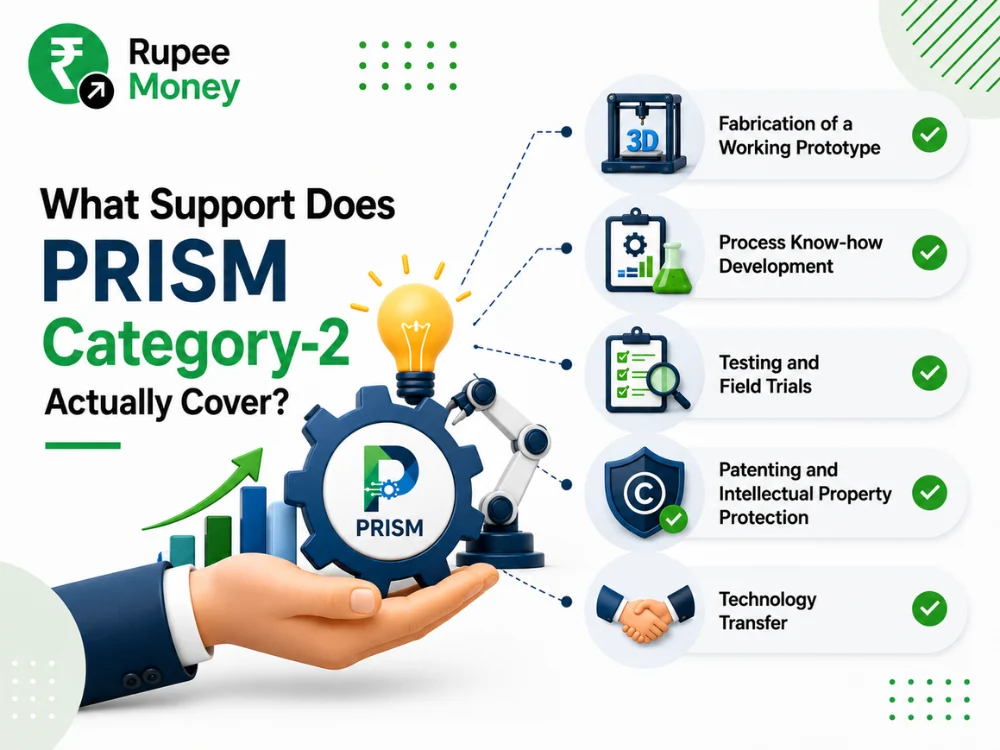
PRISM Category-2 provides Grants-in-aid across several distinct activities that move an innovator from development to commercial readiness.
Fabrication of a Working Prototype
A working prototype lets innovators demonstrate how their technology actually performs under real conditions, and it’s genuinely useful for attracting investors, customers, and industry partners, since it validates the concept beyond theoretical research alone.
Process Know-how Development
Many innovations need real improvements in manufacturing methods, production techniques, or operational processes before they’re ready to scale. The scheme funds activities that refine these processes and improve genuine scalability.
Testing and Field Trials
Before launch, most products need laboratory testing, quality validation, safety assessments, and field trials. PRISM Category-2 supports exactly these activities so technologies get properly evaluated under real-world conditions before hitting the market.
Patenting and Intellectual Property Protection
Patents matter, they protect innovative ideas from unauthorised use. The scheme supports eligible patent-related activities, helping innovators genuinely safeguard their IP before they go to market.
Technology Transfer
Technology transfer means making an innovation available for commercial production through licensing, partnerships, or industry collaboration. PRISM Category-2 supports moving innovations out of research institutions or individual inventors’ hands and into actual commercial use.
Role of DSIR and the Ministry of Science and Technology in PRISM
DSIR, functioning under the Ministry of Science and Technology, Government of India, is the implementing authority for PRISM. Its responsibilities include managing overall implementation, evaluating innovation proposals, providing financial support through Grants-in-aid, monitoring project progress, encouraging industry-academia collaboration, and promoting indigenous technology development. Through PRISM, DSIR aims to genuinely strengthen India’s research, innovation, and entrepreneurship ecosystem, not just distribute funding.
How TOCIC Supports PRISM Applicants
TePP Outreach cum Cluster Innovation Centres (TOCIC) act as regional support centres within the PRISM ecosystem, assisting innovators throughout different project stages. TOCIC centres help by providing guidance on project proposals, supporting technical documentation, assisting with prototype development, connecting innovators with technical experts, facilitating interactions with research institutions, and helping applicants actually understand scheme requirements. These centres exist specifically to make the application and implementation process less overwhelming for individual innovators navigating a formal government scheme for the first time.
How the PRISM Advisory and Screening Committee Evaluates Projects
Every proposal goes through technical and administrative evaluation before approval. The PRISM Advisory and Screening Committee (PASC) reviews applications on factors including originality of the innovation, technical feasibility, commercial potential, social and economic impact, scalability, market demand, and the applicant’s actual capability to execute the project. Only proposals that clear this evaluation move forward to the next assessment stage.
Role of the Project Review Committee in PRISM
Once a project is approved, monitoring becomes just as important as the initial evaluation. The Project Review Committee oversees implementation by reviewing technical progress, monitoring how funds are actually being used, evaluating milestones, suggesting improvements where needed, and assessing final outcomes. This ongoing oversight ensures government support gets used effectively and that projects hit their objectives within the approved timeline, rather than funds simply being disbursed and forgotten.
How to Apply for the PRISM Category-2 Scheme
Applicants should prepare all project documentation carefully before applying. The process generally runs:
- Visit the official PRISM portal or relevant government scheme portal
- Register as an applicant
- Complete the online application form
- Upload the project proposal and supporting documents
- Submit technical details of the innovation
- Wait for preliminary scrutiny by the authorities
- Participate in further technical evaluation if shortlisted
- Receive approval and project guidelines if selected
Make sure everything you submit is accurate and properly backed by technical documentation, incomplete or vague proposals are a common reason for delays at the screening stage.
Benefits of the PRISM Category-2 Scheme for Start-ups and MSMEs
The scheme offers real long-term advantages: financial assistance for technology development, a reduced burden of prototype development costs, support for patent filing and IP protection, genuinely improved commercialisation opportunities, increased credibility when approaching investors, better access to industry partnerships, promotion of indigenous innovation, and real encouragement for research-driven entrepreneurship. For many innovators, this kind of government support meaningfully reduces the financial risk of bringing new technology to market. If your funding needs eventually exceed what a grant like this covers, it’s worth understanding alternative financing too, our comparison of Personal Loan vs Home Loan explains how different borrowing options work if you need additional capital down the line. And once your venture scales and starts generating surplus capital, options like Specialized Investment Funds (SIF) become worth exploring for that capital’s own growth.
Latest Updates on the PRISM Scheme
The Government of India continues pushing innovation-led growth through initiatives supporting start-ups, research institutions, and MSMEs, and PRISM remains a core part of that strategy by funding technology development, commercialisation, and IP creation. As with any government scheme, the specific numbers here (project cost bands, grant caps, documentation requirements) can be revised periodically, so applicants should always check the official DSIR/PRISM portal for the current guidelines before applying rather than relying solely on this or any third-party summary. If you’re generally interested in how government-backed initiatives function within India’s broader financial system, our explainer on Government Securities in India covers another angle of government-backed financial instruments.
Key Takeaways
PRISM Category-2 supports innovators ready to move beyond the concept stage, funding project costs between ₹5 lakh and ₹35 lakh with a grant of up to ₹20 lakh or 90% of project cost, whichever is lower. It’s implemented by DSIR under the Ministry of Science and Technology, and covers prototype fabrication, testing, patenting, and technology transfer. TOCIC centres help innovators prepare and develop their projects, while the PRISM Advisory and Screening Committee (PASC) and Project Review Committee handle evaluation and ongoing monitoring respectively. The scheme, overall, encourages genuine innovation, entrepreneurship, and commercialisation across India.
Frequently Asked Questions (FAQs)
What is the PRISM Category-2 Scheme?
A DSIR initiative supporting innovators, start-ups, and MSMEs in turning promising technologies into commercially viable products, through Grants-in-aid for prototype fabrication, process know-how development, testing, patenting, and technology transfer. It’s specifically for projects that have already progressed beyond the idea stage.
Who is eligible to apply for PRISM Category-2?
Individual innovators, recognised start-ups, MSMEs, and innovation groups with technically feasible, commercially promising solutions. Applicants need to show their innovation has moved past the conceptual stage and genuinely requires assistance for further validation, prototyping, or commercialisation. Meeting eligibility alone doesn’t guarantee approval, every proposal still goes through technical evaluation.
How much financial assistance does PRISM Category-2 actually provide?
For projects costing between ₹5 lakh and ₹35 lakh, the grant covers up to ₹20 lakh or 90% of the total project cost, whichever is lower. The exact sanctioned amount depends on the project’s technical merit and current DSIR guidelines at the time of evaluation.
How are PRISM projects selected for funding?
The PRISM Advisory and Screening Committee (PASC) assesses technical feasibility, innovation, commercial viability, scalability, and overall impact. Shortlisted projects may face further scrutiny before approval, and once sanctioned, the Project Review Committee monitors implementation to ensure milestones are met and funds are used properly.
Why is patenting important under the PRISM scheme?
Patenting protects intellectual property and gives innovators exclusive rights over their invention, preventing unauthorised commercial use, boosting investor confidence, and opening up licensing or technology transfer opportunities. By funding patent-related activities directly, PRISM encourages innovators to actually protect and commercialise their research rather than leaving it vulnerable.
Conclusion
The PRISM Category-2 Scheme reflects a genuine government commitment to innovation, entrepreneurship, and technology-led growth. By funding prototype development, testing, patenting, and technology transfer, up to ₹20 lakh or 90% of project cost, it helps bridge the real gap between promising research and actual commercial success.
For innovators, start-ups, and MSMEs, financial support is often the exact difference between an idea staying on paper and becoming a market-ready product. PRISM Category-2 doesn’t just hand out Grants-in-aid, it builds an ecosystem where technical guidance, project evaluation, and industry collaboration work together to push indigenous innovation forward. If you’ve developed a promising technology with real commercial potential, understanding this scheme’s eligibility and application process could genuinely be your next step. And if you’re building a venture while also managing your own finances, Building Wealth in Your 20s is worth a read for combining innovation with sound long-term financial planning.
If additional funding beyond the grant becomes necessary as your project develops, the EMI Calculator can help you estimate loan repayment obligations before you commit to any supplementary financing.
Disclaimer: This article is intended for informational and educational purposes only. Details related to the PRISM Category-2 Scheme, including eligibility, grant amounts, documentation requirements, and application procedures, are subject to revision by DSIR or the Ministry of Science and Technology, Government of India. Applicants should always verify the latest official guidelines and notifications on the official PRISM/DSIR portal before applying.
ABOUT THE AUTHOR

