
How to Invest in Solar Energy in India Through Stocks, Mutual Funds, and Other Options

India’s solar story is rapidly transitioning from a government policy initiative into a massive wealth-creation theme. Driven by ambitious sustainability goals, India achieved a staggering 164.59 GW of installed solar capacity by July 2026, according to the Ministry of New and Renewable Energy (MNRE).
This historic expansion is creating numerous avenues for investors. Whether you want to buy direct solar stocks, invest through diversified mutual funds, participate in IPOs, or even install physical rooftop solar panels, the opportunities are vast. However, investing in a booming sector doesn’t guarantee automatic profits. The right strategy depends entirely on your risk appetite, investment horizon, and financial goals.
Here is a comprehensive guide on how to intelligently invest in India’s solar energy boom.
Why Is Solar Energy a Massive Investment Theme?
The solar energy opportunity extends far beyond simply generating electricity. When you look closely at India’s 164.59 GW solar capacity, you will find it is divided across ground-mounted projects (122.57 GW), grid-connected rooftop solar (30.74 GW), and off-grid solutions.
This infrastructure requires a massive, complex supply chain. The investment ecosystem includes:
- Solar cell and module manufacturing
- Solar glass and inverters
- Battery storage systems
- Engineering, Procurement, and Construction (EPC) services
- Transmission infrastructure and solar financing
This broad supply chain is why smart investors treat solar as an overarching investment theme rather than a single-stock gamble.
1. Investing Directly in Solar Stocks
Buying shares of listed renewable energy companies is the most direct way to participate in this sector. You can easily purchase these shares through your Demat and trading accounts on stock exchanges like NSE or BSE.
However, it is crucial to understand that not all solar companies operate the same way. The risks and rewards vary drastically depending on their business models.
Top Solar Stocks in India by Business Segment
| Company | Main Business Focus | Type of Solar Exposure |
| Adani Green Energy | Utility-scale renewable power generation | High |
| Tata Power | Integrated power, EPC, and solar manufacturing | High |
| Waaree Energies | Solar cells and module manufacturing | High |
| Premier Energies | Solar cells and module manufacturing | High |
| NTPC Green Energy | Renewable power generation | High |
| Borosil Renewables | Solar glass manufacturing | Solar Supply Chain |
| Waaree Renewable Tech | Solar project development and EPC | High |
| JSW Energy | Diversified power (conventional + renewable) | Moderate |
Manufacturing vs. Power Generation
- Solar Manufacturing Stocks: Companies like Waaree Energies and Premier Energies manufacture the physical hardware. Their profitability depends heavily on manufacturing capacity, raw material costs, import competition, and government incentives like the Green Business Scheme 2026.
- Power Generation Stocks: Companies like Adani Green and NTPC Green build and operate solar parks. Their revenue comes from long-term power purchase agreements (PPAs). These businesses carry heavy debt loads, meaning you must keep a close eye on interest rates and the impact of RBI repo rates on the stock market.
2. Investing via Mutual Funds and ETFs
If analyzing individual balance sheets sounds overwhelming, mutual funds and Exchange Traded Funds (ETFs) are excellent alternatives.
By utilizing a Systematic Investment Plan (SIP), you can steadily invest in thematic or sectoral funds that focus on energy, infrastructure, and power.
Why Choose Mutual Funds?
The biggest advantage here is portfolio diversification. If you invest ₹50,000 in a single solar stock and the company faces regulatory hurdles, your entire capital is at risk. A mutual fund spreads that risk across 20-30 different companies within the energy ecosystem.
Pro Tip: Always check a fund’s portfolio before investing. Just because a fund has “Green” or “Energy” in its name doesn’t mean it is a pure-play solar fund; it may also hold oil, gas, or traditional utility companies.
3. Solar IPOs: Navigating the Hype
Recent years have seen a massive influx of renewable energy companies going public, bringing immense retail interest to names like Waaree Energies, Premier Energies, and Alpex Solar.
If you are new to primary markets, it is highly recommended to understand exactly what an IPO is before applying. Many investors make the mistake of blindly chasing the unofficial Grey Market Premium (GMP) to predict listing gains. A high GMP does not guarantee long-term business success. Always read the company’s prospectus, check their debt levels, and evaluate their valuations before locking up your money.
4. The Penny Stock Trap
Searches for “solar energy penny stocks in India” are incredibly popular among retail investors hoping to find the next multi-bagger. However, a stock trading at ₹10 is not automatically “cheap.”
Share price alone tells you nothing about a company’s actual worth; you must look at its market capitalization. Penny stocks often suffer from low liquidity, poor corporate governance, and extreme stock volatility. Instead of chasing cheap share prices, focus on companies with strong cash flows and rising profit margins.
5. Physical Investment: Rooftop Solar Installations
You don’t need a Demat account to invest in solar. Installing a rooftop solar system on your home or business is a brilliant physical investment that pays dividends in the form of electricity bill savings.
Thanks to government subsidies under schemes like PM Surya Ghar, the return on investment (ROI) for homeowners has never been better.
- The Math: If a solar system costs ₹2,00,000 after subsidies and saves you ₹30,000 annually on electricity bills, your simple payback period is under 7 years. After that, your electricity is essentially free.
- Financing: If you plan to take a loan to install your system, always use an EMI Calculator to ensure your monthly loan repayment doesn’t exceed your estimated electricity savings.
Key Risks of Investing in Solar Energy
No investment is risk-free. Before allocating capital to the solar sector, be aware of:
- Policy Risk: Changes in government subsidies, import duties on Chinese modules, or net-metering rules can instantly alter profit margins.
- Interest Rate Risk: Solar projects are capital-intensive. When inflation rises and the RBI hikes borrowing costs, profit margins for heavily indebted solar developers shrink.
- Technology Risk: Solar tech is evolving rapidly. Companies manufacturing older-generation cells risk becoming obsolete if they don’t continually upgrade their facilities.
- Execution Risk: Securing land, gaining grid connectivity, and navigating bureaucratic approvals often delay mega-solar projects, leading to cost overruns.
How to Choose the Right Solar Investment (Ask These 5 Questions)
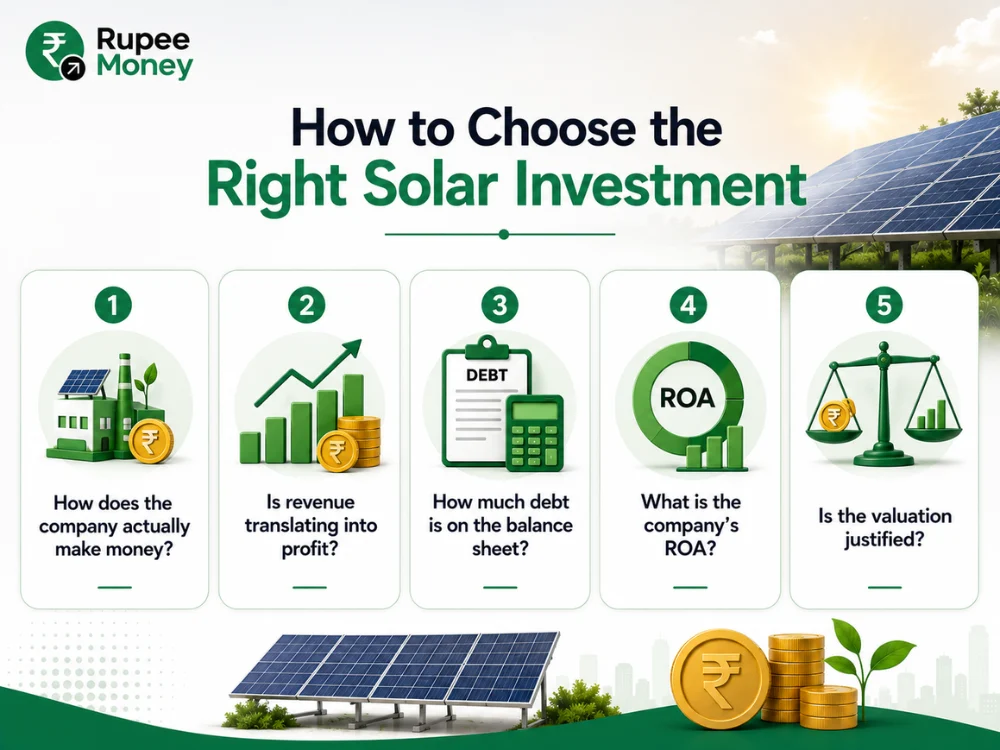
Instead of asking social media for stock tips, build a solid financial planning strategy by asking these five questions:
- How does the company actually make money? (Manufacturing vs. Generation vs. EPC)
- Is revenue translating into profit? A massive order book is useless if the company operates at a loss due to fierce price competition.
- How much debt is on the balance sheet?
- What is the company’s ROA? Looking at their Return on Assets (ROA) will tell you how efficiently management is using its massive infrastructure to generate earnings.
- Is the valuation justified? Even a fundamentally flawless company can be a bad investment if you pay an excessively high price for its shares.
Conclusion
With 164.59 GW of capacity already installed and aggressive targets set for 2030, India’s solar sector is undeniably a megatrend. However, distinguishing between a growing industry and a profitable investment requires diligent research. Whether you choose the diversified safety of mutual funds, the aggressive growth potential of direct equities, or the tangible savings of a rooftop panel, ensure your choices align with a well-researched, long-term financial strategy.
FAQs
How can I invest in solar energy in India?
You can invest financially through direct solar stocks, thematic mutual funds, ETFs, and IPOs. Alternatively, you can invest physically by installing a rooftop solar system to generate ROI through electricity bill savings.
Which are the top solar companies in India?
Major listed players include Adani Green Energy, Tata Power, NTPC Green Energy (generation), alongside Waaree Energies and Premier Energies (manufacturing). The "best" company depends entirely on its current valuation and your risk tolerance.
Are solar energy mutual funds a safe option?
While safer and more diversified than individual stocks, thematic/sectoral funds still carry higher risk than broad market index funds. Ensure you check the fund's top holdings to confirm it aligns with your goals.
Are solar energy penny stocks worth buying?
Generally, no. A low share price does not mean a company is undervalued. Penny stocks in the capital-intensive energy sector often struggle with massive debt, poor execution, and high volatility. Stick to fundamentally strong companies.
Should beginners buy direct solar stocks?
Beginners are usually better off starting with diversified mutual funds or ETFs to understand market dynamics. Once you are comfortable reading balance sheets and understanding debt structures, you can selectively allocate capital to direct stocks.
Major listed players include Adani Green Energy, Tata Power, NTPC Green Energy (generation), alongside Waaree Energies and Premier Energies (manufacturing). The “best” company depends entirely on its current valuation and your risk tolerance.
While safer and more diversified than individual stocks, thematic/sectoral funds still carry higher risk than broad market index funds. Ensure you check the fund’s top holdings to confirm it aligns with your goals.
Disclaimer: This article is strictly for educational and informational purposes and should not be construed as investment, tax, or financial advice. Stock prices, market capitalization, and corporate metrics fluctuate constantly. Always perform your own due diligence or consult a SEBI-registered financial advisor before deploying capital.
ABOUT THE AUTHOR

