
Why Do FIIs and DIIs Affect the Indian Stock Market? A Complete Guide for Investors

One day the Indian stock market rallies sharply, and the next it falls despite no major news breaking. Plenty of investors wonder what’s driving such sudden swings, and in many cases, the answer traces back to the buying and selling activity of Foreign Institutional Investors (FIIs) and Domestic Institutional Investors (DIIs).
Every trading day, investors watch closely to see whether FIIs are buying or selling Indian shares, and how DIIs respond in turn. Large moves from these institutions can shape market sentiment, liquidity, and even the direction of benchmark indices like the Nifty 500.
At RupeeMoney, we believe every investor should understand why FII and DII activity matters before making investment decisions. Whether you invest through mutual funds, individual stocks, or SIPs, understanding how institutional money moves helps you read market movements with more confidence.
This guide covers what FIIs and DIIs actually are, how they differ, why they influence the Indian stock market, and how retail investors should use this information sensibly.
What Are FIIs in the Indian Stock Market?
Foreign Institutional Investors (FIIs) are institutions or investment firms registered outside India that put money into Indian financial markets — pension funds, hedge funds, mutual funds, insurance companies, sovereign wealth funds, banks, and global asset managers, among others.
Worth noting: SEBI actually merged the FII category into the broader Foreign Portfolio Investor (FPI) framework back in 2014, so all foreign investors now register and operate under SEBI’s FPI regulations. That said, the term “FII” remains widely used in financial media, daily market reports, and everyday market conversation, so this guide sticks with the familiar term while you invest.
FIIs invest in listed shares, mutual funds, government securities, corporate bonds, exchange-traded funds (ETFs), and other approved instruments. Since FIIs manage billions of dollars globally, even a small shift in their allocation can bring huge capital inflows into India. If several global funds turn optimistic about India’s economic growth, they might invest thousands of crores into Indian equities — buying that can lift stock prices across multiple sectors at once.
What Are DIIs in the Indian Stock Market?
Domestic Institutional Investors (DIIs) are India-based investment institutions that invest money collected from Indian investors or institutions. Unlike FIIs, DIIs primarily invest domestic capital and tend to stay invested for longer stretches.
Common DII categories include mutual fund companies, insurance companies, banks, pension funds, other financial institutions, and Alternative Investment Funds (AIFs). Most SIP investments from retail investors eventually flow into the stock market through mutual funds, which makes mutual funds one of the largest DII categories by far.
Over the past few years, India’s growing SIP culture has strengthened DIIs considerably. Even when FIIs sell heavily, steady monthly SIP inflows often let DIIs absorb much of that selling pressure.
FII vs DII: Key Differences Every Investor Should Know
Both invest in the stock market, but their source of funds, approach, and behaviour differ quite a bit.
| Feature | FII | DII |
| Full Form | Foreign Institutional Investor | Domestic Institutional Investor |
| Source of Funds | Foreign investors | Indian investors |
| Investment Base | Global markets | Indian market |
| Registration | SEBI | SEBI |
| Investment Objective | Global portfolio allocation | Domestic wealth creation |
| Currency Exposure | Foreign currency | Indian Rupee |
| Market Behaviour | Can be highly sensitive to global events | Generally more stable |
| Investment Horizon | Can be short or long term | Mostly long term |
Both influence market movements, but they often react quite differently during volatile periods.
Why FIIs Move the Indian Stock Market
FIIs manage enormous portfolios spread across multiple countries. When they raise their exposure to India, liquidity improves and stock prices often climb. Several factors explain why their influence runs so deep.
- Large investment size: FIIs can invest massive sums in a single session — a purchase worth several thousand crores can lift multiple sectors at once, and heavy selling can just as easily drag the market lower.
- Global economic conditions: FIIs don’t invest based purely on India’s performance; they also weigh US interest rates, global inflation, dollar strength, oil prices, geopolitical events, and worldwide recession risks. If global markets turn uncertain, FIIs may pull money from emerging markets, including India, even when the domestic economy stays strong.
- Currency movements: if the Indian Rupee weakens significantly against the US Dollar, foreign investors can lose part of their returns after currency conversion, which sometimes leads FIIs to trim exposure despite solid company performance.
- Risk appetite: FIIs generally invest more during periods of optimism and pull back during economic uncertainty — emerging markets like India typically see larger FII inflows during strong global growth cycles.
Why DIIs Move the Indian Stock Market
DIIs have grown far more important in recent years as domestic participation has expanded rapidly. Regular SIP investments have created a consistent flow of capital into Indian mutual funds, and this steady inflow helps DIIs support markets even when FIIs sell aggressively.
- Stable, long-term investing: insurance companies, pension funds, and mutual funds usually avoid frequent buying and selling, which cuts down on unnecessary volatility.
- Growing SIP contributions: millions of Indians invest through SIPs every month, and these contributions keep flowing regardless of short-term market swings, giving mutual funds — and DII buying power — a steady boost.
- Market stability: when FIIs sell large quantities of shares, DIIs often step in as buyers, reducing panic selling and providing stability during volatile stretches. Several recent market corrections have shown just how much domestic participation has cushioned Indian equities against heavy foreign selling.
FII vs DII: Different Investment Strategies
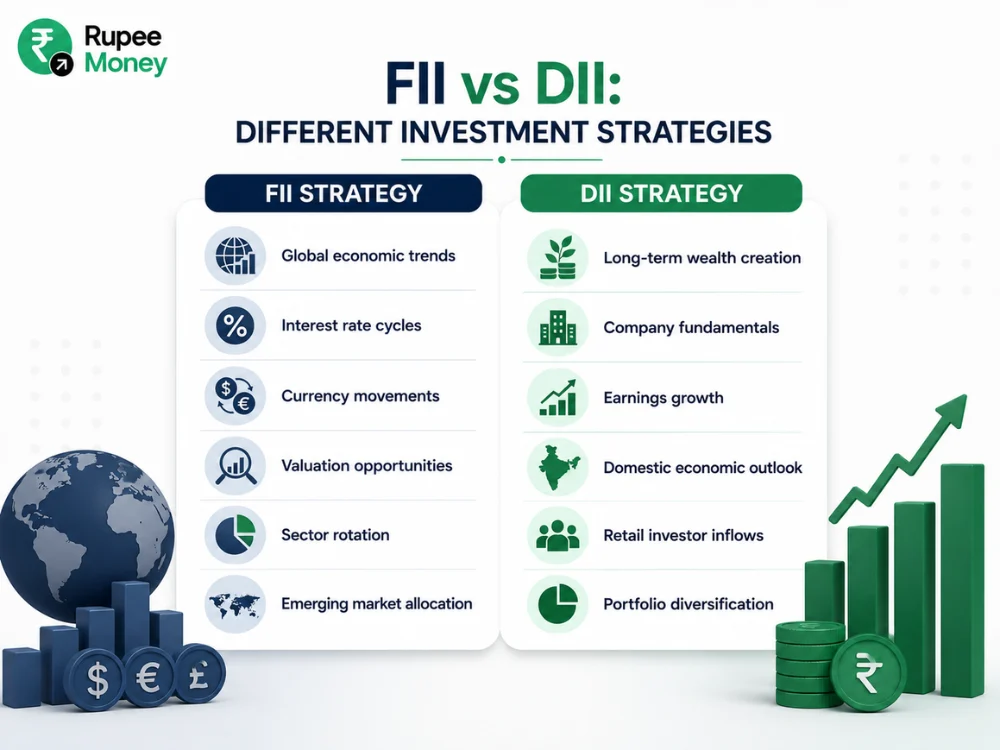
Both institutional investors chase returns, but their approaches differ:
- FII strategy typically focuses on global economic trends, interest rate cycles, currency movements, valuation opportunities, sector rotation, and emerging market allocation — decisions often shaped by international capital flows. Global rate cycles feed directly into this, and our explainer on what the repo rate means can help you understand how domestic rate policy fits into that picture.
- DII strategy usually centres on long-term wealth creation, company fundamentals, earnings growth, domestic economic outlook, retail investor inflows, and portfolio diversification — decisions that align more closely with India’s long-term economic growth story.
How FIIs and DIIs Work Together in the Market
The Indian stock market reflects the combined actions of everyone participating in it — retail investors, FIIs, DIIs, proprietary traders, and institutional funds all contribute to daily activity.
When FIIs buy aggressively and DIIs keep buying too, markets often see sustained upward momentum. But when FIIs sell while DIIs step in and purchase the same stocks, declines usually stay relatively controlled. This interaction between institutional investors often shapes the strength and direction of market trends more than retail participation alone.
How FII and DII Activity Affects the Market
FII and DII activity directly shapes liquidity, sentiment, and stock prices, since both move large amounts of money.
- Higher liquidity: when FIIs and DIIs actively invest, trading volumes rise, which generally leads to better price discovery and smoother market functioning — stocks with strong institutional participation usually see tighter bid-ask spreads and more efficient trading.
- Stock price movements: large institutional orders can push prices up or down; if FIIs collectively buy banking stocks, the whole sector may rally, and heavy institutional selling can create real downward pressure. Retail investors often follow these trends, amplifying the moves further.
- Investor sentiment: strong FII inflows usually signal optimism about India’s economy and corporate earnings, while sustained FII selling can spark fear among retail investors even when company fundamentals stay unchanged. DII buying during corrections often reassures investors that domestic institutions still believe in India’s long-term growth.
- Sector rotation: institutional investors frequently shift money between sectors as conditions change — banking stocks may attract capital during expansion, IT companies may benefit when global tech demand improves, FMCG often gets attention during uncertainty, and infrastructure or capital goods may gain from government spending. Tracking this rotation helps you spot changing market trends early.
Why the Nifty 500 Reflects FII and DII Activity
The Nifty 500 represents companies across large-cap, mid-cap, and small-cap segments. Since institutional investors allocate money across all these market caps, their buying and selling significantly shapes this broad index.
When FIIs invest heavily in Indian equities, the impact reaches beyond large-cap stocks into mid-cap and small-cap names too. DII investments through mutual funds similarly spread across diversified portfolios, touching many companies within the Nifty 500. Given its broad representation, analysts often watch the Nifty 500 to gauge the overall impact of institutional money flows.
Should Retail Investors Follow FII and DII Data?
Yes, but only as one part of your broader analysis. Many beginners base investment decisions solely on daily FII and DII buying figures, which can lead to poor calls since institutional flows shift frequently.
Instead, weigh FII and DII data alongside company fundamentals, corporate earnings, valuation, economic outlook, industry trends, and your own long-term investment goals. Institutional activity gives useful context, but it should never become the sole reason to buy or sell a stock.
Factors That Influence FII and DII Investments
Several economic and financial factors shape institutional investment decisions:
- Interest rates: lower global rates often encourage investment in emerging markets like India, while higher rates in developed countries can pull foreign investment away.
- Inflation: stable inflation supports growth and investor confidence, while high inflation can hurt corporate profitability and dampen investment flows — our explainer on what inflation is and why it matters breaks this down further.
- Government policies: reforms around taxation, infrastructure, manufacturing, and ease of doing business often attract institutional investors, while policy uncertainty tends to have the opposite effect.
- Corporate earnings: strong quarterly earnings encourage institutional buying, while weak earnings or poor guidance can trigger selling pressure.
- Global events: geopolitical tensions, financial crises, pandemics, or commodity price shocks all shape global investment decisions, and FIIs usually react to international developments faster than DIIs do.
Advantages of Tracking FII and DII Investments
Following institutional activity offers several real benefits: it helps you read overall market sentiment, shows where large investors see opportunity, highlights sectors attracting institutional interest, improves your grasp of market liquidity, supports better long-term analysis, and complements your fundamental research.
Limitations of FII and DII Data
Institutional flow data has real limits too. Daily figures can swing significantly, short-term flows may not reflect longer trends, FIIs sometimes sell for reasons entirely unrelated to India, and DIIs may buy simply because SIP inflows keep arriving regardless of market conditions. Institutional activity can’t predict future stock performance with any certainty, so always pair this data with comprehensive research — our guide to government securities in India is a useful next read if you want to understand another asset class FIIs and DIIs both invest in heavily.
Conclusion
FIIs and DIIs play a crucial role in shaping the Indian stock market. FIIs bring foreign capital, improve liquidity, and often influence short-term market direction, while DIIs provide stability by channelling domestic savings through mutual funds, insurance companies, and pension funds.
The growing participation of Indian investors through SIPs has strengthened DIIs considerably over the past few years, making the Indian stock market noticeably more resilient during periods of foreign selling. For retail investors, understanding FII and DII activity can sharpen your market awareness — but successful investing still comes down to disciplined financial planning, a diversified portfolio (our guide to large-cap mutual funds is a good starting point), and long-term thinking rather than reacting to daily institutional flows. You can also project how consistent SIP investing might grow over time using our SIP Calculator.
Frequently Asked Questions (FAQs)
What’s the difference between FII and DII?
FIIs are Foreign Institutional Investors that bring money from outside India into Indian financial markets. DIIs are Domestic Institutional Investors that invest funds collected within India through mutual funds, insurance companies, banks, pension funds, and other institutions. FIIs often respond to global economic conditions, while DIIs usually focus on India’s long-term growth.
Why do FIIs affect the Indian stock market so much?
FIIs manage very large portfolios, and even a single day’s buying or selling can involve thousands of crores of rupees. These large transactions influence market liquidity, stock prices, and investor sentiment, making FII activity a genuinely important factor in market movements.
Can DIIs balance FII selling?
Yes. In recent years, DIIs have increasingly offset FII selling thanks to strong monthly SIP inflows and rising domestic investment. While DIIs may not always fully neutralise foreign selling, they often reduce market volatility by providing consistent buying support.
Should beginners track FII and DII data every day?
Beginners can monitor institutional trends, but shouldn’t base decisions solely on daily buying and selling figures. Company fundamentals, valuation, financial goals, and long-term strategy matter far more than short-term institutional flows.
Where can investors check FII and DII investment data?
You can find daily FII and DII figures on the NSE and BSE websites, through stock brokers, mutual fund platforms, and several financial news portals that publish institutional activity after each trading session.
Disclaimer: This article is intended for educational and informational purposes only. Nothing here should be considered investment, financial, or legal advice. Stock market investments involve market risk, and FII or DII buying and selling activity should never be the sole basis for any investment decision. Always conduct your own research or consult a qualified financial advisor before investing.
ABOUT THE AUTHOR

