Udyogini Scheme 2026: Women’s Business Loan, Eligibility, Subsidy & How to Apply
Starting or developing a small business requires capital, but for many women in India, securing formal business finance is a significant hurdle. High interest rates, stringent collateral requirements, and complex banking procedures often push female entrepreneurs toward informal, high-cost money lenders. The Udyogini Scheme was designed specifically to dismantle these barriers.
Initiated to help women establish small, income-generating businesses, the scheme dramatically improves access to institutional credit and offers substantial government subsidy support. By providing a structured financial pathway, it encourages women to become self-employed, financially independent, and active contributors to the local economy. In fact, empowering female entrepreneurs is a core component of how small businesses help India’s economy grow from the grassroots up.
Implemented actively through government agencies such as the Karnataka State Women’s Development Corporation (KSWDC) and various public and private sector banks, the Udyogini Scheme provides tailored subsidies that drastically reduce the overall debt burden on female business owners.
Below is a comprehensive guide to understanding the Udyogini Scheme’s eligibility rules, loan limits, subsidy structures, eligible business categories, and the step-by-step online application process.
What Is the Udyogini Scheme?
The Udyogini Scheme is a highly focused, state-supported entrepreneurship programme that facilitates access to subsidized business loans for women engaging in income-generating activities. Its primary objective is to empower women from both rural and urban areas to establish their own micro-enterprises and achieve absolute financial self-reliance.
Under the scheme’s framework, eligible women do not borrow directly from the government. Instead, they approach participating commercial banks, cooperative banks, or state finance corporations for business credit. Once the loan is sanctioned, the concerned government agency steps in to provide an upfront margin money subsidy, effectively paying off a significant chunk of the loan principal immediately.
Because it is implemented at the state level (most prominently in Karnataka), the Udyogini Scheme should not be viewed as a single, uniform national loan product with one fixed interest rate. The applicable subsidies, maximum loan amounts, and eligibility criteria vary based on the applicant’s state and demographic category.
Udyogini Scheme Eligibility: Who Can Apply?
The eligibility requirements for the Udyogini Scheme are structured to ensure that financial assistance reaches women who need it the most, particularly those from marginalized or economically weaker backgrounds.
While conditions can slightly vary by state and the specific lending institution, the core eligibility parameters generally include:
- Gender Constraint: The applicant must be a woman.
- Age Limit: The applicant must be between 18 and 55 years of age. (Note: The upper age limit is often waived for widows, destitute women, and women with disabilities).
- Income Limits:
- General & Special Categories: The total annual family income must be below ₹1,50,000.
- SC/ST Categories: The total annual family income must be below ₹2,00,000.
- Vulnerable Categories: For widows, destitute women, and physically challenged women, there is generally no income limit.
- Credit History: The applicant must not have any past loan defaults with commercial banks or financial institutions. Knowing how to improve your CIBIL score is a great way to ensure your application sails through the bank’s underwriting process.
- State Residency: The applicant must possess permanent residency proof for the implementing state (e.g., Karnataka).
Before you apply, understanding what affects your loan eligibility can help you prepare a flawless application.
Udyogini Loan: How Does It Work?
The Udyogini loan operates as a credit-linked subsidy. The mechanics of the loan follow a structured, multi-step process:
- Business Selection: The applicant chooses a commercial activity from the scheme’s 88 eligible business categories.
- Project Report Preparation: A detailed business plan (Detailed Project Report or DPR) is draft, outlining the required capital for machinery, inventory, and working capital.
- Bank Submission: The woman submits the loan application to a participating bank (like Saraswat Bank, Punjab & Sind Bank, or a regional rural bank).
- Bank Appraisal: The bank evaluates the business’s viability and the applicant’s repayment capacity.
- Subsidy Claim: Upon sanctioning the loan, the bank routes a subsidy request to the Women’s Development Corporation or relevant state department.
- EDP Training: Approved applicants often undergo an Entrepreneurship Development Programme (EDP) to learn basic accounting, pricing, and business management.
- Disbursement: The loan is disburs, and the state subsidy is credited to the loan account, drastically reducing the total principal the borrower has to repay.
Udyogini Loan Amount and Subsidy
The financial assistance provided under the scheme is extremely generous, particularly for marginalized communities. The maximum loan amount (unit cost) considered for the scheme typically goes up to ₹3,00,000.
Here is the general subsidy breakdown based on the Karnataka implementation model:
| Applicant Category | Maximum Project Cost / Loan | Subsidy Percentage | Maximum Subsidy Cap |
| SC / ST Women | Up to ₹3,00,000 | 50% of loan amount | ₹1,50,000 |
| General Category Women | Up to ₹3,00,000 | 30% of loan amount | ₹90,000 |
| Special Categories (Widows, PwD, Destitute) | Up to ₹3,00,000 | 30% of loan amount | ₹90,000 |
Example: If a general category woman secures a ₹2,00,000 loan to open a tailoring boutique, the government provides a 30% subsidy (₹60,000). The bank credits this ₹60,000 directly to her loan account, meaning she only has to repay ₹1,40,000 plus applicable interest.
Udyogini Scheme Benefits
The Udyogini Scheme provides a transformative safety net for female entrepreneurs. Key benefits include:
- Collateral-Free Credit: Most banks extend Udyogini loans without demanding property or third-party collateral, removing the biggest barrier for poor women.
- Massive Capital Subsidies: With up to 50% of the loan cover by the state, the financial risk of starting a business is significantly lower.
- Skill Upgradation: The mandatory EDP training ensures that women not only get money but also acquire the financial literacy required to run a profitable enterprise.
- Eradication of Predatory Lending: By providing institutional credit, the scheme frees women from the grip of local money lenders charging exorbitant interest rates.
- Inclusive Focus: Zero income limits for widows and physically challenged women ensure that the most vulnerable populations receive immediate support.
Udyogini Scheme Eligible Businesses
The scheme is highly versatile, covering 88 specific small-scale business activities across manufacturing, retail, agriculture, and services.
Popular eligible businesses include:
- Food & Beverages: Bakeries, tea stalls, catering services, pickle and papad making, dairy and poultry businesses.
- Retail & Trading: Grocery stores, fair-price shops, vegetable and fruit vending, bangle shops, and bookstores.
- Services: Tailoring boutiques, beauty parlours, dry cleaning, crèches, typing institutes, and travel agencies.
- Small Manufacturing: Agarbatti making, jute carpet manufacturing, corrugated box making, and handicraft production.
Before approaching a bank, applicants must verify that their exact business idea is listed in their state’s officially approved Udyogini activities registry.
Udyogini Scheme Apply Online: How to Apply?
The application process for the Udyogini scheme involves both digital portals and physical banking channels.
Step-by-Step Application Process:
- Check Scheme Guidelines: Visit the state’s Women and Child Development website or the national myScheme portal to verify current eligibility and business categories.
- Draft a Business Plan: Create a Detailed Project Report (DPR). This should include the total capital required, machinery quotations, and expected monthly revenue.
- Visit the Portal or Bank: You can apply online via the official Karnataka State Women’s Development Corporation (KSWDC) portal or directly visit a participating bank branch (e.g., KSFC, Saraswat Bank, regional rural banks).
- Fill the Application Form: Provide accurate personal details, category information, and business location data.
- Document Upload: Submit high-quality scans or physical copies of your KYC, income, and caste certificates.
- Bank Assessment & Interview: The bank manager will evaluate your proposal. If satisfied, they will sanction the loan and automatically apply for the government subsidy on your behalf.
- Disbursement: Once approve, the loan amount is often credited directly to the vendors supplying your machinery or inventory to ensure the funds are utilized correctly.
Udyogini Scheme Documents Required
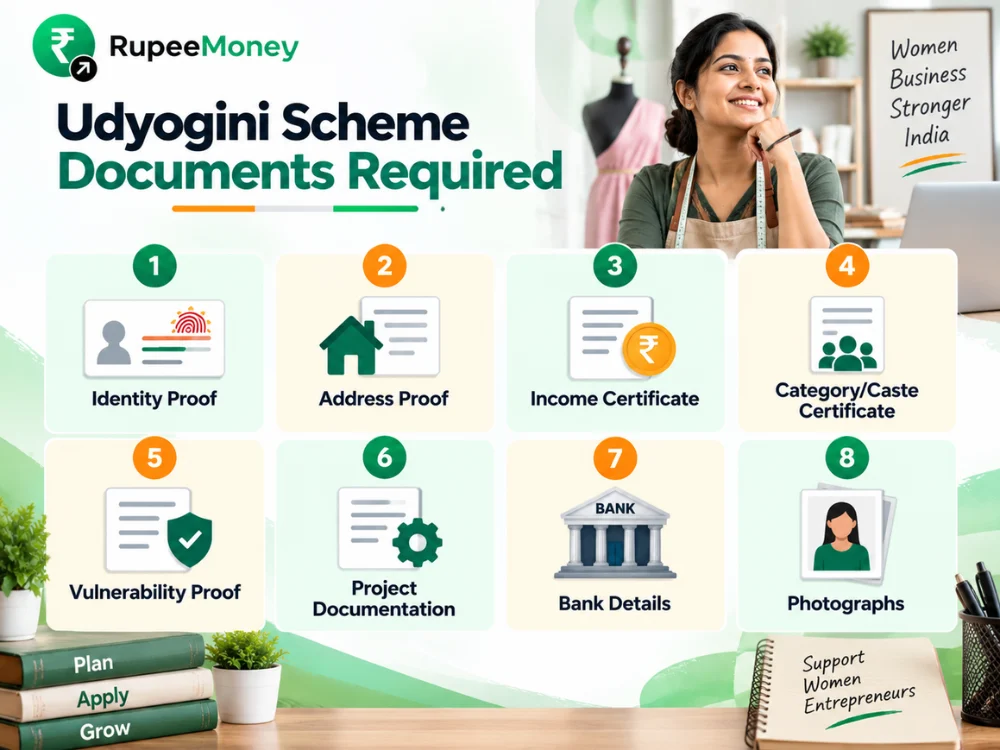
To prevent delays in loan processing, keep the following documentation ready in a secure folder:
- Identity Proof: Aadhaar card, Voter ID, or Passport.
- Address Proof: Residential certificate or recent utility bill.
- Income Certificate: Official certificate from the Tehsildar or a Below Poverty Line (BPL) card verifying family income.
- Category/Caste Certificate: Mandatory if claiming the 50% SC/ST subsidy.
- Vulnerability Proof: Disability certificate or widow certificate (if applicable).
- Project Documentation: The Detailed Project Report (DPR) and official price quotations from equipment suppliers.
- Bank Details: Copy of bank passbook displaying the Account Number and IFSC code.
- Photographs: 3 recent passport-size photographs.
Udyogini Scheme Interest Rate and Repayment
Because the Udyogini loan is disburse by commercial and cooperative banks, the interest rate is not a single, fixed national figure.
Generally, participating banks charge a highly concessional interest rate ranging from 6% to 12% per annum for general categories. In certain special cases—particularly for widows, destitute women, or BPL applicants—the state government may absorb the entire interest cost, effectively rendering it a 0% interest-free loan.
When discussing the loan with your bank manager, always clarify whether you are signing up for a fixed vs floating interest rate, as this will impact your long-term EMIs.
Repayment Tenure: Loans typically come with a flexible repayment period of 36 months to 7 years, which often includes a 6-month initial moratorium (grace period) allowing the business to generate cash flow before the first EMI is due. You can easily forecast your monthly payments using the RupeeMoney EMI Calculator.
Conclusion
The Udyogini Scheme is a masterclass in grassroots economic empowerment. By combining institutional credit with aggressive margin money subsidies (up to 50%), the scheme ensures that a lack of capital does not kill a great business idea.
However, female founders must approach this with sharp financial planning. The remaining portion of the loan (after the subsidy) is a formal bank debt that must be repaid on time to maintain a healthy CIBIL score.
Before applying, spend significant time drafting a realistic Detailed Project Report (DPR). Do not artificially inflate your funding requirements just to maximize the subsidy. Borrow exactly what your micro-enterprise needs to launch, complete your EDP training diligently, and ensure your monthly revenues can comfortably service the upcoming EMIs.
FAQs
What is the Udyogini Scheme?
Udyogini is a targeted women's entrepreneurship programme that facilitates access to institutional bank credit paired with heavy state government subsidies to encourage self-employment.
Who is eligible for the Udyogini Scheme?
Women between the ages of 18 and 55, typically with an annual family income below ₹1.5 lakh (General) or ₹2 lakh (SC/ST). There is no income ceiling for widows and differently-abled women.
Is Udyogini a direct government loan scheme?
No. It is a credit-linked subsidy scheme. The bank provides the loan, and the state government provides the subsidy to lower your principal debt.
How much loan is available under Udyogini?
Eligible women can secure project financing up to ₹3,00,000, depending on the business type and bank appraisal.
Is Udyogini available for SC/ST women?
Yes. SC/ST women are heavily prioritized and can receive an enhanced subsidy of up to 50% of the loan amount (capped at ₹1.5 lakh).
How can I apply for Udyogini?
Applicants can apply online through state portals like the KSWDC or directly offline by visiting a participating bank branch with a detailed business plan and KYC documents.
Udyogini is a targeted women’s entrepreneurship programme that facilitates access to institutional bank credit paired with heavy state government subsidies to encourage self-employment.
Disclaimer: This article is strictly for educational and informational purposes only and does not constitute financial, investment, tax, or legal advice. Government scheme guidelines, eligibility criteria, subsidy percentages, interest rates, and application processes are subject to frequent updates by state authorities and participating banks. While we strive to provide accurate information, RupeeMoney makes no guarantees regarding the completeness of the content. Readers are strongly advised to independently verify all details through official state portals (such as KSWDC) or with their local bank branch before making any borrowing decisions.
ABOUT THE AUTHOR

